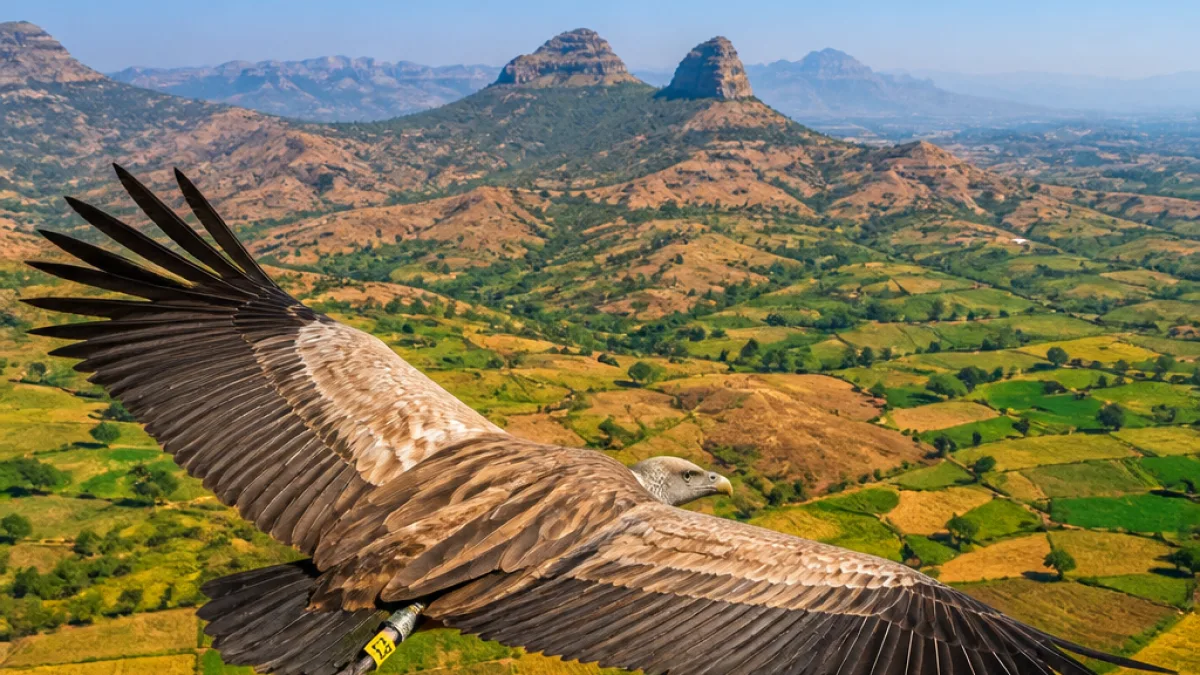
Mumbai/Nashik: A rehabilitated Indian vulture released into the wild from Nashik has covered in excess of 1,618 km over 56 days, satellite tracking and field monitoring by the Bombay Natural History Society (BNHS) show, signalling a significant conservation success for the state’s vulture recovery programme.
Tracking data shows sustained movement and feeding behaviour
The bird, identified by the tag J132, was released on 7 June after two earlier release attempts that ended with its recapture to improve physical condition and chances of survival, BNHS said in a statement. Over the past eight weeks J132 has maintained a steady average daily flight distance; its single‑day maximum was recorded at 168 km on 17 June.
Satellite telemetry indicates J132 has been largely operating in northern Nashik — described by BNHS as an important vulture habitat — and has also ranged along the Maharashtra‑Gujarat border, including movements into parts of Valsad district. Field teams visually confirmed the bird locating and feeding on cattle carcasses alongside wild vulture flocks, even during periods of heavy rainfall.
“Crucially, field monitoring teams observed J132 successfully associating with multiple wild vultures in the Dol Ohol and Deodongra areas of Nashik,” BNHS Director Kishor Rithe said. “Even during periods of very heavy rainfall, teams visually confirmed the tagged bird independently locating and feeding on cattle carcasses alongside the wild flock, proving his complete behavioural adaptation.”
Background of the release and prior movements
J132 was part of the second batch of captive‑bred Indian vultures. It was initially released at the Pench Tiger Reserve on 11 December 2025, from where it flew more than 750 km to Nashik within 20 days. Researchers recaptured the bird after that initial movement to improve its fitness. A subsequent release earlier in 2026 likewise led to recapture before the final release in June.
Following the third release on 7 June, J132 has completed a continuous 56‑day period in the wild, during which it has demonstrated “exceptional navigational ability, site fidelity and survival instincts,” the BNHS statement said.
Implications for vulture conservation in Maharashtra
Conservationists regard successful integration of captive‑bred individuals with wild flocks as a key benchmark for reintroduction programmes. The confirmed association of J132 with wild birds in the Dol Ohol and Deodongra areas indicates social and foraging behaviours essential for survival and potential breeding.
- J132’s sustained long‑distance flights suggest good flight fitness and navigational ability.
- Independent feeding alongside wild vultures points to behavioural adaptation rather than temporary refuge‑dependent survival.
- Movement across state borders highlights the need for cross‑jurisdictional monitoring and habitat protection.
Monitoring methods and ongoing work
BNHS relied on satellite telemetry complemented by field observations to assess the bird’s progress. The combination allowed teams to record daily flight distances and to visually confirm interactions with wild vultures at carcass sites, including during heavy monsoon rains.
The statement emphasised that the recapture and subsequent conditioning before the final release were deliberate measures to enhance the bird’s survival probability. Such hands‑on management forms part of the broader captive‑breeding and release protocol for the species.
| Event | Date | Detail |
|---|---|---|
| First release (Pench Tiger Reserve) | 11 Dec 2025 | Flew >750 km to Nashik within 20 days; subsequently recaptured |
| Second release | Earlier in 2026 | Followed by recapture for fitness improvement |
| Third release (Nashik) | 7 June 2026 | Completed 56 continuous days in the wild; total >1,618 km |
| Longest single‑day flight | 17 June 2026 | 168 km |
What this means locally
For Nashik and surrounding districts, the success of J132 underlines the ecological value of remaining vulture habitats and the role of community‑accessible carcass sites for scavengers. Continued monitoring will be necessary to track long‑term survival, possible pairing and breeding, and to ensure exposure to threats such as veterinary drug residues is minimised.
BNHS’s account of J132’s post‑release movements will inform future release strategies, including the timing of releases, pre‑release conditioning, and selection of release sites where wild vulture populations persist to facilitate social integration.
Conservation groups and wildlife managers in Maharashtra will be watching J132’s next months closely to establish whether this individual can become a sustainable contributor to the wild population.
Reporting from Nashik and Mumbai bureau.