District units credited as Dharni, Chikhaldara rise in national Aspirational Taluka list
AMRAVATI: Two talukas in Amravati district — Dharni and Chikhaldara — have been placed among the top 40 at the national level in NITI Aayog’s Delta Ranking for the January–March 2026 quarter under the Aspirational Taluka Programme, officials reported on Monday.
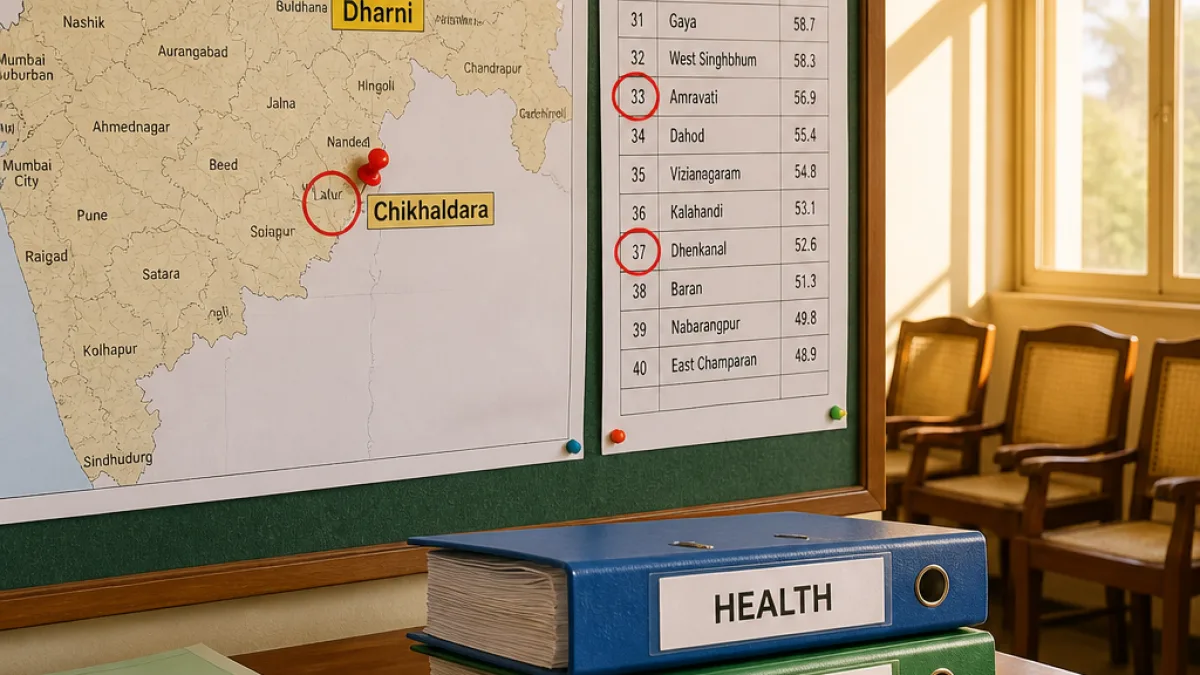
According to the published ranking of 513 aspirational talukas across the country, Dharni secured the 33rd position while Chikhaldara was ranked 37th. Within Maharashtra’s cohort of 27 aspirational talukas, Dharni was placed first and Chikhaldara second.
| Taluka | Maharashtra rank | Zone 4 rank | National rank |
|---|---|---|---|
| Dharni | 1 | 3 | 33 |
| Chikhaldara | 2 | 4 | 37 |
The Delta Ranking evaluates progress across five broad themes: health and nutrition, education, agriculture and farmer welfare, social development and infrastructure. The district administration attributed the improved positions to co-ordinated action by local bodies and line departments.
- District-level officials said the Zilla Parishad, panchayat samitis of Dharni and Chikhaldara and departments of health, education, agriculture and rural development contributed to the outcome.
- The rankings cover performance for the January–March 2026 quarter and compare change over time rather than absolute baselines.
- Both talukas also performed strongly within Zone 4 (Maharashtra, Gujarat and Rajasthan), finishing third and fourth respectively among 69 talukas.
"Officials and field staff were congratulated for their contribution to the achievement," the district administration said.
Local officials said the recognition marks validation of targeted interventions aimed at improving service delivery in rural areas. The Aspirational Taluka Programme, overseen by NITI Aayog, focuses on accelerating development in backward regions by tracking progress on priority sectors and encouraging best-practice exchanges.
For Amravati district, the rankings could have immediate administrative and operational consequences. Higher positions in the Delta Ranking typically increase visibility for a taluka and may influence resource allocation priorities, technical assistance and replication of successful models across neighbouring blocks. The district administration’s statement did not specify any additional funds or direct incentives linked to this quarter’s placement.
Officials highlighted several on-ground measures that likely supported the improvement, including intensified outreach for maternal and child health, efforts to reduce school dropouts and schemes to support farmers’ access to inputs and entitlements. Enhanced co-ordination between the Zilla Parishad and panchayat samitis was credited with sharpening implementation and monitoring.
Stakeholders in the district also noted that sustaining momentum will require continued emphasis on data-driven monitoring and closing remaining gaps in service delivery. The Aspirational Taluka framework assesses delta (change) in outcomes, so maintaining or improving rank next quarter will depend on persistent field-level action and timely reporting.
With two talukas from Amravati earning national recognition this quarter, district officials have called for replication of successful practices across other blocks. They urged departments and field staff to continue focused implementation to build on the gains recorded in the January–March 2026 assessment.
Further details on the specific indicators and numerical scores that led to the talukas’ ranks were not included in the district release. NITI Aayog’s full ranking bulletin contains the sectoral break-up and comparative deltas for all listed talukas.