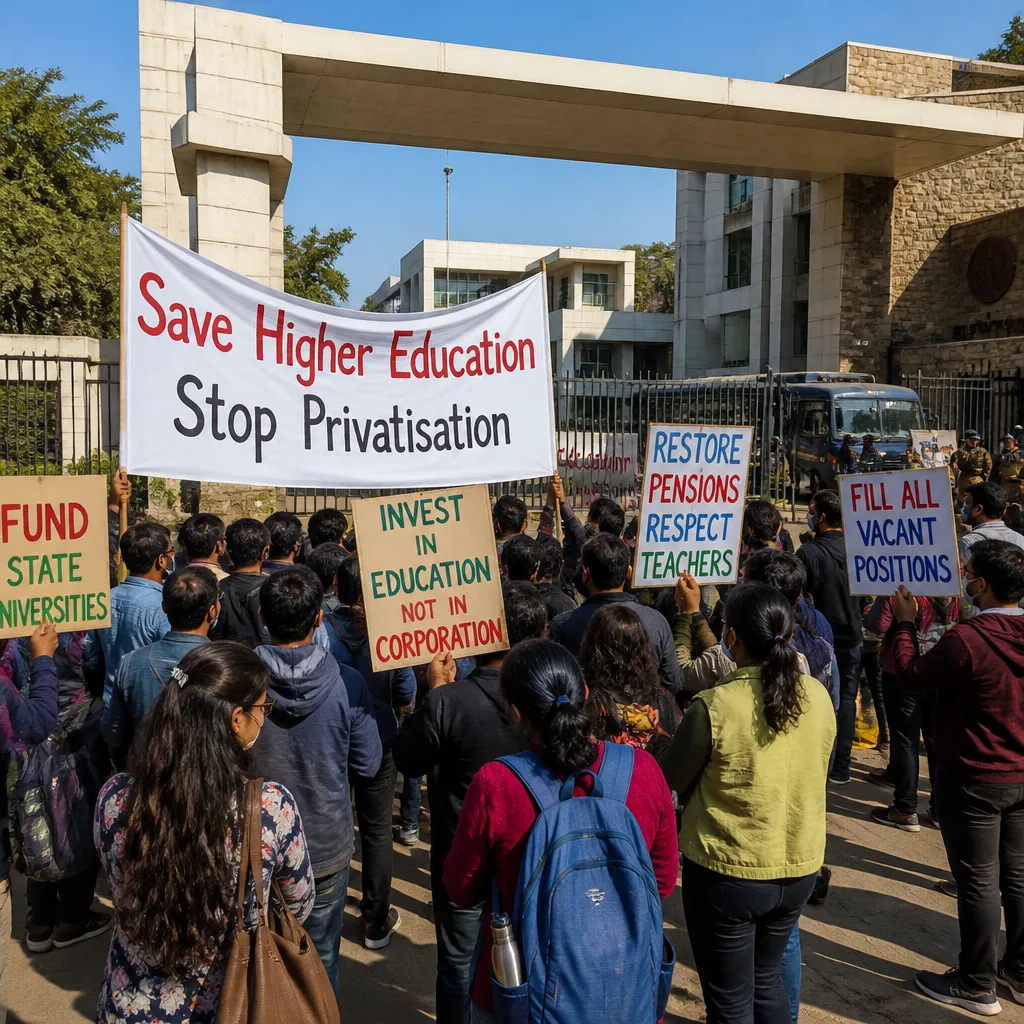
Hisar, Haryana: Teachers’ organisations and allied groups held a state-level protest at Guru Jambheshwar University of Science and Technology (GJUST) on Tuesday under the banner “Save Higher Education–Save Campuses from Privatisation”, opposing recent state government measures they say will shrink public higher education capacity.
Central demands and trigger for agitation
The demonstration was organised by the Haryana Federation of University and College Teachers’ Organisations (HFUCTO) and drew participation from university and college teachers’ associations across Haryana, non-teaching employees, contractual teachers and student bodies. Protest leaders said the movement will continue until the state withdraws a government letter dated 17 August 2026 that they interpret as effectively allowing the abolition of sanctioned posts that have remained vacant for four years.
Speakers at the protest reiterated a set of core demands including:
- Full financial assistance to state universities.
- Filling of all sanctioned vacant posts.
- Conversion of Self-Financing Scheme (SFS) posts and employees into the regular budgeted system.
- Implementation of the Old Pension Scheme (OPS) for all eligible employees.
- Raising the retirement age to 65 years for university and college employees.
Vacancies and concerns over privatisation
Participants said reductions in university budgets have placed institutions under severe strain and that state policies are, in practice, nudging higher education towards privatisation. Prof Vinod Goyal, president of the Guru Jambheshwar University Teaching Association (GJUTA), highlighted the scale of unfilled positions at state institutions, saying that in almost all state universities more than 50 per cent of teaching posts lie vacant.
“The movement will continue until the state government’s letter dated August 17, 2026, is withdrawn and long-pending issues concerning higher education are resolved,”
HFUCTO state president and Kurukshetra University Teachers’ Association president Jitender Khatkar told the gathering that similar protests will be held at other state universities across Haryana. HFUCTO general secretary Dayanand Malik accused the state government of ignoring the demands of teachers and other stakeholders for several years.
Scope of the problem and institutional impact
Leaders pointed to major state universities — including Maharshi Dayanand University (MDU), Kurukshetra University and GJUST — as examples where numerous sanctioned posts remain unfilled, a situation they say undermines teaching quality, research output and student support services. The Haryana College Teachers Association (HCTA) state president Rajender Parmar raised additional issues specifically affecting teachers in aided colleges.
The protest’s organisers characterised the August 17 communication as a policy lever that could be used to remove sanctioned posts permanently if vacancies persist, effectively shrinking the permanent workforce and compelling institutions to depend more on contractual and self-financed arrangements. Representatives argued that such a shift would erode the public character of higher education and affect affordability and access for students.
| Issue | Claim by protest leaders |
|---|---|
| Vacant teaching posts | More than 50% unfilled in most state universities |
| Key government action | Letter dated 17 Aug 2026 on abolition of posts vacant for four years |
| Primary demands | Funding, filling posts, OPS, convert SFS, raise retirement age to 65 |
Protest leaders said they will sustain efforts until authorities address the listed grievances. They warned of further state-level demonstrations if the government does not engage with the demands and withdraw the referenced letter.
The demonstration in Hisar reflects growing tensions between faculty unions and state governments across India over funding models, hiring freezes and the expanding role of contractual appointments in higher education. The outcome of the HFUCTO campaign could influence policy debates on staffing norms, pension coverage and the financing of state universities in Haryana and potentially other states where similar practices are under scrutiny.