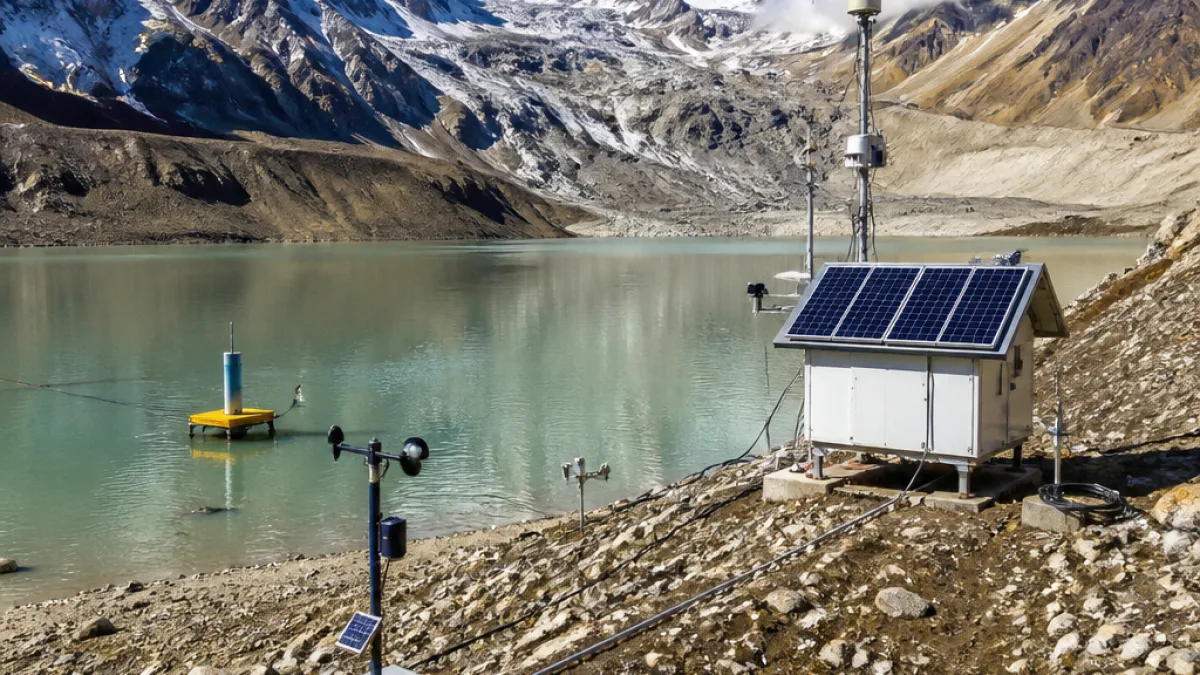
Chamoli, Uttarakhand: The Uttarakhand State Disaster Management Authority (USDMA) has begun installing the state’s first Glacial Lake Early Warning System at Vasundhara Tal in Chamoli district to monitor in real time changes in water level, weather, snow and flow that could precede a glacial lake outburst flood (GLOF).
Why the system is being deployed
The move comes against the backdrop of increasing concern over expanding glacial lakes in the Himalaya and the damage a sudden breach of lake ice- or moraine-dams can inflict on downstream communities and infrastructure. A GLOF occurs when a natural barrier containing a glacial lake fails, releasing a large volume of water that can cause rapid rises in river levels and destructive floods.
According to satellite assessments, Uttarakhand has a substantial number of lake features formed by glacier retreat. The National Remote Sensing Centre (NRSC) identified 344 glacial lakes in the state in 2023, while the National Disaster Management Authority (NDMA) has listed 13 of these as high-risk.
High-risk lakes: district distribution
| District | High-risk lakes |
|---|---|
| Pithoragarh | 6 |
| Chamoli | 4 |
| Bageshwar | 1 |
| Tehri Garhwal | 1 |
| Uttarkashi | 1 |
Two-stage approach: survey then sensors
The USDMA has outlined a two-stage strategy for managing risk from identified glacial lakes. The first stage is a scientific survey that assesses lake dimensions, depth, storage capacity, surrounding topography and the potential volume of water that might surge downstream in the event of a breach.
The second stage moves from assessment to continuous observation: installing sensors and monitoring equipment to track variations in lake water level, local weather parameters, snow conditions and water flow. The installation at Vasundhara Tal represents the first operational step in this continuous monitoring phase for the state.
- Real-time monitoring: Sensors will provide continuous data on lake and weather behaviour.
- Early warning potential: Continuous data can allow authorities to detect rapid changes and issue alerts for downstream communities.
- Risk reduction: The initiative aims to reduce damage to villages, roads, bridges and hydropower installations from sudden floods.
Local and regional significance
Vasundhara Tal is among the lakes classified by NDMA as presenting a significant hazard. Installing the early warning system there is intended both as a pilot and as a practical safeguard for downstream habitations and critical infrastructure in Chamoli district.
Experts and disaster managers across the Himalayan region have emphasised that as glaciers retreat under warming conditions, glacial lakes are likely to grow and the frequency and scale of GLOF events may increase. Real-time systems that couple ground sensors with communications protocols can provide lead time for evacuation and for safeguarding assets such as hydropower projects and transport links.
What this means for residents and authorities
For residents living below identified lakes, the new monitoring network should eventually mean earlier alerts and better coordination during high-risk episodes. For state agencies, the data will inform maintenance, engineering interventions and longer-term planning.
The USDMA’s work follows NDMA and NRSC identification of high-risk lakes and complements broader efforts to survey and manage glacial hazards across the state. The pilot at Vasundhara Tal is expected to guide similar installations at other vulnerable lakes identified by recent surveys.
Implementation details such as the timeline for full commissioning, the exact sensor types to be used, data-sharing arrangements and the protocols for issuing warnings have not been released publicly. Authorities have framed the installation as part of a comprehensive monitoring programme that begins with scientific surveys and proceeds to permanent, automated observation.
The installation marks a substantive step in Uttarakhand’s adaptation and disaster-mitigation strategy in the high Himalaya, where communities, roads and power projects remain exposed to the risks of sudden glacial lake outbursts.