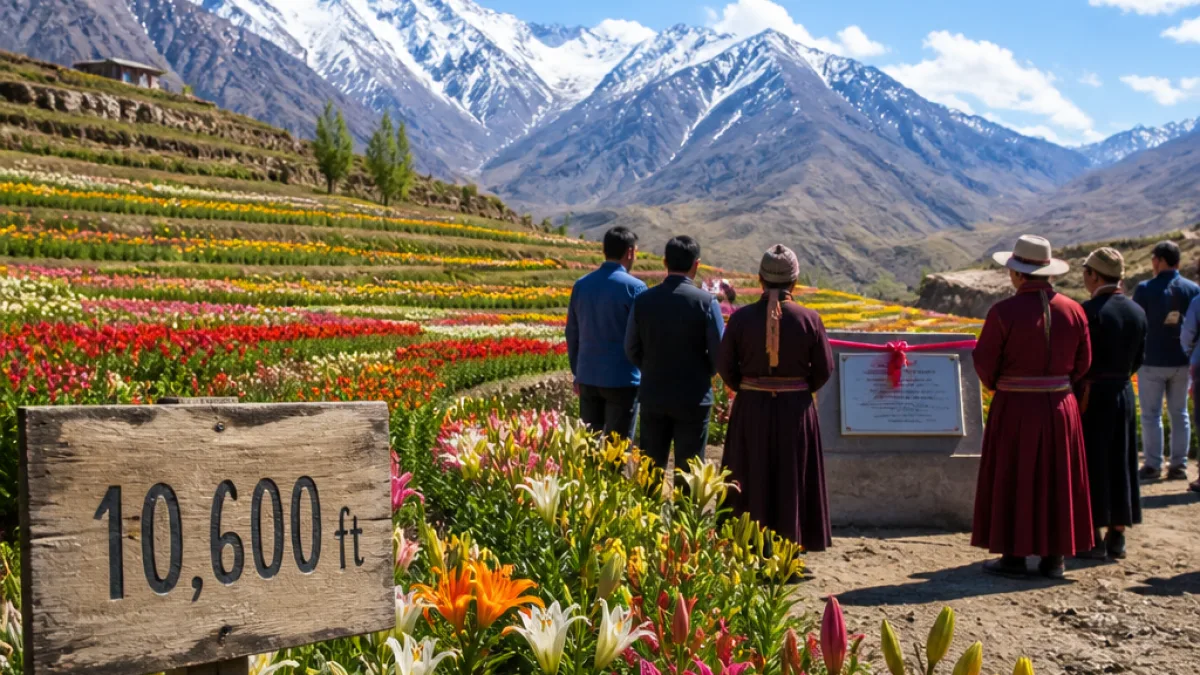
Leh, Sep 17 — The Union Territory administration on Thursday inaugurated what officials described as the world’s highest-altitude twin flower fields in Leh, showcasing more than 25 lakh high-value flowers cultivated across 40 acres at an altitude of 10,600 feet. The project was opened to mark Prime Minister Narendra Modi’s 76th birth anniversary.
Two sites: Choglamsar and Stakna
The twin gardens are located at Choglamsar and Stakna and comprise approximately 24 lakh Lilium and 1 lakh Gladiolus, a Lok Bhavan spokesperson said. The Choglamsar park will be accessible to the general public from September 18, the spokesman added.
| Site | Altitude (ft) | Flower types | Approx. number |
|---|---|---|---|
| Choglamsar | 10,600 | Lilium, Gladiolus, tulips, other ornamentals | ~24 lakh Lilium; part of the 25 lakh total |
| Stakna | 10,600 | Lilium | ~14 lakh Lilium planted at Stakna (plantation began in August) |
Objectives: tourism, training and livelihoods
At the inauguration, Lieutenant Governor V K Saxena said the gardens were intended not only as recreational and educational spaces for residents and visitors but also to foster an ecosystem for skills and enterprise.
"A key objective of the Flower Garden is to develop it as a training and demonstration centre for farmers and youth. The facility will provide exposure to modern cultivation techniques, scientific farming practices and improved post-harvest management," he said.
The Lok Bhavan spokesperson described the project as the first experiment of its scale and nature at high altitude in Leh, and said its execution could pave the way for similar models across Ladakh. Officials said the Choglamsar field was developed in about two months: plantation began on July 16 and the first blooms appeared in the first week of September.
At Stakna, plantation of nearly 14 lakh Lilium began in August, with the first blooms expected around the end of October, according to the spokesperson.
Commercial prospects and community engagement
Officials highlighted the commercial potential of floriculture in the Union Territory. At prevailing market rates cited by the administration, a Lilium stick sells for around ₹60-70 in wholesale markets, with higher retail prices. The Choglamsar park is planned as a demonstration and model floriculture centre where high-value flowers such as Lilium, Gladiolus, tulips and other ornamentals will be cultivated.
- The project aims to create sustainable income streams for the farming community through self-help groups (SHGs) and cooperatives.
- Structured training in scientific floriculture and modern cultivation practices will be provided to local farmers and youth.
- Post-harvest management and market linkages are key focus areas mentioned by the administration.
The administration indicated that local farmers are being trained in structured modules covering scientific floriculture and improved post-harvest practices, with an intent to establish floriculture as a commercially viable enterprise in the high-altitude environment.
Implications for Ladakh’s economy and tourism
Officials framed the initiative as a convergence of tourism promotion and rural livelihood development. If sustained, floriculture could offer seasonal earnings for growers in Leh and nearby areas and add a new attraction for visitors during bloom periods. The demonstration model is being positioned for replication in other parts of Ladakh where climatic and land conditions permit.
While the administration emphasised training and cooperative structures, it also flagged the need for continued attention to cold-chain facilities, transport and market access to fully realise the income potential of high-altitude floriculture. The spokesperson underlined that the project’s scalability will depend on lessons learned during the first cycles of cultivation and harvest.
The twin flower fields add to recent efforts by the administration to diversify agricultural and tourism offerings in Ladakh, where short growing seasons and extreme conditions challenge conventional farming but also create niche opportunities for hardy, high-value crops.
The garden’s opening to the public from September 18 is expected to draw local residents and tourists keen to view large-scale floriculture in an alpine setting, officials said.