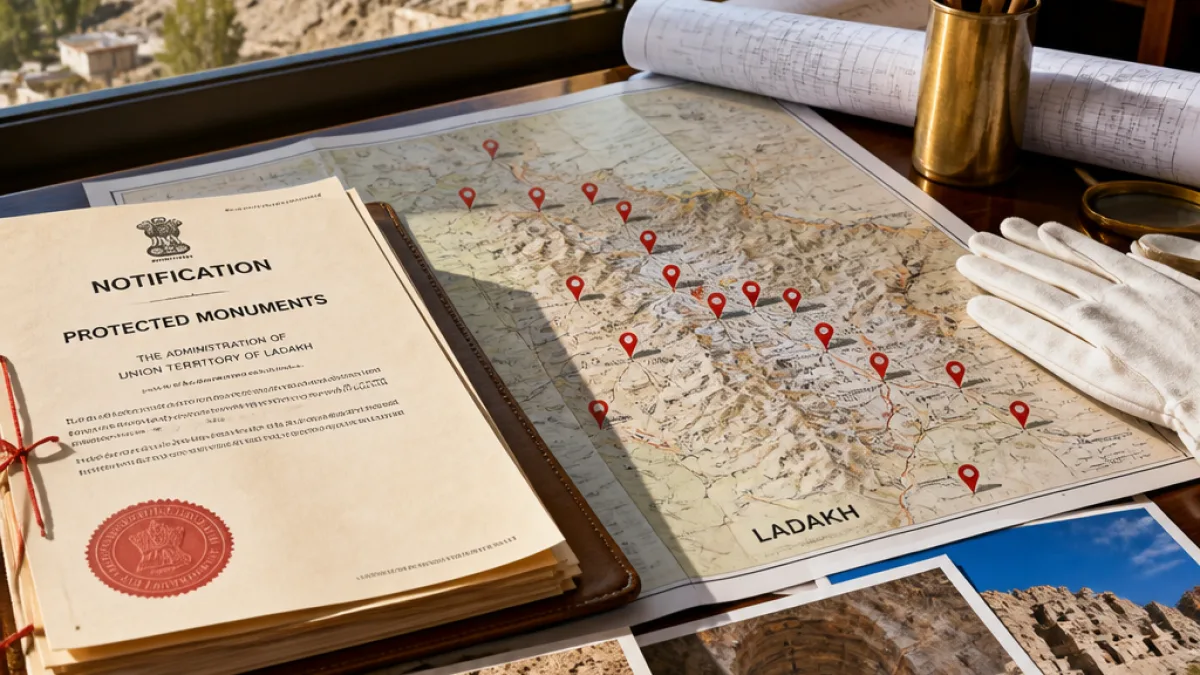
The Union Territory administration of Ladakh has formally granted protected-monument status to 23 sites across Leh and Kargil, a move aimed at providing statutory conservation, preventing encroachment and regulating activities that could damage fragile archaeological and cultural remains.
Legal backing and scope
The notification, approved by Lieutenant Governor Vinai Kumar Saxena under the Jammu and Kashmir Ancient Monuments Preservation Act, brings a range of sites into the ambit of official protection. The list includes prehistoric petroglyph locations, medieval forts, meditation caves and rock-cut Buddhist sculptures, officials reported.
Granting protected status will allow the administration to undertake scientific conservation and restoration work and to control land use or development activity in and around these monuments, the notification said. The measure is expected to strengthen safeguards for sites that have for decades remained outside mainstream tourist circuits and conservation programmes.
Geographic and historic spread
The newly notified monuments trace human presence and religious activity in Ladakh over millennia. Among the oldest are petroglyph concentrations at places such as Sharnos, Domkhar, Lehdo, Alchi, Murgi and Mangmore, where carvings on rocks record scenes and symbols linked to early inhabitants, pastoral communities and trade routes that once connected the region with Central Asia and Tibet.
Other entries in the list include later Buddhist-era sites — meditation caves and carved images — as well as forts and structures associated with medieval polities in the trans-Himalayan zone. Officials indicated the designation acknowledges the value of both visible monuments and open-air archaeological features that form part of Ladakh's cultural landscape.
"Ladakh's ancient monasteries, forts, caves, petroglyphs, and rock carvings are invaluable testimonies to our rich civilisational heritage and cultural identity. Their preservation is not merely about protecting monuments but about safeguarding the collective memory of our people for future generations," Saxena said.
What protection entails
Under the preservation Act, protected-monument status typically imposes controls on construction, excavation and commercial activities within prescribed limits around a notified site. The administration will be able to plan and execute conservation projects, restrict unauthorised alteration or encroachment, and manage visitor access to minimise damage.
Local authorities and heritage experts will need to identify buffer zones, prepare conservation plans and mobilise resources for maintenance. The recognition could also open avenues for technical assistance from federal agencies and for regulated tourism that benefits local communities while limiting adverse impacts.
Potential implications for tourism and local communities
Officials and stakeholders expect the notification to raise awareness of lesser-known heritage locations beyond the prominent monasteries and lakes that draw most visitors to Ladakh. Regulated visitation and interpretive facilities could diversify heritage tourism in Leh and Kargil, but implementation will require sensitive planning to avoid over-exposure of vulnerable sites.
- Conservation: Scientific restoration and preventive maintenance can be undertaken under legal protection.
- Regulation: Encroachment and damaging activities can be checked through formal mechanisms.
- Tourism management: Potential to develop sustainable, site-specific visitor policies and local benefits.
Next steps and enforcement
The notification provides the administrative framework; practical conservation will depend on surveys, resource allocation and coordination between the UT administration, archaeology departments and district authorities. Officials will also have to balance heritage protection with the needs of nomadic and settled communities that use landscapes containing archaeological remains.
| Aspect | Expected outcome |
|---|---|
| Legal protection | Controls on construction, excavation and encroachment |
| Conservation | Scientific restoration and maintenance projects |
| Tourism | Opportunities for regulated heritage tourism |
The formal notification marks a policy shift toward preserving an extensive archaeological record in the high-altitude environment of Ladakh. Authorities say the move is intended to protect these cultural assets for posterity while enabling planned interventions that respect the region's fragile environment and traditional livelihoods.
Further details on the list of individual sites and the boundaries of protection were released with the official notification, which will guide district-level implementation in the coming months.