Major administrative reshuffle, infrastructure push announced
Leh: On the 80th Independence Day, Lieutenant Governor Vinai Kumar Saxena said Ladakh has entered a new phase of development since its formation as a Union Territory in 2019, announcing the creation of five new districts and multiple administrative and engineering units to improve governance and public service delivery in remote areas.
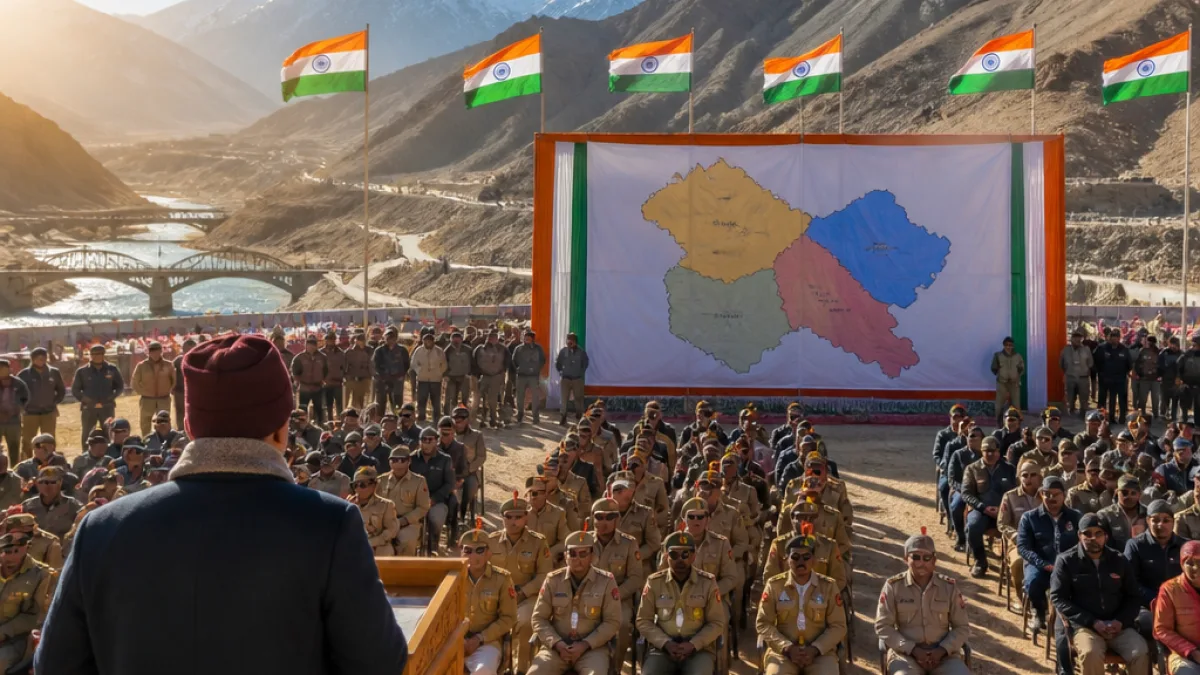
Addressing the Independence Day function at Leh Polo Ground, Saxena described the UT's reorganisation as a significant step towards bringing administration closer to people in far-flung regions. He said the new districts—Sham, Nubra, Changthang, Zanskar and Drass—had been created, along with 17 new tehsils and 16 engineering divisions.
The Lieutenant Governor said the Administration was also moving forward with a plan to establish Hill Councils in all seven districts to strengthen local-level democracy and encourage grassroots participation in development planning.
Connectivity and tourism gains highlighted
Saxena underlined expansion in physical connectivity since 2019 as a prime enabler of development. He said the road network in Ladakh had grown substantially and the number of bridges had risen sharply, facilitating access to remote habitations.
| Indicator | Before 2019 | Now |
|---|---|---|
| Road network (kilometres) | About 1,799 km | Over 4,200 km |
| Number of bridges | 19 | 72 |
| Tourist arrivals (Jan–Jul 2026) | More than 3.30 lakh visitors by end of July 2026, nearly matching full-year 2025 arrivals |
He noted ongoing strategic infrastructure projects—naming the Zojila Tunnel and the Leh Bypass—that would further ensure all-weather connectivity and bolster local economic activity once completed.
Environment, water security and energy on the agenda
The Lieutenant Governor said the Administration was emphasising environmentally sustainable development. He cited several initiatives intended to address water security, ecological balance and renewable energy needs in the high-altitude region.
- Project Him Sarovar – listed as a key intervention for water management;
- Himalayan rock check dams and the Indus River Green Corridor – measures aimed at conserving water and preventing soil erosion;
- Renewable energy projects and geothermal exploration at Puga – steps to diversify energy supply.
Saxena framed these initiatives as essential to balance development imperatives with preservation of the fragile Himalayan environment, though he did not provide timelines for the completion of each project.
Pashmina sector, livelihoods and finances
On livelihoods, the Lieutenant Governor said the Ladakh Pashmina Development Board had been set up to support the traditional pashmina sector. Incentives had been extended to more than 1,200 pashmina producers, and an ₹8-crore revolving fund created to ensure timely payments to artisans and producers, according to his address.
These measures are intended to strengthen market linkages and provide working capital support to sustain income for pastoral and craft communities in the region.
Administration to expand local governance
Creation of additional administrative units and engineering divisions is expected to shorten delivery chains for public works and services in areas that have historically faced access challenges because of terrain and weather. The proposed Hill Councils in each district are meant to provide a forum for local priorities to be reflected in planning and implementation.
Officials said the announcements signal a continued focus on decentralised administration, connectivity and environmentally minded infrastructure. Saxena's address also highlighted tourism recovery after the pandemic and framed the year's arrivals as evidence of the sector's rapid revival.
Further details on the timelines for setting up the new districts, tehsils and engineering divisions, and on the workings of the Hill Councils, were not provided in the address.
The Lieutenant Governor's remarks map an ambitious agenda for Ladakh's next phase of development, balancing infrastructure, livelihoods and ecological safeguards as the Union Territory deepens administrative reach into its remote areas.