Survey finds pedestrian infrastructure a weak link in Nashik’s road network
A mobility survey conducted by Maharashtra Metro Rail Corporation Ltd (Maha Metro) for Nashik’s Comprehensive Mobility Plan (CMP) has found that nearly 65% of the city’s road network lacks footpaths, exposing significant gaps in pedestrian infrastructure and raising concerns over road safety and walkability.
The draft CMP estimates Nashik’s total road network at 2,400 km, of which footpaths exist along only 35% of major roads. More alarmingly, the report states that just 7% of roads have footpaths that meet prescribed pedestrian standards.
| Parameter | Value |
|---|---|
| Total road network | 2,400 km |
| Roads with any footpath | 35% |
| Roads with standard-compliant footpaths | 7% |
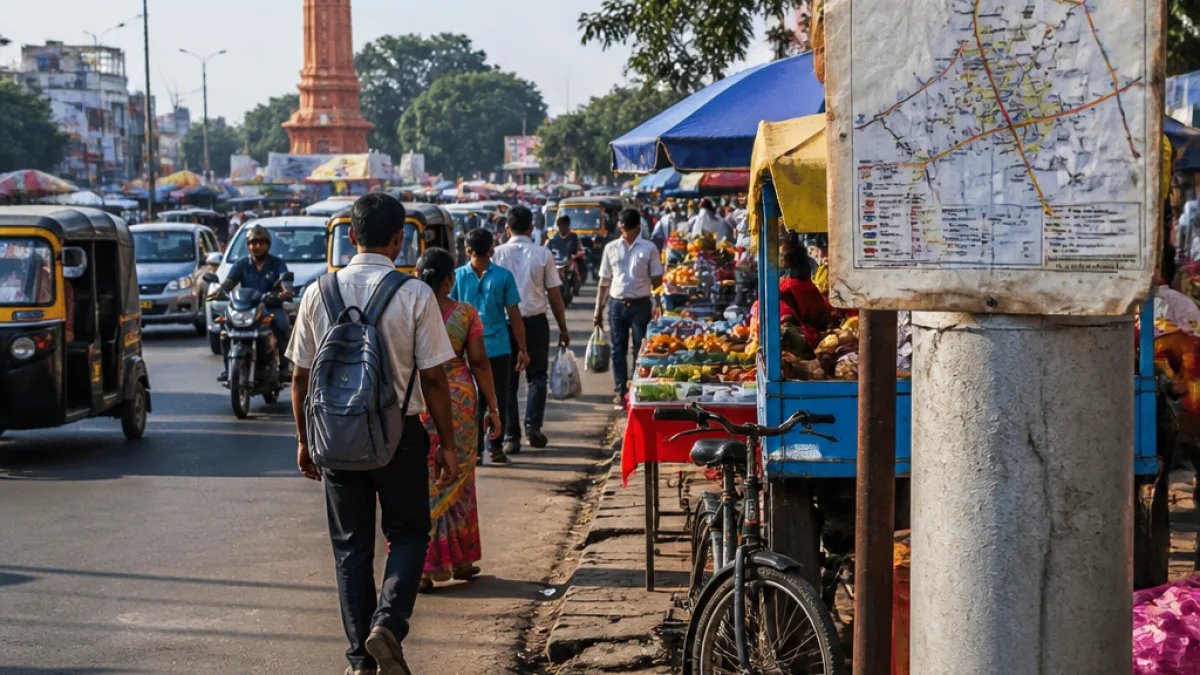
The report highlights multiple problems with existing pedestrian facilities: encroachment by street vendors operating kiosks and handcarts; poor maintenance; narrow or damaged pavements; and unsafe crossing conditions. Such deficiencies force pedestrians onto carriageways, increasing the risk of conflicts with moving vehicles and accidents.
“Gangapur Road sees heavy traffic, and there is little scope for widening. Although footpaths exist on both sides, many stretches have been encroached on by street vendors running kiosks and handcarts for tea stalls, scrap collection and tailoring. As a result, pedestrians are forced onto the road, risking their safety,” said resident Sandeep Shinde.
The survey singled out busy locations where pedestrian volumes are already high. Ashok Stambh recorded the highest observed pedestrian movement, with 2,293 pedestrians per hour during peak periods and 764 during non-peak hours, amounting to an estimated 22,934 pedestrians daily. Such concentrations, combined with inadequate footpaths and unsafe crossings, have led to severe congestion and frequent pedestrian–vehicle conflicts at junctions.
Recommendations and local implications
In its draft proposals, the CMP identifies pedestrian infrastructure as one of Nashik’s weakest links and calls for urgent improvements to enhance safety and walkability. The report notes that while current pedestrian traffic in Nashik remains lower than in larger metropolitan cities, demand is expected to rise with continued urban expansion, increased commercial activity and improved public transport.
Planners are also preparing for a substantial short-term surge in visitors and incidental pedestrian demand during the Simhastha Kumbh Mela in 2027, which will place additional pressure on existing infrastructure unless corrective measures are taken well in advance.
- Upgrade and widen existing footpaths to meet national pedestrian standards where feasible.
- Address encroachment through coordinated vendor management and designated vending zones to preserve pedestrian space.
- Improve maintenance, lighting and safe crossing facilities at high‑footfall junctions such as Ashok Stambh.
The CMP’s findings will inform future investments in Nashik’s transport network. City authorities and Maha Metro are expected to use the draft study to prioritise projects under upcoming urban development and mobility schemes. Implementation will require coordination between the Nashik Municipal Corporation, traffic police, market committees and state agencies to reconcile pedestrian needs with commercial activities that currently use footpath space.
Residents and civil society groups have in the past raised concerns about encroachment and the lack of safe walking space on arterial roads such as Gangapur Road, where dense commercial activity and limited scope for road widening complicate engineering solutions. The draft CMP provides a data-driven basis for interventions but also underscores political and administrative challenges in enforcing pedestrian rights in congested commercial corridors.
With the Simhastha Kumbh Mela three years away, planners say there is a limited window to rehabilitate core pedestrian corridors and implement temporary measures that can be upgraded later. The draft CMP’s release opens a public consultation phase during which stakeholders can flag priority locations for immediate action.
For now, the survey’s key message is straightforward: unless footpath provision, maintenance and encroachment are addressed, Nashik’s residents will continue to face elevated pedestrian safety risks as the city grows.