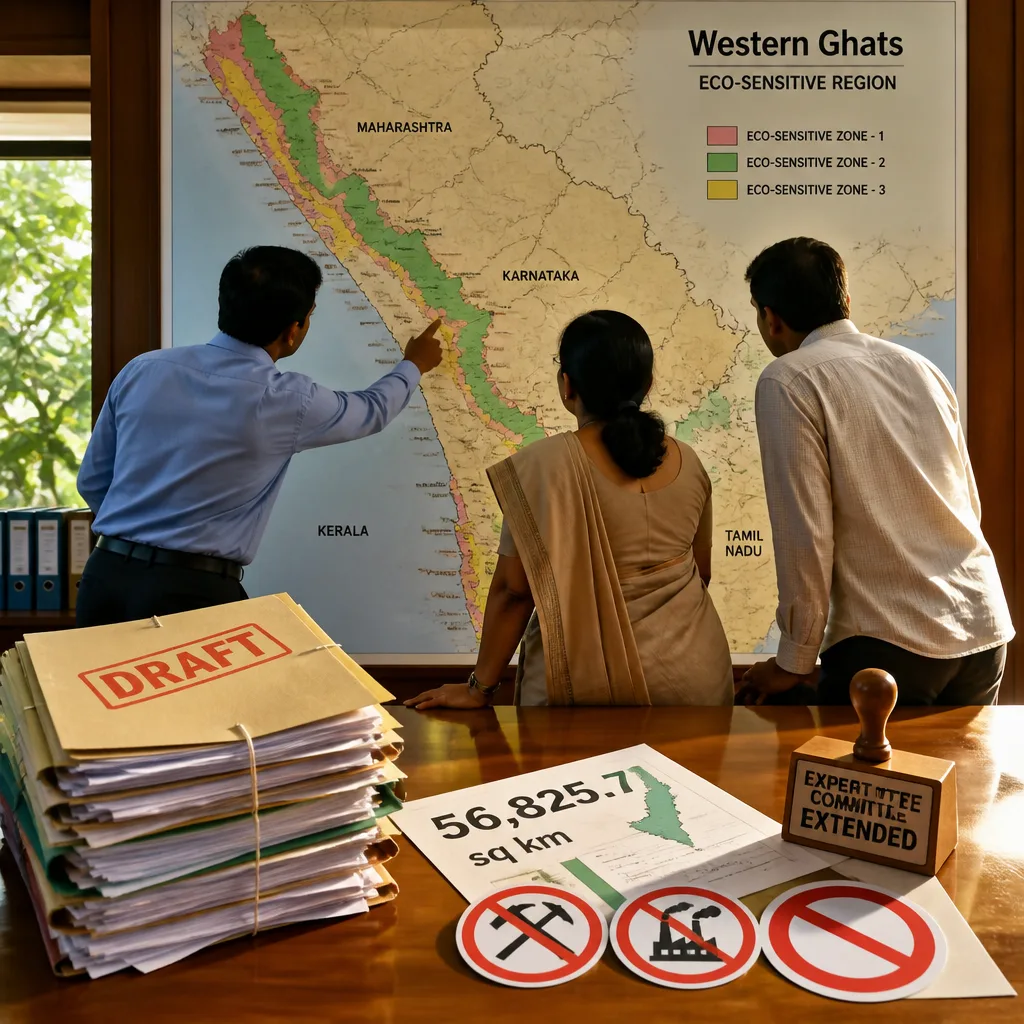
The Ministry of Environment, Forest and Climate Change (MoEFCC) has floated a seventh draft notification proposing that 56,825.7 square kilometres of the Western Ghats be notified as an ecologically sensitive area (ESA), officials said. The draft repeats earlier policy prescriptions aimed at strengthening protection across the biodiversity hotspot that spans six states.
State-wise spread and responses
The draft maps out ESAs across Gujarat, Maharashtra, Goa, Karnataka, Kerala and Tamil Nadu. The proposed extents by state are:
| State | Proposed ESA area (sq km) |
|---|---|
| Gujarat | 449 |
| Maharashtra | 17,340 |
| Goa | 1,461 |
| Karnataka | 20,668 |
| Tamil Nadu | 6,914 |
| Kerala | 9,993.7 |
| Total | 56,825.7 |
According to the MoEFCC briefing, Gujarat and Goa have largely agreed on the areas to be finalised as ESA. Maharashtra has submitted a fresh, revised proposal that is currently being appraised. Karnataka continues to oppose the draft, while the central government is working to resolve information discrepancies and other sticking points with Kerala and Tamil Nadu.
Regulatory measures proposed
The draft reiterates a number of prohibitions and restrictions in line with earlier iterations. Key regulatory proposals include:
- Complete ban on mining, quarrying and sand mining within the ESA boundaries.
- Phasing out of all existing mines within five years from the date of final notification or the expiry of the lease, whichever comes earlier.
- Prohibition on new thermal power plants and on expansion of existing thermal facilities in the ESAs.
- Banning of new projects and expansion by ‘red’ category industries — classified as the most polluting — within designated areas.
These measures largely mirror the restrictions proposed in previous drafts and are aimed at reducing pressure on fragile ecosystems and catchments that sustain biodiversity and local livelihoods.
Expert committee and process
The centre has extended the tenure of an expert committee, originally constituted in April 2022 and headed by Sanjay Kumar, former Director General of Forests at the MoEFCC. The extension, granted in June, gives the panel another year to examine state submissions and stakeholder views.
The committee’s mandate, as outlined by the ministry, is to weigh conservation considerations for a region prone to disasters along with the rights, needs and developmental aspirations of communities in the Western Ghats.
Context and implications
The Western Ghats is a recognised biodiversity hotspot and a key source of ecological services including water security for large parts of peninsular India. The repeated iterations of the draft reflect sustained centre–state consultations and a continuing deadlock in some quarters over precise demarcation, permissible activities and the balance between conservation and development.
Notably, the sixth draft had lapsed amid similar disagreements. The present seventh version seeks to reconcile state-level inputs with national conservation priorities, but the varied positions of the six stakeholder states indicate negotiations will continue before a final notification is issued.
The proposed prohibitions on mining and thermal power development, and restrictions on high-polluting industries, have potential economic and social consequences for affected districts and existing leases. The expert committee’s process will therefore be central to shaping timelines for phase-outs and any compensatory or transitional arrangements that may be required.
As the MoEFCC evaluates the revised state proposals and the expert panel concludes its review, further notifications and clarifications from the ministry will determine the pace at which the ESA designations and associated controls are implemented.