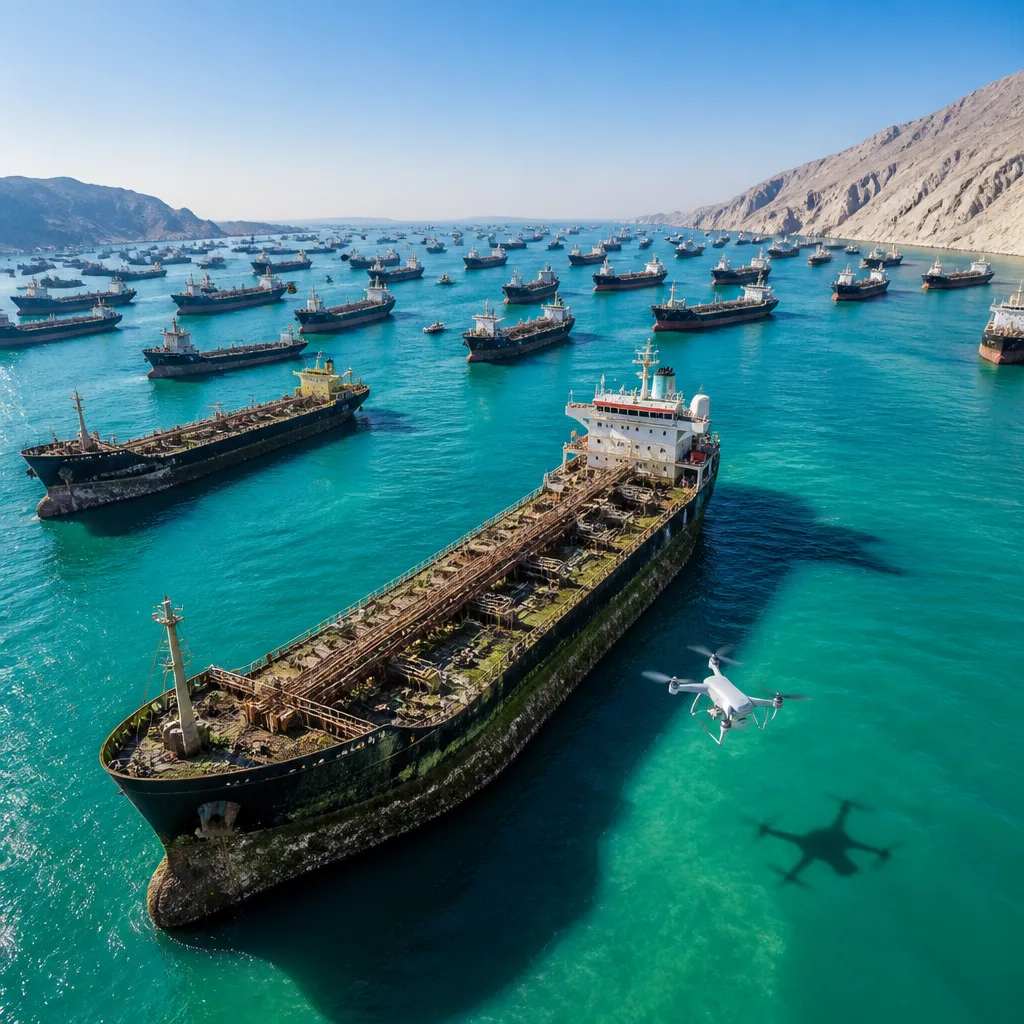
More than five months into open hostilities between the United States and Iran, researchers have warned that thousands of commercial vessels anchored near the Strait of Hormuz risk becoming vectors for a global marine bioinvasion when trade restarts.
Study, scope and core finding
The peer‑reviewed study, published in Biological Invasions and led by a team of 24 marine scientists coordinated by the University of Maryland Center for Environmental Science (UMCES), with contributors including the Woods Hole Oceanographic Institution (WHOI), cautions that the unprecedented lay‑up of ships could trigger what the authors describe as a bioinvasion ‘super‑spreader’ event.
According to the research, prolonged idling allows ship hulls and submerged appendages to accumulate dense assemblages of organisms — a process known in the maritime sector as biofouling. The succession typically begins with microbial films and slime and progresses to algae, barnacles, mussels and other invertebrates that can survive long voyages and colonise new regions when vessels move again.
Scale of the problem
The study places the scale of the incident in stark terms: roughly 1,500 vessels are reported stuck in the Persian/Arabian Gulf, with several hundred more held in the adjacent Gulf of Oman. The Strait of Hormuz is identified as the world’s most critical maritime energy chokepoint, facilitating the passage of roughly 600 billion worth of energy trade annually.
| Metric | Reported figure |
|---|---|
| Vessels laid up in Persian/Arabian Gulf | ~1,500 |
| Additional vessels in Gulf of Oman | Several hundred |
| Duration of conflict at time of report | Nearly five months |
| Research team | 24 marine scientists; lead: UMCES; contributors include WHOI |
Why this matters for oceans and ports
The authors argue that the combination of sheer vessel numbers and prolonged stationary periods creates conditions rarely seen in modern shipping. When movement resumes, ships carrying heavy biofouling can unintentionally transport non‑native species across ocean basins. If introduced into favourable habitats, these species can establish, outcompete native fauna, alter ecosystems and impose ecological and economic costs on fisheries, aquaculture and coastal infrastructure.
- Biofouling begins with microbial layers and advances to larger macro‑organisms that can survive transit.
- Extended lay‑ups increase the likelihood of dense and diverse communities forming on hulls.
- Resumption of commercial traffic could disperse these organisms to distant ports, creating a multi‑region invasion risk.
Authors emphasise the exceptional nature of this event and caution that it may produce invasion dynamics unlike those seen in routine shipping, where anti‑fouling measures and regular movement typically limit heavy colonisation.
Implications for policy and management
The study’s warning has practical implications for maritime and environmental authorities worldwide, including those in India. Port authorities, shipping companies and national biosecurity agencies may need to prepare enhanced surveillance, rapid response planning and stricter hull‑cleaning protocols when vessels begin transiting again. The research underscores the role of coordinated international action: outbreaks of non‑native species do not respect national boundaries and require harmonised prevention and mitigation measures.
While the publication highlights a heightened risk, it does not quantify the probability of specific invasions or identify particular species likely to spread; rather it frames the situation as one of elevated potential due to unusual operational circumstances in a strategic chokepoint.
As global trade and energy movements are restored, scientists and managers will face the dual challenge of resuming commerce while limiting unintended ecological consequences. The study serves as an early alert that the environmental fallout of geopolitical crises can extend far beyond immediate human and economic costs to long‑term changes in marine biodiversity.