New eco‑educational facility to showcase plants, heritage and livelihoods
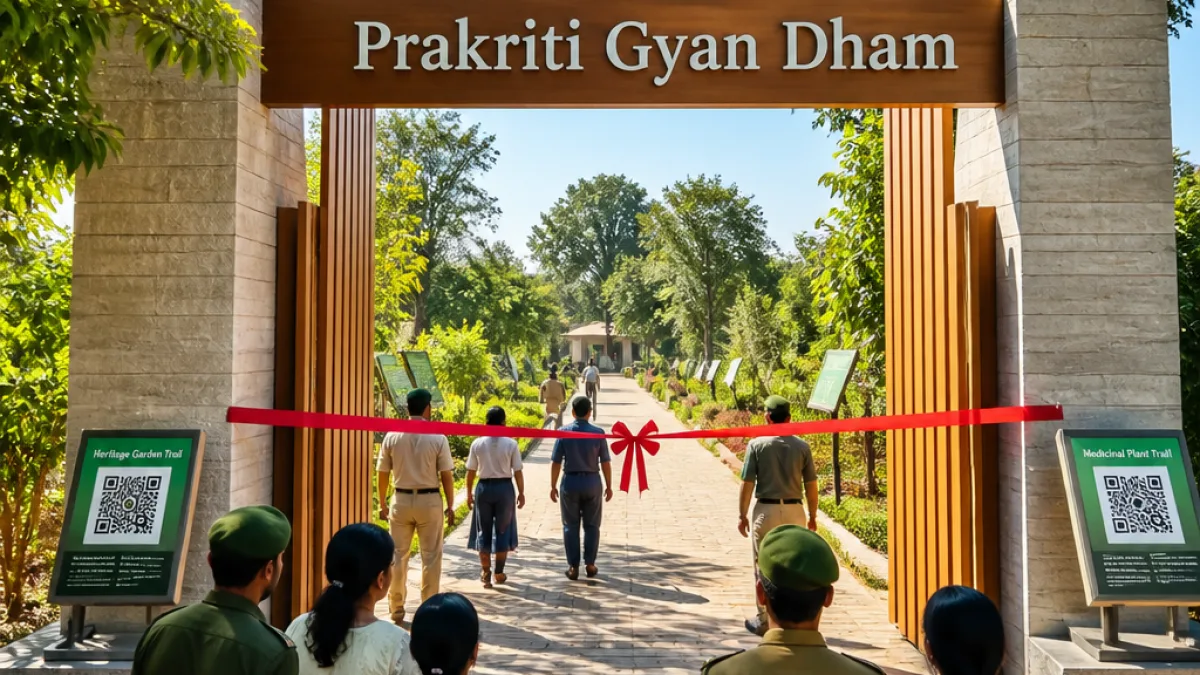
Union Minister of State for Science and Technology Dr Jitendra Singh on Saturday formally opened the Prakriti Gyan Dham, an eco‑educational hub developed by the CSIR‑National Botanical Research Institute (CSIR‑NBRI), at the Maharishi Parashar Bioresource Centre in Banthra, Lucknow. The facility is described by its developers as a first‑of‑its‑kind attempt to bring botanical research closer to society.
Designed as a living repository of India’s plant and cultural heritage, the hub combines conservation, environmental education and experiential learning. The centre features interactive displays, curated plant collections and digital aids intended to help students, farmers, entrepreneurs and the general public understand practical applications of plant science.
- PAaVan Path — an interpretive heritage trail showcasing plant communities and vegetation types from different ecological regions.
- Indian Heritage Garden — trees propagated from historically significant locations across the country, including specimens tied to freedom‑movement sites.
- Digital engagement — QR‑enabled audio systems installed across the garden to provide visitors with contextual information and histories.
At the inauguration Dr Singh urged scientific institutions to extend their reach beyond the laboratory and make innovations accessible to broader sections of society. He also emphasised the use of digital and social media to highlight technologies and initiatives that can generate livelihood opportunities.
“Take scientific institutions beyond their laboratories and campuses and make their technologies, innovations and success stories more accessible to farmers, entrepreneurs, students, industry and the wider public,”
He further called for better coordination between departments and ministries undertaking similar or complementary projects to enhance the social impact of research, the official release said.
Heritage trees, interpretive trails and audio guides
The centre’s Indian Heritage Garden includes trees propagated from sites of historical importance. The release lists specific examples planted or represented at the garden: the Bawan Imli tamarind from Fatehpur associated with the sacrifice of 52 freedom fighters; the Mother Dussehri mango from Lucknow; the Patalpuri banyan of Prayagraj; a descendant of a mango planted by Mahatma Gandhi at Bhitiharwa in Champaran; and progeny of trees linked to the Dandi March route in Gujarat.
| Feature | Purpose |
|---|---|
| PAaVan Path | Interpretive trail to appreciate plant diversity and vegetation types |
| Indian Heritage Garden | Living collection of historically significant trees |
| QR audio system | Visitor access to historical and cultural context via mobile devices |
CSIR‑NBRI has positioned the hub as a bridge between botanical research and society, offering an environment where visitors can experience plant science and its applications directly. The combined use of living collections and digital interpretation is intended to attract school groups, researchers, conservationists and citizens interested in heritage and biodiversity.
Locally, the hub could strengthen educational programming in Lucknow and provide new opportunities for community outreach and small‑scale enterprise linked to plant‑based technologies. Officials highlighted potential benefits such as increased scientific literacy, promotion of conservation ethics and the creation of livelihood options through technology demonstrations and entrepreneurship showcases.
The inauguration marks the latest expansion of CSIR‑NBRI’s public engagement activities in the city. The institute’s move to develop an eco‑educational centre aligns with national priorities emphasising science communication and biodiversity conservation ahead of larger regional and national observances.
Visitors will be able to experience the PAaVan Path, view the heritage tree collections and use QR‑enabled audio guides to access stories and scientific explanations. The hub’s programming and opening hours were not specified in the release.