Police intercept 11 women carrying kanwars; ritual completed at nearby temple
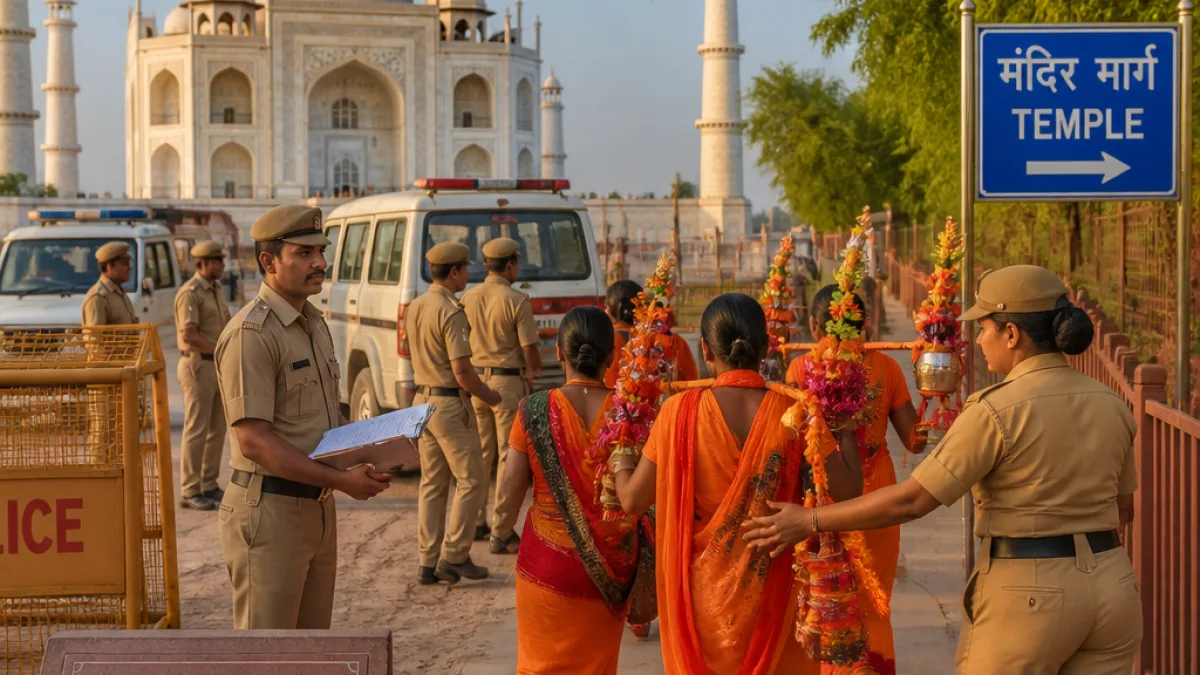
AGRA: Uttar Pradesh police on Monday intercepted members of the Akhil Bharat Hindu Mahasabha who were attempting to enter the Taj Mahal to perform religious rites and escorted them to the nearby Rajeshwar Temple, an officer said.
The group had sought to carry out rituals on the first Monday of the Hindu month of Shravan, a period during which several Hindutva organisations have in recent years tried to perform ceremonial offerings at the Mughal monument, claiming it was originally a Shiva temple. Historians have repeatedly disputed that claim. The monument is a protected site under the Archaeological Survey of India.
- Number intercepted: 11 women
- Organisation involved: Akhil Bharat Hindu Mahasabha
- Action taken: Stopped en route and escorted to Rajeshwar Temple
A police officer said the authorities had received prior information that the group was proceeding from the western gate of the Taj Mahal to perform the rituals. "They were stopped on the way and were taken to the Rajeshwar Temple, where they performed jalabhishek," the officer said.
"If qawwali programmes can be held at the Taj Mahal, we should also be allowed to offer prayers there. We have been stopped this time, but there are more Mondays in Shravan. We will again carry kanwars and perform worship," said Meera Rathore, district president of the Akhil Bharat Hindu Mahasabha.
According to police, the women were carrying kanwars—the traditional water-carrying frames used by devotees of Lord Shiva—when intercepted. After being diverted to Rajeshwar Temple, they offered holy water and performed jalabhishek, the ceremonial bathing of a Shivling, the officer added.
Recurring attempts and legal protections
Hindutva organisations routinely attempt to enter the Taj Mahal during Shravan to offer Ganga water and conduct worship, claiming the monument is a Shiva shrine often referred to by them as "Tejo Mahalaya." Such assertions have been the subject of public debate but are not accepted by mainstream historians. The Archaeological Survey of India classifies the Taj Mahal as a protected monument, and entry and activities at the site are regulated.
Local police briefings made clear that the interception on Monday was based on prior intelligence. The officer said the action was intended to prevent a potential violation of rules at the protected site and to maintain public order around one of the city's most visited monuments.
| Item | Detail |
|---|---|
| Date | First Monday of Shravan (reported Monday) |
| Individuals intercepted | 11 women |
| Destination diverted to | Rajeshwar Temple |
Authorities in Agra have in the past managed several similar attempts by groups seeking access to the Taj Mahal for religious activities. Police and heritage protection agencies have typically sought to balance freedom of worship with legal restrictions designed to preserve and protect monuments and to prevent communal tensions.
The police statement did not indicate any arrests. The Akhil Bharat Hindu Mahasabha's district president reiterated the group's view that worship should be permitted at the monument, and said they would attempt further processions on subsequent Mondays in Shravan.
Local civic and law-enforcement officials are likely to monitor the area more closely during Shravan, when the pattern of demonstrations and attempted entries by religious groups has historically been higher, particularly on Mondays associated with Lord Shiva worship.
Further action, if any, by the Archaeological Survey of India or the administration was not reported by the time of filing.