Centre cites policy threshold as basis while approving metros for smaller cities including Agra
The Union Ministry of Housing and Urban Affairs (MoHUA) has again turned down proposals from Tamil Nadu for Metro rail projects in Coimbatore and Madurai, while cities with smaller resident populations such as Agra and Prayagraj have received Metro approvals under the existing policy framework, according to reporting by News18.
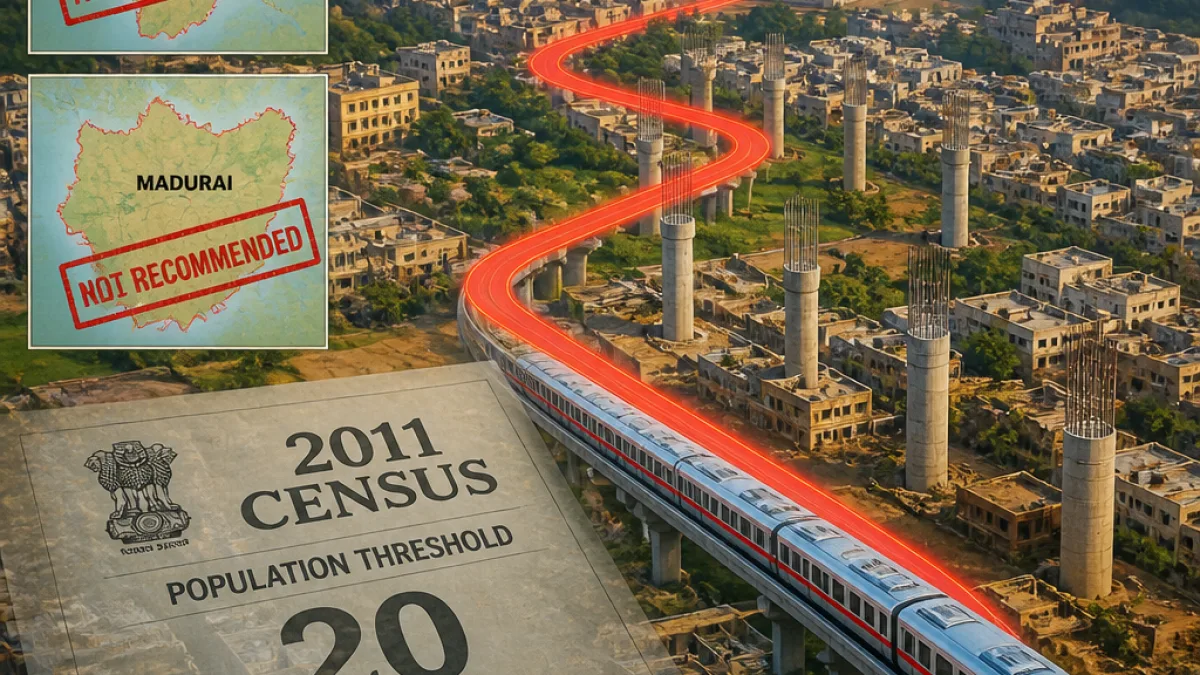
Under the Metro Rail Policy, 2017, only cities with a population of at least 20 lakh as per the 2011 Census are considered eligible to begin planning a Metro through a Comprehensive Mobility Plan (CMP). The ministry told Tamil Nadu that Metro was not recommended for Coimbatore and Madurai, and suggested elevated or at-grade Bus Rapid Transit Systems (BRTS) as alternatives.
"Population was not the sole criteria"
The ministry, while rejecting the Tamil Nadu proposals, emphasised that population was not the only factor in deciding Metro feasibility but indicated that the 2011 population shortfall weighed heavily in its decision. The 2011 Census figures cited in the ministry’s communication put Coimbatore at about 15.84 lakh and Madurai at roughly 15 lakh, both short of the 20 lakh threshold.
- Policy trigger: Metro projects normally begin through a CMP for cities meeting the 20 lakh (2011) population criterion.
- Alternatives suggested: For cities below the threshold, the ministry has recommended BRTS or elevated/at-grade systems.
- Contrast: Despite smaller resident populations, some cities including Agra and Prayagraj have been approved for Metro projects under the existing framework.
The ministry’s stance has revived debate on how eligibility is assessed, particularly for cities with substantial floating populations such as tourists, commuters and industrial visitors. Tamil Nadu had argued that Coimbatore and Madurai merited Metro corridors because of their industrial roles and tourist footfall, which increase daily demand beyond resident numbers. The ministry, however, maintained the formal threshold as a key gateway for initiating Metro planning.
| City | 2011 Census population (as cited) | MoHUA decision |
|---|---|---|
| Coimbatore | 15.84 lakh | Metro rejected; BRTS suggested |
| Madurai | 15 lakh | Metro rejected; BRTS suggested |
| Agra | — | Metro approved (reported) |
| Prayagraj | — | Metro approved (reported) |
For Agra residents, the ministry’s decision confirms that the city has cleared whatever formal or contextual assessments the Centre applied in selecting locations for Metro networks. The reporting does not provide details on alignments, timelines, funding shares or project cost for the Agra Metro, nor does it specify whether the approval arose from meeting the population threshold, a special dispensation, or other criteria invoked by the ministry.
The issue highlights a broader policy question: whether the 2011 Census-based population cut-off remains the most appropriate single determinant for large urban transport investments a decade-and-a-half later, given rapid demographic and economic change. Cities such as Coimbatore have argued that current-day commuter patterns, industrial activity and tourism produce peak demands that are not visible from resident population figures recorded in 2011.
MoHUA’s reference to alternatives such as BRTS underscores a central trade-off for cities like Coimbatore and Madurai. While BRTS can be delivered faster and at lower capital cost than a Metro, it also carries different capacity, operational and urban impacts. For Agra, which has been reported as an approved Metro city, the coming months will be watched closely by residents and local authorities for announcements specifying routes, funding, and project partners.
Urban planners, municipal officials and commuters in Agra will now be attentive to the next administrative steps that typically follow a Metro approval: preparation or revision of a Comprehensive Mobility Plan, detailed project reports, and central-state funding accords. The ministry’s insistence on the 2011 threshold — even while noting it is not the sole criterion — ensures that the framework for Metro selection remains a focal point for debate between the Centre and states over urban transport priorities.