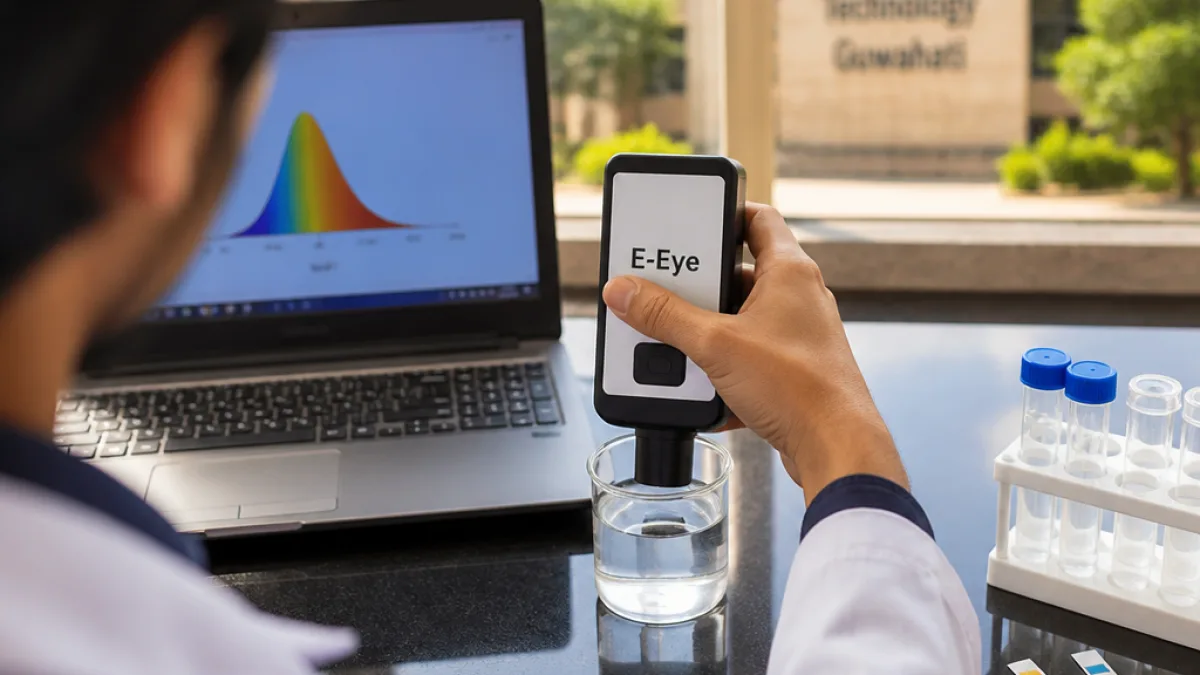
Portable optical sensor aims to strengthen local water testing and Jal Jeevan Mission delivery
Guwahati, August — Researchers at the Indian Institute of Technology Guwahati have developed a portable optical sensing device named E-Eye capable of rapid detection of several toxicants in water and biological samples, according to a report in the IEEE Sensors Journal.
The team, led by Professor Tapas K Mandal and Professor Harshal B Nemade of the Department of Chemical Engineering at IIT Guwahati, together with research scholars and collaborators from KIIT Bhubaneswar and Ramakrishna Mission Residential College, Kolkata, designed the device as a point-of-care solution for on-site screening of contaminants. The research was reported in the IEEE Sensors Journal, which published the findings.
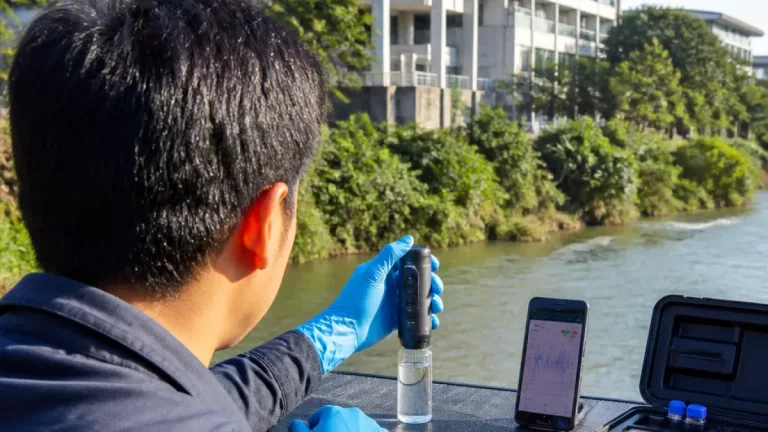
Officials and the research report said E-Eye operates through a chemical reaction that produces a coloured compound; the intensity of the colour is analysed using basic optical principles and converted into digital readings representing toxicant concentration. The device also wirelessly transmits data, enabling integration with water-treatment facilities and monitoring systems.
"The device operates on the Beer-Lambert law and combines optical sensing with digital electronics to generate accurate quantitative measurements. Our device has been able to successfully detect toxicants such as arsenic, lead, iron, chromium, fluoride, and Escherichia coli bacteria," Professor Tapas K Mandal said.
Developers emphasised cost-effectiveness and field readiness. The reported development cost for the prototype is approximately ₹3,500, while the per-sample testing cost is about ₹2, figures that the team said could make routine screening feasible in resource-constrained settings and support the Government of India's Jal Jeevan Mission's objective of ensuring safe drinking water.
- Portable, point-of-care operation with wireless data transmission
- Detects multiple toxicants including heavy metals and E. coli
- Laboratory performance comparable to standard spectrophotometers
A laboratory comparison reported by the researchers found E-Eye's results comparable to measurements from standard UV-Visible and Atomic Absorption spectrophotometers while offering digital integration suited to field deployment. The combination of optical sensing with embedded electronics enables quantitative readings at the source without reliance on costly laboratory instruments.
For Guwahati and neighbouring districts, where diverse water sources and contamination risks pose ongoing public-health challenges, a low-cost portable tester could permit more frequent local screening by municipal agencies, community groups and small water utilities. Wireless data output also allows rapid feed into treatment-control systems and centralised monitoring frameworks.
| Detected toxicant | Reported capability |
|---|---|
| Arsenic | Quantitative detection via colourimetric optical sensing |
| Lead | Quantitative detection |
| Iron | Quantitative detection |
| Chromium | Quantitative detection |
| Fluoride | Quantitative detection |
| Escherichia coli | Detection of bacterial contamination |
The research team noted that costs and portability were priorities; the reported prototype development cost of ₹3,500 and an estimated ₹2 per-sample consumable cost are substantially lower than typical laboratory instrumentation, the report said. The developers propose deployment at primary screening points to identify samples that need confirmatory laboratory testing.
Local water authorities, non-governmental groups and public-health agencies assessing field-ready monitoring tools may consider such devices for expanded surveillance and faster response to contamination events. The researchers said further work would likely focus on field trials, ruggedisation, wider validation across diverse water matrices, and scaling the device's production for broader use, according to the published article.
The study lists IIT Guwahati faculty and scholars as principal contributors and names collaborating institutions in Odisha and West Bengal. The findings are presented as a potential technological aid for decentralised water-quality monitoring under national programmes aimed at ensuring potable water supply.