India's cotton sector is facing mounting pressure as estimates point to a sharp rise in imports and a steep fall in exports for the 2025–26 season, prompting experts to call for urgent technology and policy reforms.
Trade gap widens as consumption outpaces production
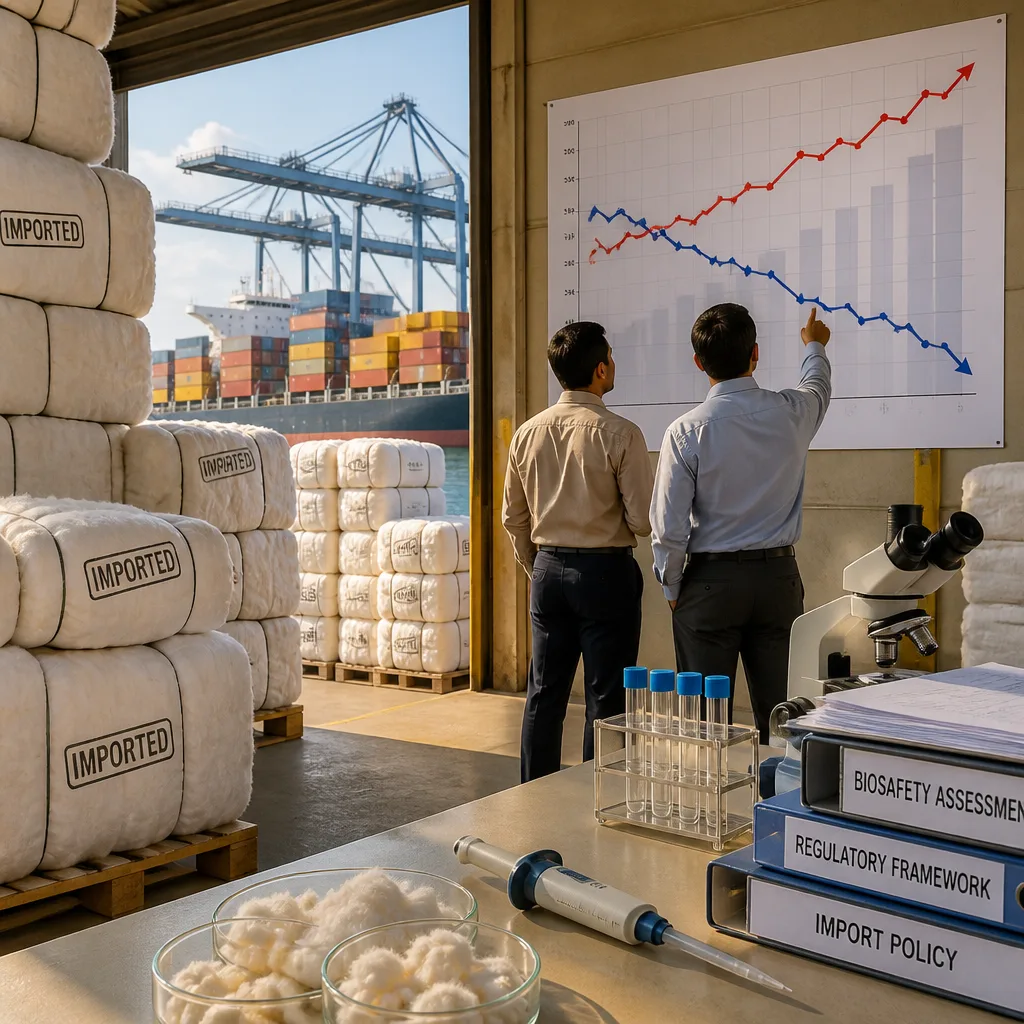
The Cotton Association of India (CAI) projects that cotton imports in 2025–26 will reach 60 lakh bales, while exports are expected to decline to just 15 lakh bales. Domestic consumption has been revised upward to 348 lakh bales, underscoring a significant shortfall between supply and demand and an increased reliance on foreign cotton.
These numbers, experts say, reflect structural problems in the sector rather than cyclical fluctuations, with implications for farmers, ginning and textile industries, and India’s position in global cotton markets.
Calls for GM adoption and science‑based regulation
Agricultural scientist R.S. Paroda, in remarks cited by media reports, described the situation as a "significant setback" for cotton farmers and the wider industry. He said that while other cotton‑producing countries have rapidly taken up newer agricultural technologies, India has been "deprived" of genetically modified (GM) technology for more than two decades, which has hurt productivity and competitiveness.
"This technological stagnation has adversely affected productivity, competitiveness, and farmers’ incomes, underscoring the need for a transparent and science‑based regulatory framework," the Padma Bhushan awardee said.
Paroda urged policymakers to undertake a critical review and to pursue a long‑term strategy centred on advanced biotechnology, science‑based regulation and innovation‑led growth. He noted that the cotton mission announced recently does not address scaling up GM cotton, which he described as a proven technology capable of delivering benefits to farmers and the agricultural sector.
Experts warn of strategic risks
Commenting on the CAI estimates, Paroda said the rise in import dependence in a crop where India was the world’s largest producer until 2014 — and the second‑largest exporter — should be treated as a wake‑up call. He added that growing reliance on imports exposes the country to avoidable geopolitical and market risks.
Another expert cited in reports, Piyush Singh, observed that the current challenges in cotton are rooted in structural deficiencies, particularly the absence of an enabling policy environment that fosters innovation and the adoption of new technologies.
Implications for farmers and industry
Industry observers say lower domestic productivity and limited access to advanced technologies can depress farmer incomes, increase production costs and reduce the competitiveness of Indian cotton on world markets. The projected decline in exports to 15 lakh bales signals a loss of market share that could affect ginning capacity, spinning mills and textile exporters.
- Imports (2025–26): 60 lakh bales (CAI estimate)
- Exports (2025–26): 15 lakh bales (CAI estimate)
- Domestic consumption: 348 lakh bales (revised estimate)
| Parameter | 2025–26 estimate |
|---|---|
| Imports | 60 lakh bales |
| Exports | 15 lakh bales |
| Domestic consumption | 348 lakh bales |
Experts argue that technological interventions, including next‑generation GM traits, could raise yields, reduce pest losses and lower input use, thereby improving farmer incomes and reducing import needs. They also call for a regulatory framework that is transparent, science‑driven and capable of fast‑tracking safe innovations.
At the same time, stakeholders emphasise that any policy action must balance productivity gains with biosafety, farmers’ interests and market acceptance. The debate over GM crops in India has been protracted and complex, involving scientific, regulatory, trade and socio‑economic considerations.
The CAI estimates and expert comments come amid broader discussions on how to revive India’s cotton competitiveness after several years of stagnation in productivity growth. Policymakers will face pressure to decide whether to open the door wider for biotechnology, recalibrate support mechanisms and strengthen extension services to help farmers adopt improved practices and inputs.
How the government responds could determine whether India reclaims lost ground in global cotton markets or continues to see rising import dependence and shrinking export volumes.