Independent Drive Tests evaluate on-ground mobile performance across Jammu and Kashmir
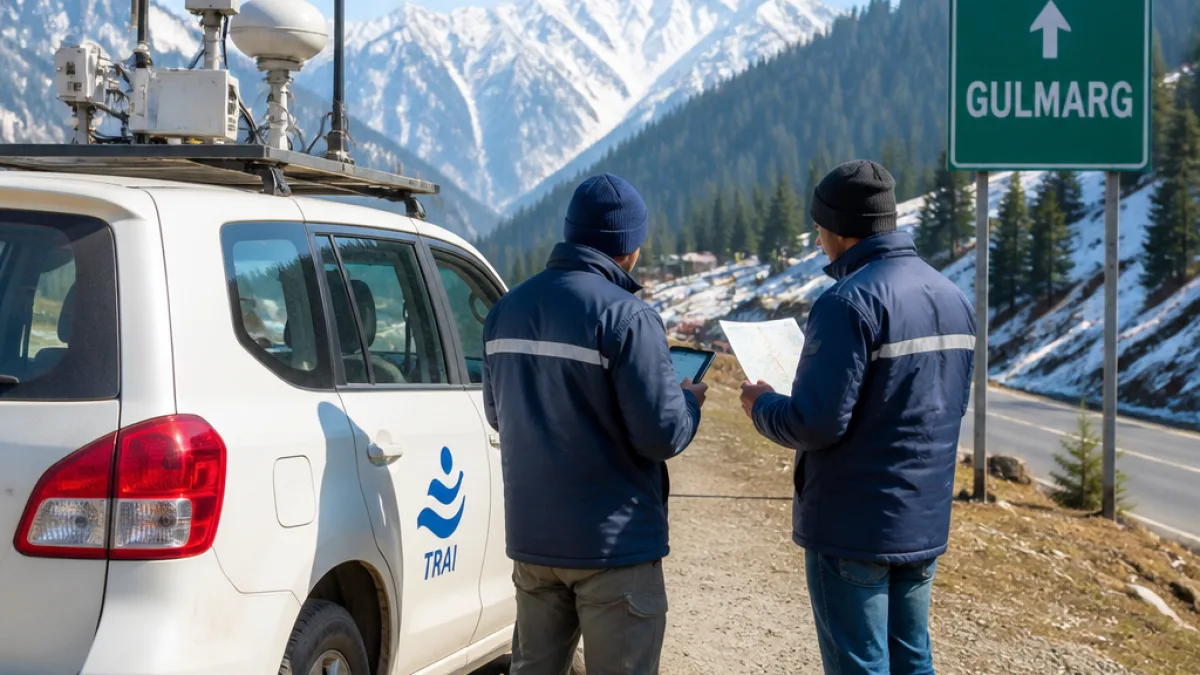
The Telecom Regulatory Authority of India (TRAI) has completed Independent Drive Tests (IDTs) to assess the real-time quality of mobile network services across several locations and routes in Jammu and Kashmir, officials said on Tuesday. The exercise, conducted in June 2026 under the Jammu and Kashmir Licensed Service Area (LSA), examined live voice and data sessions over 2G, 3G, 4G and 5G services.
TRAI's tests covered urban and tourist environments and public transport corridors. Areas listed in the official statement included Srinagar city, Gulmarg, Anantnag, Pahalgam, the Srinagar–Pahalgam Highway and the Srinagar–Gulmarg Highway. The authority said the testing was intended to provide telecom consumers with an independent view of on-ground network performance across different usage scenarios.
"The assessment was carried out through Independent Drive Tests (IDTs) during June 2026 under the JK Licensed Service Area (LSA), covering Srinagar city, Gulmarg, Anantnag, Pahalgam, the Srinagar–Pahalgam Highway and the Srinagar–Gulmarg Highway."
During the IDTs, evaluators used SIM cards belonging to all telecom service providers (TSPs) operating in the LSA to run live voice calls and data sessions while traversing the designated routes. Officials said the approach allowed comparison of network performance across differing environments, such as crowded urban centres, tourist hotspots and road corridors used by commuters and visitors.
- Scope: Live voice and data measurements across 2G–5G networks.
- Coverage: Urban centres, tourist destinations and highways in the Jammu and Kashmir LSA.
- Outcome: IDT findings shared with respective telecom service providers for remedial action.
TRAI emphasised that the exercise is part of its mandate to inform consumers about comparative network performance and to prompt service providers to address deficiencies. The regulator, constituted in 1997 under the Telecom Regulatory Authority of India Act, functions as an independent statutory body for the telecom and broadcasting sectors.
Officials confirmed that the IDT results have already been communicated to the concerned TSPs for necessary corrective measures. No timetable or detailed list of provider-specific shortcomings was released in the initial statement. The regulator typically follows up such exercises with regulatory engagement and may require service providers to submit rectification plans depending on the deficiencies identified.
Local implications for Jammu residents and travellers
While the published list of locations did not explicitly name Jammu city, the findings are relevant to Jammu residents who travel across the union territory on highways or visit tourist centres covered in the survey. Mobile service quality on inter-city routes and in tourist pockets affects emergency response, tourism activities, digital payments and daily communications for locals and visitors alike.
| Area / Route | Primary focus of testing |
|---|---|
| Srinagar city | Urban voice & data performance |
| Gulmarg & Srinagar–Gulmarg Highway | Tourist hotspot and corridor connectivity |
| Anantnag, Pahalgam & Srinagar–Pahalgam Highway | Rural / tourist corridor voice & data tests |
Consumer advocacy groups and local stakeholders often rely on TRAI's independent assessments to press for network improvements. The authority's disclosure that results were forwarded to telecom operators signals a regulatory push to ensure on-ground gaps are addressed, but residents will await more detailed public reporting to understand specific provider-level performance.
TRAI's IDTs form part of a broader framework of monitoring and enforcement. In past assessments nationwide, the regulator has used drive tests to benchmark voice quality, data throughput, call drops and network availability; similar metrics are likely to have been part of the recent Jammu and Kashmir exercise, although TRAI's statement did not publish the numerical scores or rankings.
For Jammu users and stakeholders, the next steps will centre on whether telecom operators publish improvement plans and on TRAI releasing a detailed public report. Until then, consumers are advised to log persistent network issues through provider grievance channels and the regulator's consumer portals so problems can be tracked alongside the IDT findings, officials said.