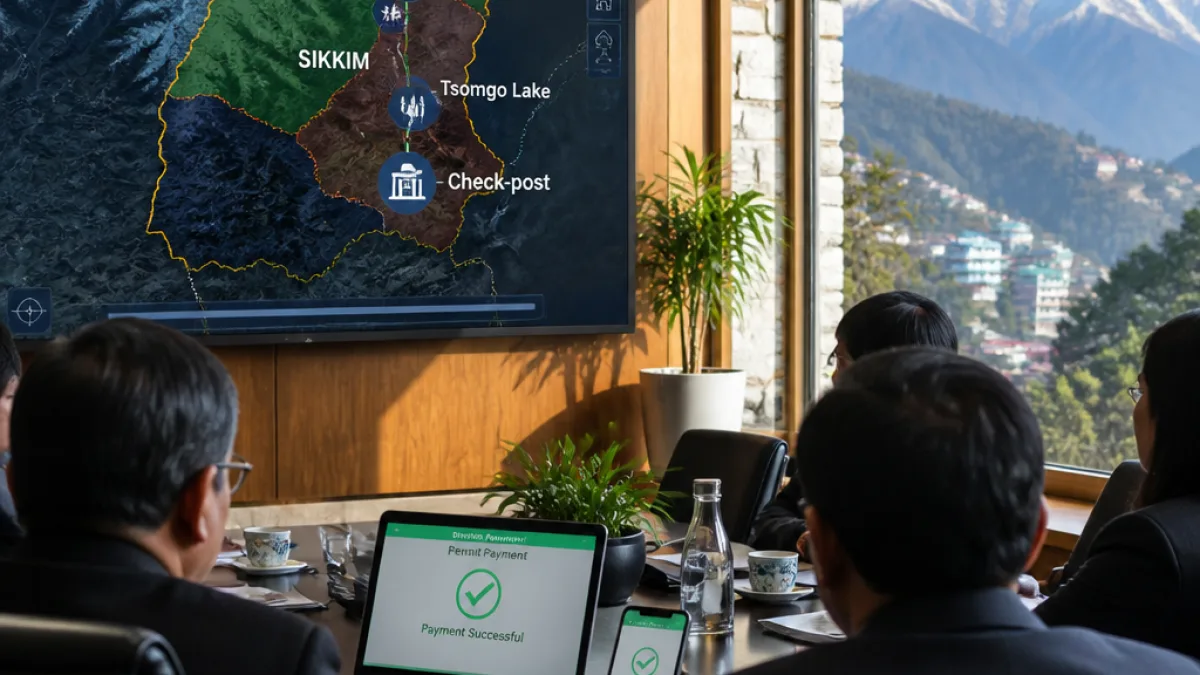
Gangtok, Sikkim: The Sikkim government has initiated plans to roll out an AI-powered, single-window online permit system to manage travel permits to restricted and protected areas of the state, officials said. The move is aimed at digitising and streamlining the issuance of permits for destinations such as Nathu-la, Tsomgo (Chhangu) Lake, the Baba Mandir and locations in north Sikkim that currently require special permissions.
Proposal discussed with tourism stakeholders
The plan was explained at a meeting held on August 5 convened by the state tourism and civil aviation minister T. T. Bhutia, where representatives from the tourism industry reviewed the new system. A follow-up meeting is scheduled for August 18 in the presence of the Chief Minister, according to officials who attended the discussion.
Officials said the portal will be a geofenced platform restricted to in-state access, enabling only Sikkim-registered travel agencies to generate permits by using designated IP addresses. The system will combine application submission, integrated online payments and real-time application tracking, aiming to replace the current manual process handled through department offices and police check-posts.
Features and operational details
According to the presentation made at the meeting by Raj Kumar Yadav, commissioner-cum-secretary of the department, the portal will incorporate several operational modules, including permit generation and synchronisation, vehicle arrival and check-post processing, and exit verification.
“The platform will be geofenced within Sikkim, using restricted IP addresses so that only Sikkim-registered travel agencies could generate permits,”
Officials also said the system will include an automated notification feature that ensures tourists settle package fees with local operators before a permit is issued. Further, vehicle-related rules will be made more flexible: drivers will be able to select an appropriate mode of transport based on real-time weather and terrain data, which the portal will factor into clearance decisions.
Current practice and intended benefits
At present, Restricted Area Permits (RAPs) and Protected Area Permits (PAPs) are processed by departmental offices and police check-posts. The proposed portal aims to provide a transparent, faster and traceable mechanism for permit issuance, reducing paperwork and on-site delays that can affect itinerary planning for tourists and operations of local travel agencies.
- Who can generate permits: Sikkim-registered travel agencies via restricted IP access.
- Areas covered: Nathu-la, Tsomgo (Chhangu) Lake, Baba Mandir and north Sikkim.
- Key modules: Application tracking, integrated payments, vehicle arrival/check-post processing, exit verification.
Security and administrative considerations
Officials framed the portal as a measure that balances facilitation of tourism with security and environmental safeguards, given Sikkim’s proximity to the China border and the sensitive nature of many restricted locations. By limiting permit generation to registered local agencies and tying issuance to payment confirmation and vehicle verification, the administration expects tighter control over movements into restricted zones.
While technical and operational specifics — such as exact timelines for rollout, data protection measures and contingency processes for visitors without in-state access — were discussed in outline during the meeting, officials said further details will be finalised at the August 18 meeting with the Chief Minister.
Implications for tourists and local operators
Travel agents and tour operators who rely on permit-based itineraries welcomed the prospect of a faster digital system but emphasised the need for clear guidelines, training and a reliable helpdesk during the transition. For independent travellers, the geofencing and agency-only permit generation means they will continue to depend on authorised local operators to secure clearances.
Officials said the portal’s integration of weather and terrain data into vehicle selection is intended to reduce safety risks on high-altitude routes, while automated notifications are expected to help ensure better compliance with local tourism regulations and package payments that support the state’s small-scale operators.
| Permit Type | Current Issuing Authority | Planned Portal Function |
|---|---|---|
| RAP / PAP | Department offices / Police check-posts | Online application, tracking, payment integration, exit verification |
Further operational guidelines and a detailed timeline are expected after the next stakeholder meeting. The state government has positioned the portal as a step towards modernising permit processes while preserving security and aiding local tourism businesses.
Correspondent reporting from Gangtok.