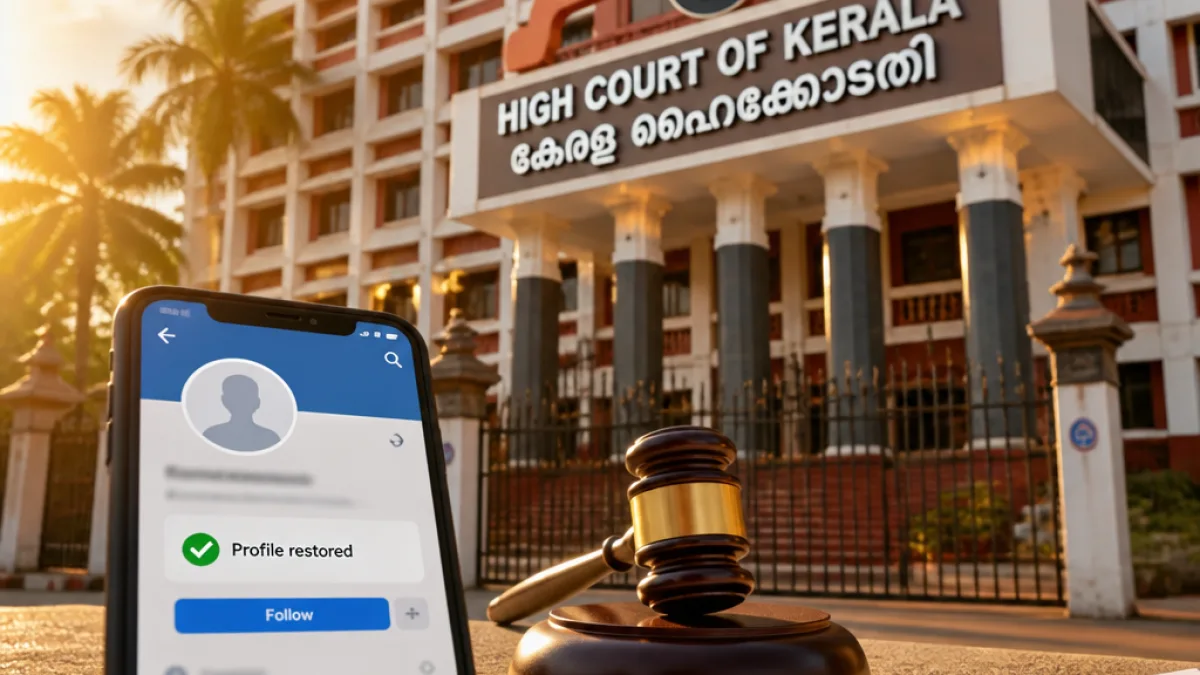
Thiruvananthapuram — The Kerala High Court on Tuesday directed the grievance officer at Meta to restore the Facebook account of journalist N. Madhavankutty, observing that authorities cannot ask social‑media companies to disable an entire account on the basis of a few objectionable posts.
Bench allows targeted removal of content, not blanket ban
Justice Ziyadh Rahman told the Meta grievance officer in charge of the matter to re-enable Mr. Madhavankutty’s profile while noting that competent police officers under the Director General of Police, Vellayambalam, retain the power to identify and seek removal of specific posts that may affect state security or public interest.
The court said that if such content is identified, the grievance officer could temporarily disable access to that particular material without prejudicing the overall functioning of the journalist’s account, the reported order said.
“If there was any objectionable content that affected the security of the State or against public interest, the police could issue instructions to block the same. But the police exceeded their powers by blocking the entire account,” the court observed.
Background and procedural posture
The petition was filed after Facebook blocked Mr. Madhavankutty’s account on instructions from the Kerala Police. The court examined whether the police action that led to the deletion of the journalist’s entire profile fell within lawful authority.
Rejecting the broader exercise of power, the bench held that ordering a complete blockage of a social‑media account exceeded the scope of what the police may lawfully request from an online intermediary.
Implications for platform compliance and policing
The ruling emphasises a distinction between:
- removal or restriction of specific content identified as problematic, and
- complete deactivation of a user’s account.
According to the judgment excerpt, the court instructed Meta’s grievance officer to act in a calibrated manner: remove or restrict only content identified by a competent police authority as objectionable, while ensuring the account’s other functions remain intact.
| Issue | Court direction |
|---|---|
| Blocking entire account | Not permitted when based on police instruction without admissible grounds |
| Blocking specific content | Permissible on lawful identification by competent police officer |
| Role of grievance officer | Restore account; temporarily restrict only flagged content if lawful |
Reactions and wider context
The order touches on continuing debates over platform liability, intermediary guidelines and state action in the digital sphere. While the court permitted the police to seek removal of content that impacts state security or public interest, it restricted blanket measures that silence an entire account.
Legal observers and digital‑rights advocates routinely argue for clear procedural safeguards when state agencies seek content restrictions. The HC’s directive reinforces the need for specificity in any request that curtails online expression, the judgment indicates.
What this means for journalists and users
For media professionals and social‑media users in Kerala, the ruling provides a precedent limiting the scope of police requests to online intermediaries. Platforms operating in India will likely need to ensure that any action on user profiles in response to government requests is narrowly tailored and supported by competent identification of offending material.
The court’s instructions place emphasis on the grievance redressal mechanism within platforms: officers tasked with handling notices should carefully distinguish between content‑level takedowns and account‑level deactivations, restoring access where the latter is unjustified.
The case will be watched for further hearings or clarifications that could set a broader standard for interaction between law‑enforcement agencies and social‑media companies in Kerala.
Anand Menon reports from Kerala.