Tarkhola / North Sikkim, Residents and activists from Sikkim and West Bengal undertook a four-day march to highlight environmental and social concerns over hydropower projects on the Teesta River, the largest river flowing through Sikkim. The action, led by the community group Affected Citizens of Teesta (ACT), brought together 19 participants on foot from Dzongu and allied supporters to press for protection of the river and surrounding landscapes.
Grassroots mobilisation and cultural symbolism
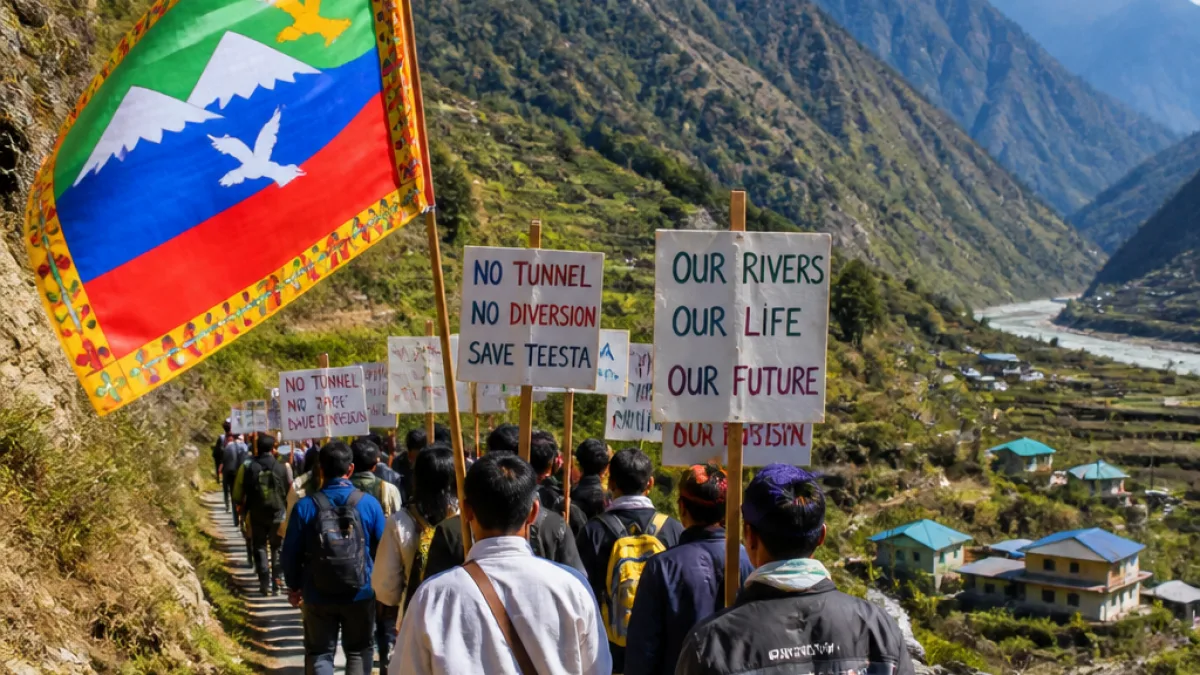
The march combined environmental advocacy with cultural expression. Participants repeatedly invoked the Lepcha interjection “Aachulay!”, a word used to celebrate life and mark solemn occasions, here repurposed as a cry of resistance. Marchers carried a flag with local motifs — the hill partridge (Kohom-Fo), Mount Khangchendzonga and paddy straws — and slogans addressing the perceived harms of hydropower construction.
“Aachulay!”
Placards bore messages such as “Flooded Future”, “Our Rivers, Our Responsibility”, “Every Tunnel Leaves a Wound” and “Let Our Teesta Flow Freely”, signalling concern about tunnel construction, river diversion and ecological disruption associated with hydroelectric projects.
Roots of the movement
The march forms part of a resistance that, according to the reporting, spans approximately two decades. ACT originated in Dzongu — a forested mountain region in North Sikkim — and has organised campaigns, protests and public outreach to raise awareness of project impacts on riverine ecosystems, livelihoods and cultural sites.
Members of the Sikkim Bhutia Lepcha Apex Communities (SIBLAC), a regional political party, joined the march in solidarity, along with other individuals who lent support for the cause and helped amplify the demonstrators’ demands as they moved towards West Bengal.
Concerns articulated by marchers
While the group’s statements during the walk emphasised a desire to preserve the Teesta’s uninterrupted flow, their placards and chants focused on specific themes that have animated local opposition to hydropower development:
- Ecological risks from tunnelling and river diversion.
- Threats to local livelihoods and traditional sites.
- Demand for free-flowing river stretches and community rights over river management.
| Element | Meaning / Message |
|---|---|
| “Aachulay!” | Life-affirming Lepcha interjection used here as a chant of resistance |
| Flag symbols | Kohom-Fo (hill partridge), Mount Khangchendzonga — cultural and ecological identity |
| Placard slogans | Calls to protect river flow, highlight tunnelling impacts and future flood risk |
Regional implications and public interest
The Teesta flows from Sikkim into West Bengal, making river management decisions and hydropower projects in Sikkim of cross-border relevance. The marchers’ route into West Bengal was intended to draw broader public and administrative attention to the consequences of hydropower development beyond state boundaries.
For communities in Dzongu and other riparian areas, the debate encompasses environmental, cultural and economic dimensions. Opposition groups argue that large-scale hydropower infrastructure can change river morphology, affect fish and other aquatic life, increase landslide and flood vulnerability, and alter access to sacred and livelihood sites.
What the action seeks
By undertaking the trek, ACT and allied participants sought to:
- Publicise long-standing local grievances against project impacts.
- Mobilise solidarity across communities and political formations.
- Press state and central authorities to consider ecological flows, social safeguards and alternative approaches to energy planning.
The march underscores an ongoing negotiation in Sikkim between the perceived need for renewable energy development and demands for stronger environmental protection and community participation in decision-making.
As the mobilisation continues to attract attention, authorities and project proponents may face increased pressure to address community concerns over the Teesta’s future. The movement’s cultural framing — linking ecology with Lepcha symbols and language — reflects the deep local connection to the river that underpins the protesters’ claims.
Further developments, including official responses or follow-up actions by ACT and allied groups, were not reported in the original account.