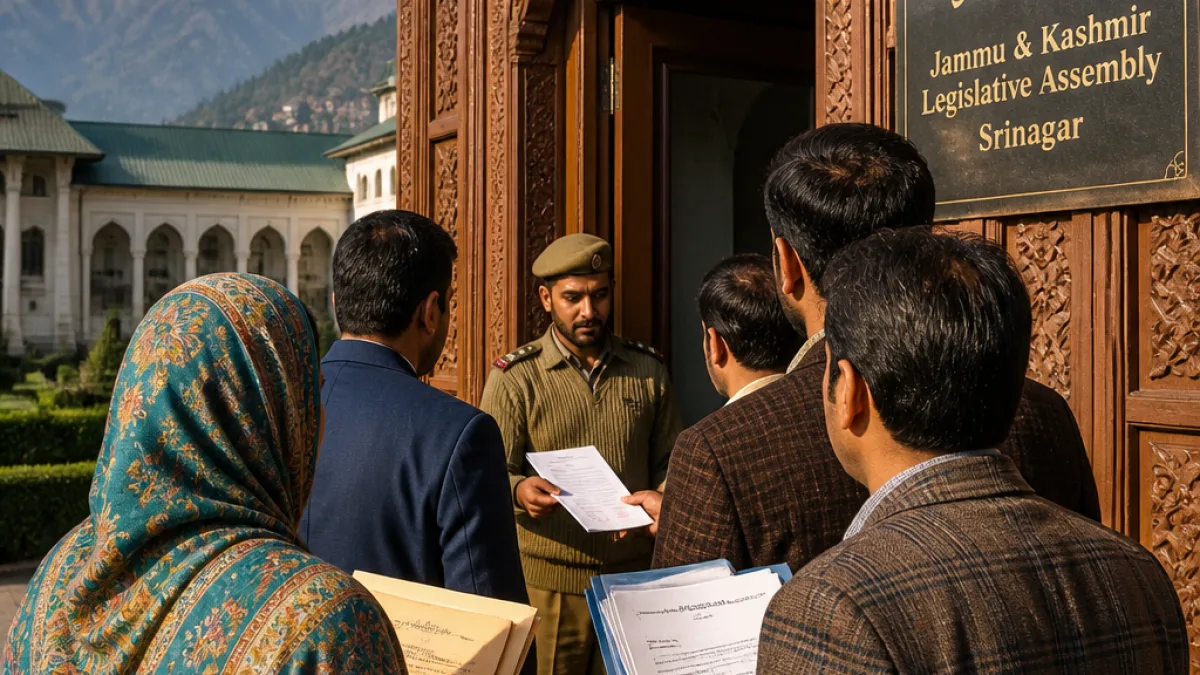
SRINAGAR, July 31: A delegation of the J&K RTI Movement (RTIM) and Climate Action Group-JKCAG on Friday called on Assembly Speaker Abdul Rahim Rather to press for suspension of ongoing eviction drives by the Forest Department, asserting that the Forest Rights Act, 2006 (FRA) has been extended to Jammu and Kashmir and should protect forest-dwelling communities.
Delegation raises legal and implementation concerns
The delegation, led by Dr Raja Muzaffar Bhat and accompanied by Mushtaq Ahmad Lone, District Coordinator RTI Movement Budgam, submitted a memorandum to the Speaker outlining their contention that the Forest Department is invoking the Indian Forest Act, 1927 and relying on a 2020 High Court order in SAVE v/s J&K Govt and others (dated 3 September 2020) to carry out evictions.
“Forest Rights Act 2006 which was extended to Jammu & Kashmir around 6 years back ... is a pro people legislation that gives legal protection to forest dwellers like Gujjars, Bakarwals, Chopans, Kashmiri or Dogri people living in the forest area for more than 75 years,” said Dr Raja Muzaffar Bhat, according to a press release.
The memorandum, as described by the delegation, argued that the FRA has an overriding effect on other forest laws and must be implemented through the J&K Tribal Affairs Department, which is the nodal agency for the Act’s rollout.
Background: petitions and court orders
The delegation noted that the petition in the J&K High Court was filed by the NGO SAVE in 2017, before FRA was extended to Jammu and Kashmir. They said the eviction order pronounced in September 2020 did not account for the later extension of FRA, and that the High Court had not been updated about the change in law.
They warned that, instead of operationalising the FRA to secure rights for communities traditionally living in forests, the Forest Department has continued to issue eviction notices under the provisions of the Indian Forest Act, 1927.
Communities mentioned and scope of concern
The memorandum specifically referenced groups that the delegation said are vulnerable to the evictions: Gujjars, Bakarwals, Chopans and other local people of Kashmiri and Dogri origin residing in forest areas for generations. The delegation claimed the FRA should protect individuals and communities who have resided in forests for over 75 years.
- Delegation: J&K RTI Movement (RTIM) and Climate Action Group-JKCAG
- Leaders: Dr Raja Muzaffar Bhat; Mushtaq Ahmad Lone
- Official met: Assembly Speaker Abdul Rahim Rather
- Key laws cited: Forest Rights Act, 2006; Indian Forest Act, 1927
- Court order referenced: SAVE v/s J&K Govt and others, High Court order dated 3 September 2020
| Issue | Claim by delegation |
|---|---|
| Applicable law | FRA 2006 extended to J&K (overrides older forest laws) |
| Current action | Forest Department invoking Indian Forest Act, 1927 and issuing eviction notices |
| Legal challenge history | Petition by SAVE filed in 2017; eviction order pronounced Sept 3, 2020 |
The delegation urged the Speaker to intervene, arguing that the apparent use of the 1927 Act and reliance on pre-FRA judicial orders is violative of the legal protections now available to forest dwellers.
Calls for administrative action
According to the delegation’s account, the Tribal Affairs Department must take responsibility to ensure the FRA is implemented in the Union Territory. They asked that the Speaker use his office to direct concerned departments to review eviction notices and to halt further action until the legal position is clarified and necessary processes under FRA are completed.
The report did not include an immediate reaction from the Forest Department, the Tribal Affairs Department or the High Court registry. The Speaker’s office acknowledged receipt of the memorandum, the delegation said, and took note of the concerns raised.
The development adds to continuing tensions over land and resource rights in parts of Jammu and Kashmir, where questions about statutory protection, administrative implementation and court directions intersect. The delegation’s submission seeks to foreground the legal claim that FRA’s extension confers new protections that should change the course of eviction drives now underway.
Further updates are likely as departments respond to the memorandum and as legal agencies consider whether earlier court directions remain operative in light of statutory changes cited by the delegation.