Srinagar: The Jammu and Kashmir and Ladakh High Court has rejected a petition seeking to quash disciplinary proceedings initiated against a Border Roads Organisation (BRO) engineer accused of receiving financial transfers totalling ₹4.5 lakh from a labourer under his command, the court order showed.
Bench finds no reason to stop preliminary inquiry
Justice Sanjay Dhar said there was no prima facie ground to interfere with the charges at this early stage and permitted the competent authority to carry on with departmental action under the relevant Central Civil Services rules. The judgement in WP(C) No. 1082/2025 was reserved on July 9 and pronounced on August 7, 2026.
The petitioner, identified in court records as Badavath Kishan, an Executive Engineer (Civil) posted with 18 RCC and holding a rank equivalent to Major in the General Reserve Engineer Force (GREF), had challenged a memorandum of charges dated February 27, 2025. The charges were issued under Rule 14 of the Central Civil Services (Classification, Control and Appeal) Rules, 1965.
Allegations concern cash and digital transfers in 2021-22
The disciplinary memorandum alleges that during Kishan's stint as Officer Commanding of 18 RCC, Project Vijayak, from November 2019 to March 14, 2022, he entered into prohibited monetary dealings with a labourer named CPL/Mazdoor Alauddin Ansari, who was deployed at Detachment Hanuthang within the 81 RCC area of responsibility.
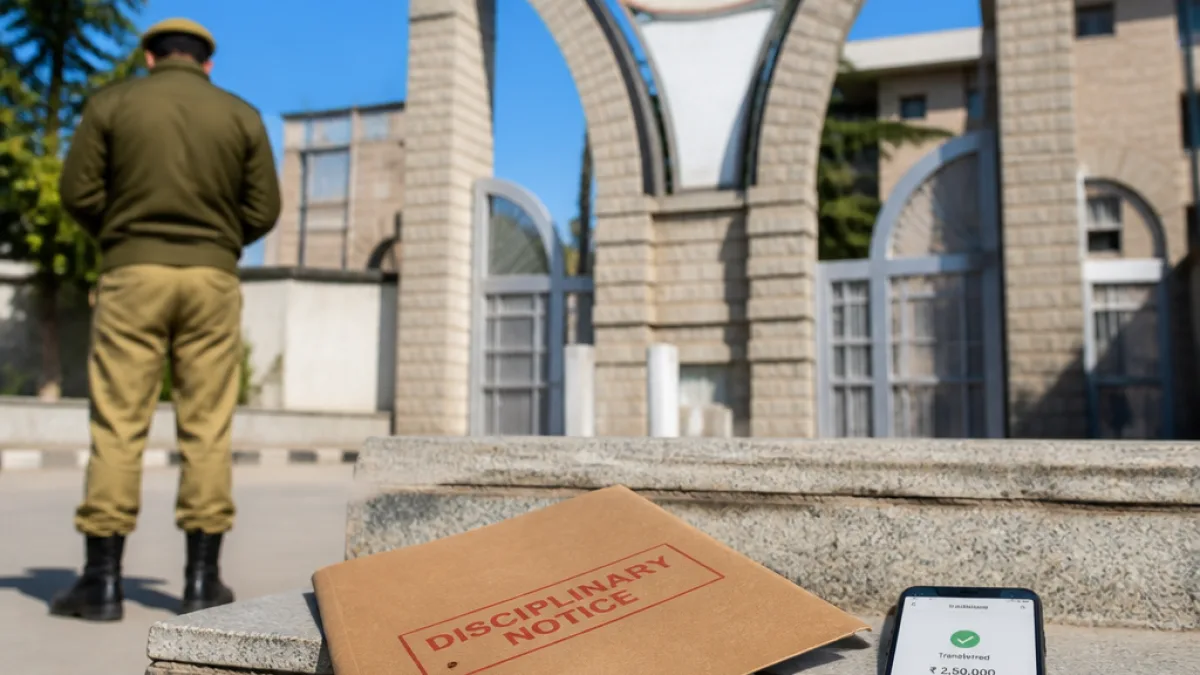
According to the charges, transactions amounting to ₹4.50 lakh were received by Kishan via cash and electronic transfers during 2021-22 in connection with the recruitment of labourers for the 81 RCC area. The authorities said bank statements and other records corroborated the transfers, and cited a specific entry of ₹1 lakh credited to Kishan’s Axis Bank account on June 4, 2021, where the IMPS entry and Unique Transaction Reference were traced to a transfer from Ansari.
Investigators also alleged that another ₹2 lakh was moved in five instalments to two individuals, named in the memorandum as Pulakhandam and Srinivasa Gupta, who were purportedly known to Kishan.
Legal positions and representation
Kishan contested the accusations in his writ petition, while the Union of India opposed the challenge. In court, Kishan was represented by advocates Tapas Das and Syed Faheem Indrabi. The Union was represented by Deputy Advocate General Hakim Aman Ali.
The bench observed that members of the GREF are governed by a dual disciplinary regime and that the competent authority has the jurisdiction to initiate proceedings under the CCS (CCA) Rules, 1965. The court’s order declined to stay the departmental process, effectively allowing the inquiry to proceed.
What the decision means
By refusing to interfere at the preliminary stage, the High Court has left open the disciplinary machinery to examine the allegations and decide on any penalties as per service rules. The ruling underscores that courts may not ordinarily intervene in service matters while the departmental inquiry is pending unless there is demonstrable illegality or patent arbitrariness in the process.
- Case number: WP(C) No. 1082/2025 (judgement pronounced Aug 7, 2026)
- Accused officer: Badavath Kishan, Executive Engineer (Civil), 18 RCC
- Alleged amount: ₹4.50 lakh (cash and digital transfers, 2021-22)
- Legal provision invoked: Rule 14, CCS (CCA) Rules, 1965
Context and implications for BRO units
The BRO and its constituent GREF units operate across difficult terrain and depend on structured recruitment of contractual labour for several projects. Disciplinary checks are a recurrent aspect of maintaining probity in such setups, and the court action highlights the overlap between military-style formations and civilian disciplinary statutes when allegations involve financial impropriety.
With the High Court allowing the inquiry to continue, the next steps will depend on the disciplinary authority’s findings. If any penalty is imposed, avenues for challenge before tribunals and higher courts would remain available to the officer concerned, subject to the applicable statutory framework.
Legal observers say this ruling reaffirms judicial restraint in meddling with preliminary departmental processes unless a clear legal error is shown. The outcome of the internal inquiry will determine whether the matter proceeds to formal punishment or is dropped for lack of evidence.
Further developments in the departmental proceeding and any subsequent legal challenges are expected to be monitored closely given the public interest in accountability within government engineering establishments operating in Jammu and Kashmir.