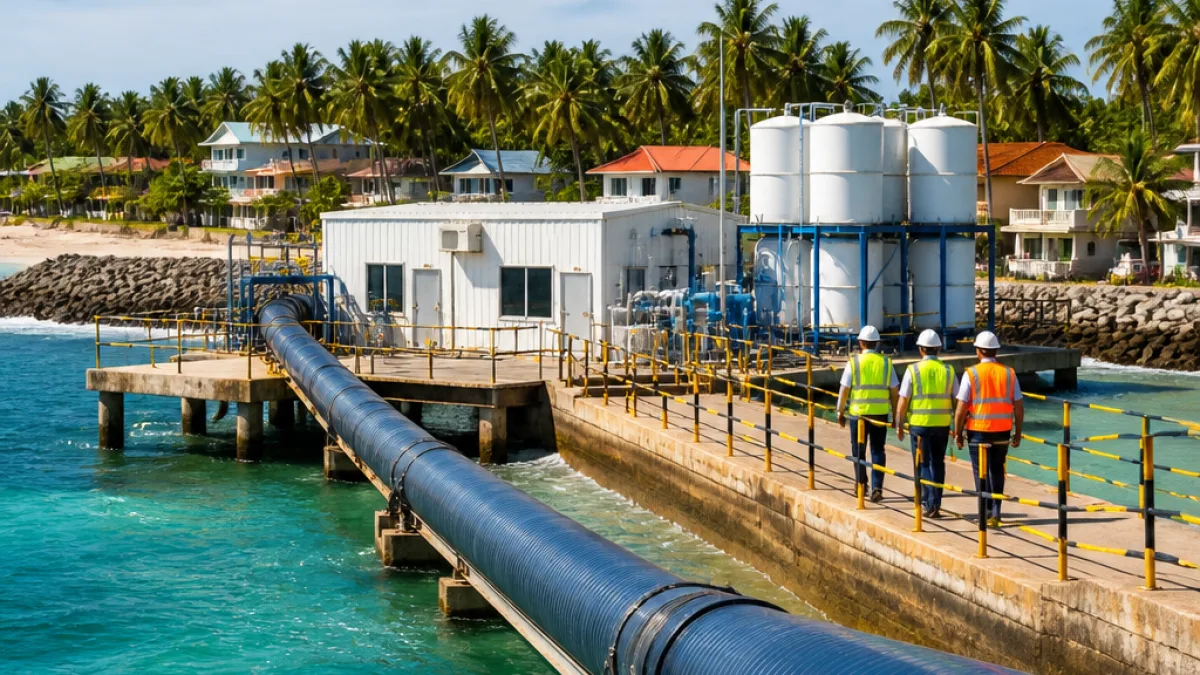
Kavaratti, Lakshadweep: The Union government is establishing a first-of-its-kind integrated Ocean Thermal Energy Conversion (OTEC)-powered desalination plant on Kavaratti island that will simultaneously convert seawater into potable water and generate electricity, Union Earth Sciences Minister Dr Jitendra Singh said on Friday.
Pilot project details and objectives
Speaking after a progress review of the pilot facility, Dr Singh said the plant is designed to supply about one lakh litres of drinking water daily and produce 60 kilowatts of electricity. The electricity generated will fully power the desalination system, making the installation self-sustaining and independent of diesel or grid supply, he said.
"This pilot project will eventually supply approximately one lakh litres of drinking water daily while also producing 60 kilowatts of electricity," Dr Jitendra Singh said in remarks carried by Akashvani News.
The plant uses the ocean's natural thermal gradient — warmer surface water and colder deep water — to drive a thermodynamic cycle that produces electricity and, in an integrated arrangement, desalinated freshwater. Officials have characterised the project as the country's inaugural OTEC-powered desalination facility.
Why the project matters for Lakshadweep
Lakshadweep currently relies almost entirely on diesel generator sets for electricity, a dependency that raises both operating costs and environmental concerns. The OTEC-desalination pilot aims to provide a cleaner alternative by harnessing renewable ocean energy and reducing fuel consumption on the island.
- Projected daily freshwater output: 1,00,000 litres
- Projected power generation: 60 kW
- Operational model: Electricity produced will power the desalination plant, enabling disconnect from diesel reliance
Local administrators and project engineers have highlighted the potential for OTEC systems to offer steady baseload power in island environments where solar and wind can be intermittent. If successful, the pilot could inform similar deployments across other islands and coastal regions.
Technical and environmental considerations
OTEC technology exploits a relatively stable temperature difference between surface and deep seawater. Integrated desalination systems are designed so that the electricity generated runs the pumps and treatment units, reducing external energy inputs. Proponents say this arrangement can lower lifecycle greenhouse gas emissions compared with diesel-run desalination systems.
At the same time, OTEC installations require careful engineering to manage deep-sea water intake and discharge, and to avoid unintended ecological impacts. The minister's statement framed the Kavaratti plant as a pilot — a phase intended to test performance, reliability and environmental compatibility before any scale-up.
Prospects and next steps
Dr Singh's review indicates central-government oversight of the pilot. The statement did not specify timelines for commissioning, capital cost, operational partners or the agencies responsible for long-term maintenance. Officials have previously described such pilots as essential for assessing viability in local conditions.
| Parameter | Projected figure |
|---|---|
| Daily potable water output | 1,00,000 litres |
| Electricity generation | 60 kW |
| Primary energy source | Ocean thermal gradient |
Local residents and administrators will be watching the pilot's operational performance, cost-effectiveness and maintenance needs closely. If the plant reliably supplies water and electricity as projected, it could reduce diesel imports and lower generation costs for the island's utilities.
Further announcements on commissioning dates, implementing agencies and performance benchmarks are expected as the project moves from the construction and testing phases to operation. Central and local authorities will need to coordinate on operations, maintenance and monitoring to ensure the plant meets potable-water and power standards without adverse environmental effects.
For now, the Kavaratti OTEC-desalination pilot stands as a test case of a renewable, ocean-based solution to two chronic island challenges: freshwater scarcity and diesel-dependent power generation.