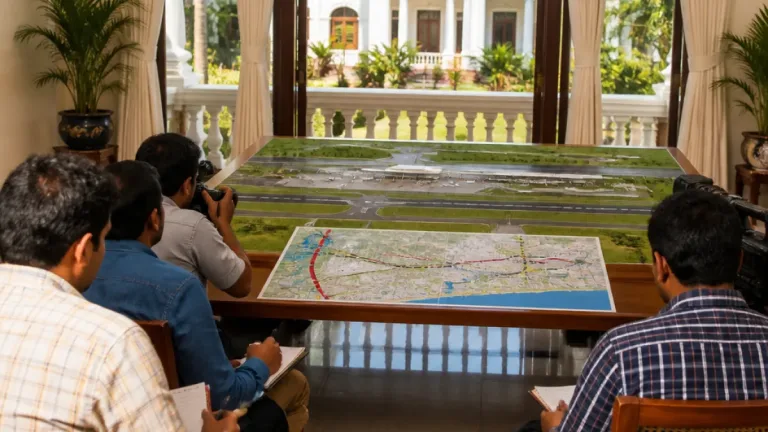

Kavaratti — The Lakshadweep Town and Country Planning and Development Regulation, 2026, unveiled this year, is being framed by the administration as a blueprint for sustainable development, tourism and environmental protection in the island Union Territory. Legal experts and community stakeholders, however, say the Regulation vests broad powers in the executive and raises serious constitutional and democratic concerns.
Executive authority and planning powers
The Regulation authorises the Government and the Lakshadweep Administrator to take a range of planning decisions, including declaring and reconfiguring planning areas, constituting Planning and Development Authorities, approving or modifying Regional and Master Plans, directing preparation of fresh plans and suspending Master Plans during emergencies. It also permits withdrawal of revised Regional Plans after they have come into force.
Those measures, while framed as administrative tools for efficient governance, have prompted apprehension among legal commentators who say the language of the law concentrates discretion in the executive without clear checks.
Concerns over local self-governance and property rights
Observers note that the Regulation could weaken institutions of local self-governance on the islands. The breadth of executive discretion in altering planning areas and directing plan preparation has been flagged as potentially sidelining locally elected or representative bodies in land-use decisions. Critics argue that such centralised authority risks impacting customary land arrangements and long-standing community rights.
Legal experts also point to possible implications for property rights and the indigenous communities of Lakshadweep. The Regulation’s provisions on plan modification and plan withdrawal, coupled with executive powers to intervene in land-use regimes, are viewed as creating uncertainty over tenure security for residents and businesses.
Judicial remedies and constitutional questions
Another strand of concern centres on access to judicial relief. Counsel and constitutional commentators read parts of the Regulation as limiting the scope of judicial review or delaying redress, potentially infringing on the Right to Constitutional Remedies that is central to constitutional jurisprudence. The ultimate legal test, they say, will depend on interpretation and implementation in the courts.
These constitutional questions include whether executive directives under the Regulation can be subjected to ordinary standards of judicial scrutiny, and whether procedural safeguards for those affected by planning decisions are sufficiently robust.
Administration’s public stance
The Regulation is being promoted by the administration as a landmark legal framework to channel development in the islands. Visuals published alongside the Regulation’s release showed the Lakshadweep Administrator Praful Khoda Patel with the Prime Minister, underscoring the central government’s involvement in the policy push. Official communications emphasise objectives such as planned urbanisation, environmental protection and tourism promotion.
Local reactions and practical implications
Among islanders and civil society groups, reactions have been mixed. Supporters welcome a unified planning code that could facilitate infrastructure and economic activity. Critics, including community advocates and legal analysts, caution that the balance between development and protection of local rights may be skewed if decision-making remains highly centralised.
Practically, the Regulation could affect:
- How land is zoned and redeveloped across inhabited islands.
- Roles of local bodies in plan-making and implementation.
- Ability of residents to seek timely judicial review of planning actions.
| Provision | Concerns flagged |
|---|---|
| Declaration and reconfiguration of planning areas | Centralised discretion may override local preferences |
| Power to approve/modify Regional and Master Plans | Unclear safeguards for affected communities |
| Authority to withdraw or suspend plans | Creates tenure and legal uncertainty |
Way forward
Legal observers note that while the Regulation’s text raises significant questions, many of the practical outcomes will hinge on the rules framed under the law, the processes followed in plan-making, and judicial interpretation. Remedies could include greater procedural safeguards, clear avenues for local participation and explicit provisions to preserve access to courts.
For residents and stakeholders in Lakshadweep, the Regulation marks a pivotal moment: the islands’ future land-use framework is now set to be determined by a law that centralises planning power. Its effects on property rights, indigenous practices and local governance will be closely watched in the coming months, likely culminating in litigation and parliamentary or administrative scrutiny.
Reporting from Kavaratti.