
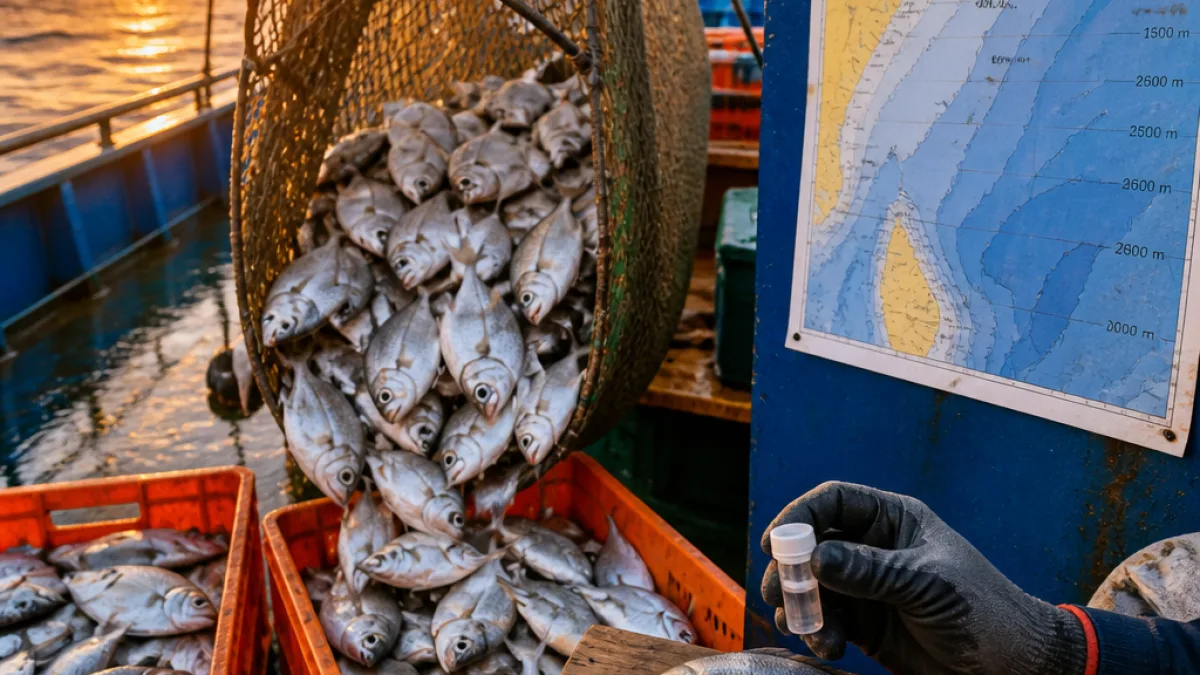
Marine researchers have identified a new species of deep‑sea fish from the eastern Lakshadweep Sea, describing it as distinct on both anatomical and genetic grounds. The species, named Cyttopsis indica — commonly referred to as the Indian dory — was recognised from specimens collected by commercial trawlers and examined in laboratory studies, the research team reported.
Where and how the specimens were found
The fishes were landed at the Sakthikulangara Fisheries Harbour in Kerala after being caught by commercial trawlers operating along the continental slope of the eastern Lakshadweep Sea. Fishing depth for the specimens ranged between 350 and 500 metres, the researchers said, placing the species within the ocean’s twilight (mesopelagic) zone.
The initial catches resembled other known dory species, but closer inspection revealed consistent differences that prompted a comprehensive taxonomic study combining classical morphology and molecular analysis.
How Cyttopsis indica differs from its relatives
- Anal fin spines: presence of two hard spines in the anal fin.
- Lateral line scales: a specific count of 68 to 78 scales along the lateral line.
- Colouration: uniform rosy to silvery pink, lacking the prominent black spot seen in some Pacific relatives.
- Head proportions: broader space between the eyes (interorbital region) and a relatively shorter head posterior to the eyes compared with Atlantic cousins.
To verify the distinctiveness of the species, the team applied integrated taxonomy — pairing morphological examination with DNA barcoding. Molecular data showed genetic differences of between 4.6% and 11% from its closest known congeners, supporting the conclusion that it represents a separate species.
| Feature | Cyttopsis indica (Indian dory) | Closest relatives (general) |
|---|---|---|
| Anal fin spines | Two hard spines | Different count or structure |
| Lateral line scales | 68–78 | Different counts |
| Colour | Rosy to silvery pink (uniform) | Often with prominent black spot (Pacific relatives) |
| Genetic divergence (DNA barcode) | 4.6%–11% | Lower divergence within same species |
Scientific and local significance
The researchers said naming the fish indica honours its occurrence in the Indian Ocean. The finding highlights the degree of cryptic biodiversity in deeper waters off India and suggests that more undiscovered species may inhabit the mesopelagic and upper bathypelagic zones adjacent to the Lakshadweep Sea.
Specimens were obtained through routine commercial operations rather than targeted scientific sampling, underscoring the value of collaborations and reporting between fishers and marine research institutions for documenting biodiversity in underexplored habitats.
Implications for fisheries and conservation
While the immediate conservation status of Cyttopsis indica cannot be determined from the recent landings alone, the discovery raises questions about the vulnerability of deep‑sea fauna to commercial trawl operations. The species was retrieved from depths commonly targeted by deep‑water trawling, a practice that can have wide ecological impacts on continental slope communities.
- Further targeted surveys are needed to establish distribution, abundance and life history traits.
- Genetic data provide a baseline for future monitoring of population structure.
- Engagement with fishing communities can help improve reporting of unusual or unfamiliar catches.
The identification of Cyttopsis indica adds to a growing list of discoveries that document India’s still largely unexplored deep‑sea ecosystems. Researchers stressed that continued taxonomic work, supported by molecular methods, is essential to fully map the region’s marine biodiversity and to inform management of deep‑water fisheries.
Reporting for this article is based on the researchers’ published identification and laboratory analyses of the specimens landed at Sakthikulangara.