Haryana continues to grapple with contaminated drinking water in rural areas, with Union Jal Shakti Ministry records showing that 1,698 out of roughly 19,000 samples tested during the 2026-27 financial year were found contaminated. The findings have assumed urgency after recent episodes of serious sickness and reported deaths in villages of Kaithal and Faridabad.
Scope and nature of contamination
Data from the Water Quality Management Information System of the Department of Drinking Water and Sanitation, under the Union Jal Shakti Ministry, indicates that contamination is both microbiological and chemical. Total coliform contamination was detected in samples drawn from 855 villages. Chemical parameters that exceeded permissible limits include total hardness, total dissolved solids (TDS) and fluoride, among others.
| Parameter | Number of samples |
|---|---|
| Total coliform | Across 855 villages (exact sample count not specified) |
| Total hardness | 87 |
| Total dissolved solids (TDS) | 78 |
| Fluoride | 58 |
| Sulphate | 26 |
| Chloride | 23 |
| Total alkalinity | 11 |
| Turbidity | 4 |
| Iron | 3 |
| Nitrate | 2 |
Recent outbreaks and local response
The contamination issue has been highlighted by health incidents in several districts. In Kaithal’s Sajuma village, multiple residents fell ill with hepatitis A and typhoid earlier this month; a suspected death of a minor girl was also reported. In Faridabad and other districts, villagers have suffered serious illness attributed to suspected water contamination.
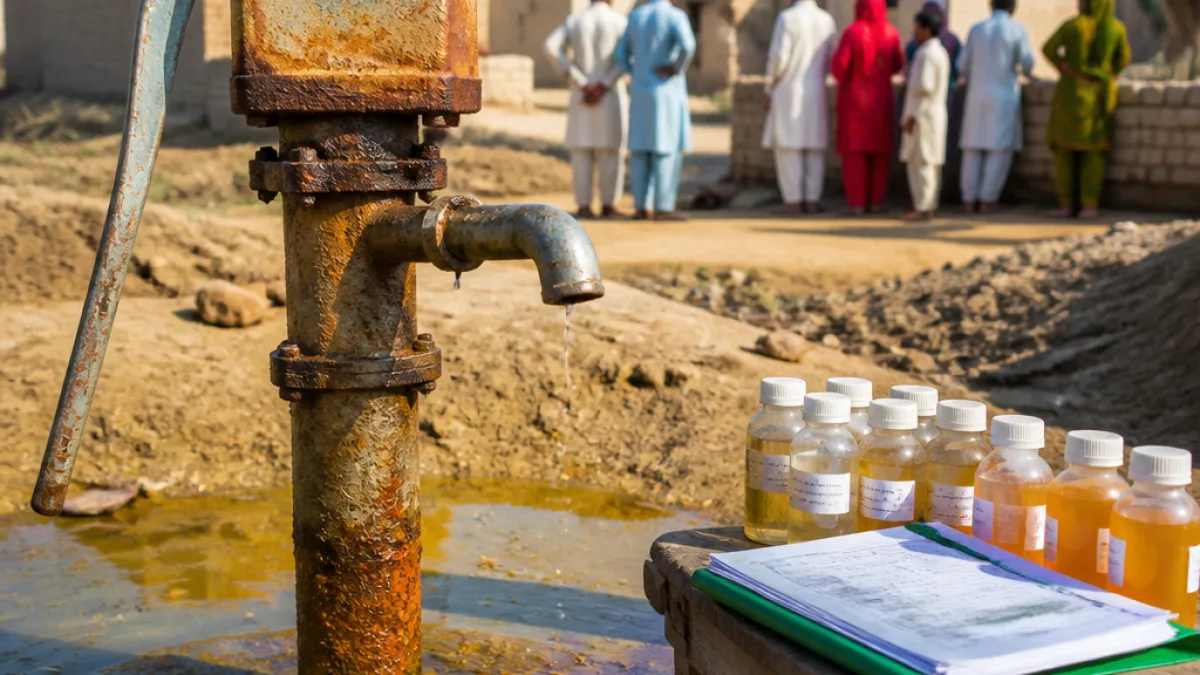
Chanot village in Hisar held a two-month agitation demanding supply from the Bhakra pipeline, accusing the local waterworks of distributing water unfit for consumption. Local leaders and residents have pressed for canal-based water to be prioritised over groundwater sources they say are contaminated.
“The test reports of water from these tubewells have suggested excessive fluoride. But we have no option but to consume this water. The canal-based water supply to feed the waterworks is not sufficient as just the canal water is available for one week in a month,”
The comment was made by a resident of Sajuma, identified in reporting as Anil Saini, who said the village was relying on groundwater when canal supplies were intermittent. He also said that local water supply had been restored and that the situation was under control.
Responding to the Sajuma incident, Kaithal PHED (Public Health Engineering Department) XEN Jagdeep Singh said potable water supply had been restored and that the tubewell identified as the contamination source had been closed.
What the data implies for rural Haryana
The Ministry figures suggest contamination is widespread and varied — affecting microbiological safety (coliforms) as well as chemical quality. The predominance of total coliform detections across hundreds of villages indicates persistent risks of waterborne disease, while fluoride and high TDS point to groundwater quality problems in specific locations.
Practical consequences for affected communities include increased incidence of gastrointestinal and waterborne illnesses, school absenteeism, economic strain on households and pressure on local health services. Villagers in several places are demanding reliable supply of Bhakra canal water to replace contaminated sources, highlighting tensions between surface and groundwater provision.
- Immediate measures reported: Closure of contaminated tubewell(s) and restoration of potable supply in affected villages, according to PHED officials.
- Community actions: Protests and sustained agitations seeking canal water supply from the Bhakra system.
- Ongoing monitoring: State and central agencies maintain water testing through the Water Quality Management Information System.
The Ministry data provides a baseline for planning remedial action, but local officials and residents say supply-side constraints — limited canal water availability and dependence on groundwater — complicate mitigation. Continued testing, timely public communication of results, targeted repairs or treatment at waterworks and expansion of safe piped canal supply are among the measures stakeholders are urging to prevent further outbreaks.