
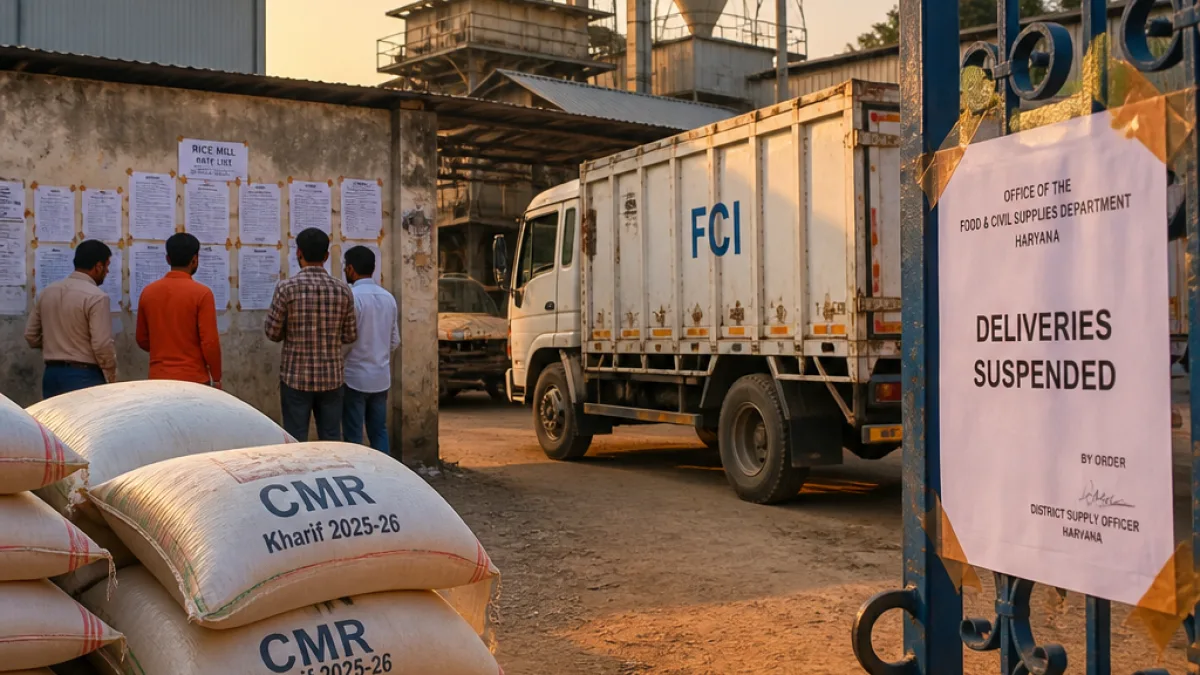
Chandigarh: Confusion has emerged among rice millers and procurement agencies in Haryana after state and central authorities issued seemingly contradictory directions on delivery of custom-milled rice (CMR) produced from paddy procured in the kharif 2025-26 season.
Two orders, opposite effects
In a recent communication, the Directorate General, Food, Civil Supplies and Consumer Affairs, Haryana, instructed all District Food and Supplies Controllers (DFSCs) that the Union government has granted a final extension for milling paddy and delivering CMR to the Central pool till 30 September. The letter directed DFSCs to tell field staff and millers to speed up milling and clear outstanding CMR balances before the revised deadline, while emphasising that no further extension would be granted.
At the same time, a separate letter from the Food Corporation of India (FCI), Regional Office Haryana, advised district managers not to accept rice/CMR deliveries "until further directions from the Regional Office". The FCI communication did not provide a reason for the hold on acceptance.
“The department has extended the deadline,” said an official.
The juxtaposition of an extension to speed up deliveries and a halt on acceptance has created uncertainty across the procurement chain. Millers, some of whom are yet to meet their contracted delivery obligations, and procurement agencies are left unsure whether to continue with logistics and dispatch plans.
Background: scheduled delivery milestones
Under the existing CMR policy for the season, millers were expected to deliver consignments to the central pool according to a staggered schedule. The original timeline stipulated the following delivery percentages by month-end:
- 15% by December-end
- 25% by January-end
- 20% by February-end
- 15% by March-end
- 15% by May-end
- 10% by June-end
Despite these targets, the department acknowledged that a significant quantity of rice remained undelivered to the FCI, prompting notices to defaulting millers and physical verification of mills allocated paddy during procurement.
| Month-end | Planned delivery (%) |
|---|---|
| December | 15% |
| January | 25% |
| February | 20% |
| March | 15% |
| May | 15% |
| June | 10% |
Inspections and notices
Following millers’ requests for an extension, the state department formed multiple teams to conduct physical verifications of mills that had been allotted paddy during procurement. These teams inspected facilities across the state to assess the status of CMR delivery and to verify stock quantities. The department has also issued notices to those millers who failed to meet their delivery targets under the CMR policy.
Officials said the extension to 30 September is being treated as final, signalling that the administration expects pending deliveries to be completed within the revised timeline.
Industry response and immediate concerns
Millers and procurement agents contacted by other outlets expressed concern that the FCI instruction to stop accepting deliveries could render the extension purposeless, as finished rice cannot be handed over to the central agency until the hold is lifted. The absence of an explanation in the FCI letter amplified anxiety among stakeholders, who face potential penalties for non-delivery but also risk warehousing finished stock without an accepted buyer.
- Millers face a deadline of 30 September under the Directorate's order.
- FCI's regional office has temporarily stopped accepting CMR deliveries; reasons were not disclosed.
- State teams have been inspecting mills and issuing notices to defaulters.
Possible implications
The impasse could have operational and financial consequences: millers may incur storage costs and procurement agencies could face logistical bottlenecks. For the central pool, delays in receiving CMR may affect buffer stocking plans ahead of the next procurement season.
At present, the department's letter and the FCI instruction together create a contradictory framework for action. Stakeholders will be watching for follow-up orders from the FCI Regional Office or clarifying instructions from the state Directorate to resolve the uncertainty and enable smooth completion of pending deliveries.
Further developments are expected as district managers await additional guidance and as millers schedule their remaining deliveries under the revised timeline.