
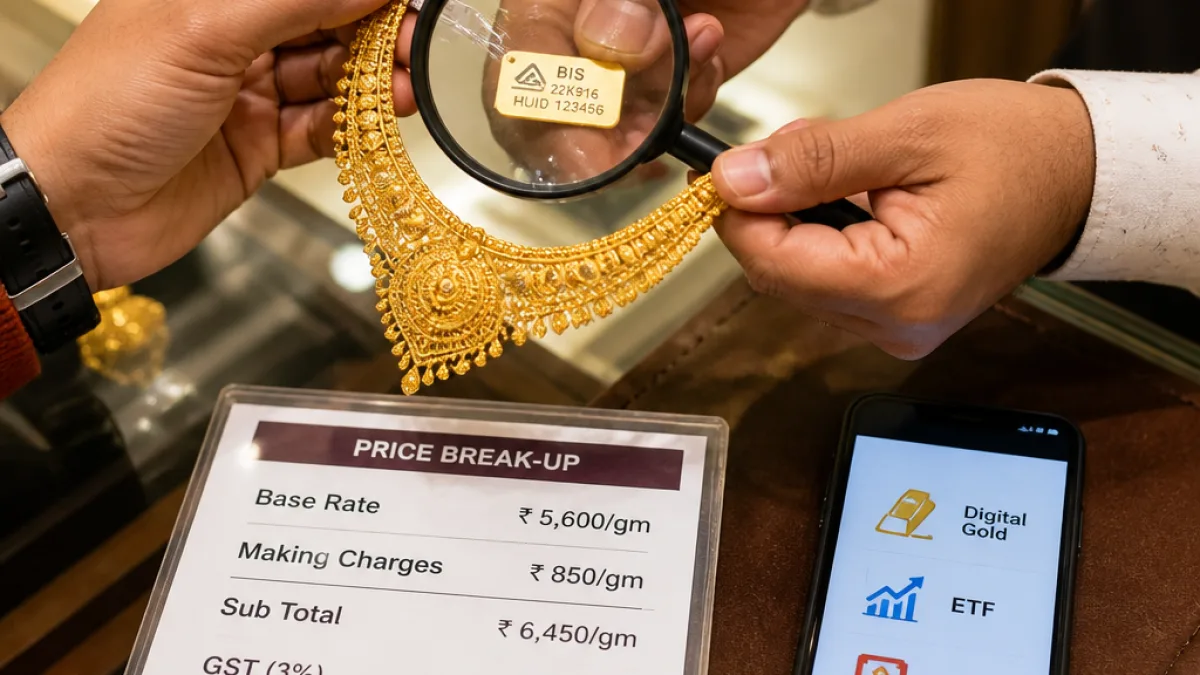
Buyers in Gaya advised to check purity, making charges and KYC rules before purchasing gold
Gaya shoppers purchasing gold jewellery or bars are being urged to pay close attention to purity marks, making charges and the mandatory 3% GST that applies on gold purchases, according to a market explainer circulated by national business information services.
The advisory summarises key points that affect the final showroom price paid by consumers in Gaya: the displayed daily benchmark for gold is only a starting point. The final price typically comprises multiple elements including the base metal rate, additional charges levied by jewellers and statutory taxes.
"Base gold price + making charges (which vary by design and are often negotiable) + 3% GST."
The explainer sets out practical details that local buyers should note before transacting:
- Purity and karat selection — 24K (99.9%) is the purest form and mainly suited to investment in coins and bars; 22K (91.6%) is the standard for traditional Indian jewellery owing to greater durability.
- Making charges — these are applied by jewellers for workmanship and design and are variable. Consumers in Gaya should seek a written breakdown and negotiate where possible.
- GST and taxes — a flat 3% GST is charged on the final price. Buyers should ensure GST is properly invoiced to avoid disputes on resale.
- BIS hallmarking — check for the BIS logo, the purity grade (for example, 916 for 22K) and the six‑digit HUID code which can be verified on the BIS Care app.
- KYC requirements — transactions above specified limits require documentation: PAN is mandatory for purchases exceeding ₹2 lakh; cash purchases over ₹10 lakh require stricter KYC compliance.
Investment alternatives and practicality for small buyers
For residents who wish to invest in gold without incurring making charges or storage concerns, the advisory highlights several paper and digital alternatives available nationally that Gaya investors can access through banks and brokerage platforms.
- Digital gold — enables purchase in small quantities online, sometimes from as low as Re 1, with storage handled by the vendor.
- Gold ETFs and mutual funds — these are liquid paper assets that track the market price of gold and remove the need for physical storage.
- Sovereign Gold Bonds (SGBs) — government securities that pay a fixed annual interest in addition to any capital appreciation of gold.
Those considering non‑physical options should verify the platform’s credentials, charges and the custodial arrangements before investing.
Practical steps for buyers in Gaya
Local jewellers and market observers in Gaya say buyers should take straightforward precautions to avoid overpaying or facing problems during resale or inheritance:
- Ask for a complete invoice showing base price, making charges and GST.
- Look for the BIS hallmark and note the six‑digit HUID for verification.
- Compare making charges across multiple showrooms for the same design.
- Keep PAN and other KYC documents ready for high‑value purchases to ensure compliance.
| Karats | Purity | Common use |
|---|---|---|
| 24K | 99.9% | Investment (coins, bars) |
| 22K | 91.6% (916) | Traditional Indian jewellery |
The advisory also notes tax and gift rules: inherited gold is not taxed until sold, and gifts of gold are tax‑free when received at marriage or from specified close relatives; otherwise, gifts exceeding ₹50,000 in a financial year may be taxable.
With festivals and wedding season driving demand in Gaya, jewellers expect higher footfall. Buyers are advised to prioritise verification and documentation over impulse purchases so that any future sale or transfer can be carried out without dispute.