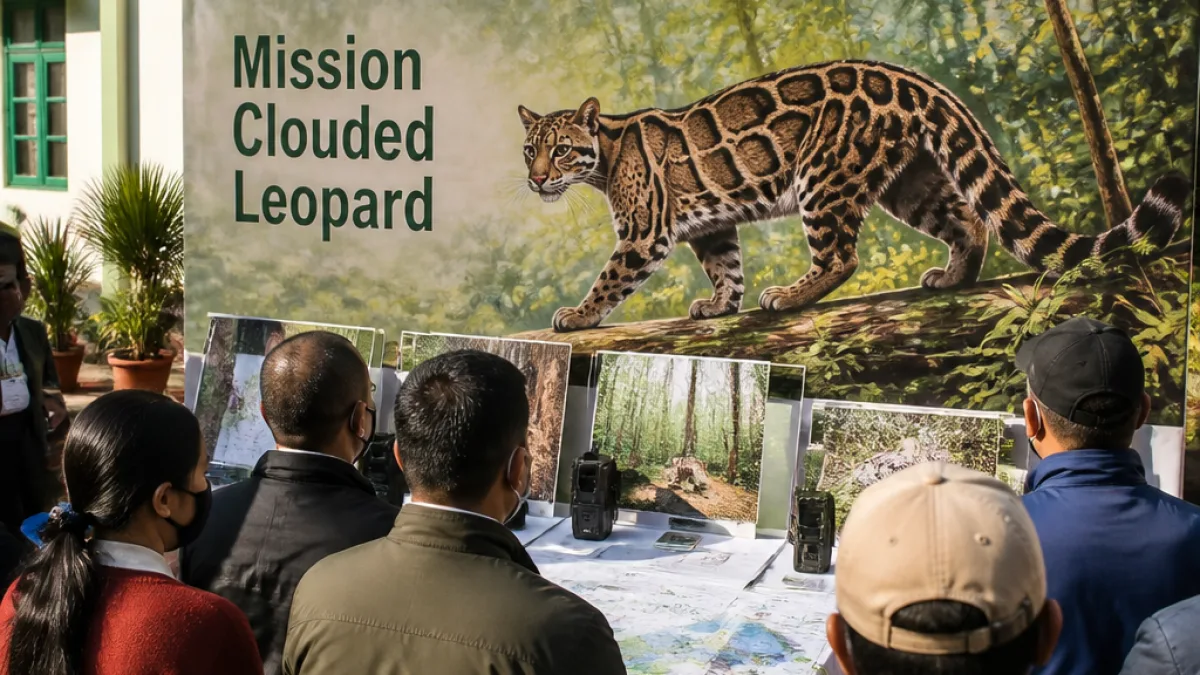
Shillong: The Meghalaya government on Tuesday unveiled Mission Clouded Leopard, a state-level flagship initiative aimed at securing viable populations of the Clouded Leopard (Neofelis nebulosa), the state animal. The announcement came from Chief Minister Conrad Sangma on the occasion of International Clouded Leopard Day, observed annually on 4 August.
Integrated framework for conservation
An official release from the Forest and Environment Department said the Mission provides an integrated framework addressing habitat protection and restoration, long-term scientific research and monitoring, stronger protection measures, and improved landscape connectivity. It also emphasises capacity building of frontline staff, community participation and public awareness, and cooperation with neighbouring north-eastern states for landscape-level conservation.
The programme will be guided by the Meghalaya Clouded Leopard Action Plan, which the department has initiated as the strategic roadmap for implementing the Mission across the state.
Why the species matters locally
The Clouded Leopard is listed as Vulnerable on the IUCN Red List, falls under Schedule I of the Wild Life (Protection) Act, 1972, and is included in Appendix I of CITES. Locally the species is known as Maccha Pheng in Garo, Lakrong in Khasi and Khla in Jaintia. As an arboreal and largely nocturnal predator, it plays a role in regulating prey populations and serves as an indicator of forest health.
Key landscapes and pressures
Meghalaya contains several important habitats for Clouded Leopards, including the forest systems of Nokrek, Balpakram, Baghmara, Narpuh and Nongkhyllem, along with extensive community-managed forests. The release noted these landscapes face multiple threats: fragmentation, loss of ecological connectivity, illegal hunting and snaring, declining prey base and the effects of climate change.
- Habitat protection and restoration: measures to secure and rehabilitate key forest tracts.
- Scientific research and monitoring: systematic surveys and long-term data collection.
- Strengthened protection: enhanced anti-poaching and law enforcement efforts.
- Landscape connectivity: actions to maintain ecological corridors between habitats.
- Community engagement: participation of local and community forest stakeholders.
Preliminary assessment and next steps
The state’s ongoing scientific assessment has already produced tangible results: preliminary findings from the Balpakram landscape have identified 21 individual Clouded Leopards, a notable outcome given the species’ elusive nature. The assessment will be expanded to other major habitats across Meghalaya, the department said, to broaden knowledge of distribution and population status.
| Landscape | Role | Primary threats |
|---|---|---|
| Nokrek | Core habitat | Fragmentation, hunting |
| Balpakram | Key surveyed landscape | Snaring, connectivity loss |
| Baghmara, Narpuh, Nongkhyllem | Community-managed and protected forests | Prey decline, climate impacts |
Governance and community roles
The Mission explicitly links state actions with community involvement, reflecting Meghalaya’s extensive network of community-managed forests. The action plan is expected to set out duties for frontline forest staff, mechanisms for capacity building and protocols for working with local communities to reduce threats such as snaring and retaliatory killing.
Officials said inter-state collaboration will be an important element of the Mission, given the transboundary nature of many forest landscapes in the north-eastern region. Strengthening ecological connectivity beyond Meghalaya’s borders is part of the stated approach.
Implications for conservation and local stakeholders
Conservationists and local forest-dependent communities are likely to be directly affected by measures under the Mission, including changes in forest management, patrolling regimes and community awareness drives. For researchers, the expanded assessment offers opportunities to generate baseline data on a species that is difficult to monitor.
While the announcement sets out broad priorities, implementation details and timelines will be determined through the Meghalaya Clouded Leopard Action Plan and subsequent operational guidelines from the Forest and Environment Department.
State authorities indicated the Mission is intended to secure long-term conservation outcomes for the Clouded Leopard while strengthening the health of Meghalaya’s forest ecosystems and the livelihoods of communities that depend on them.