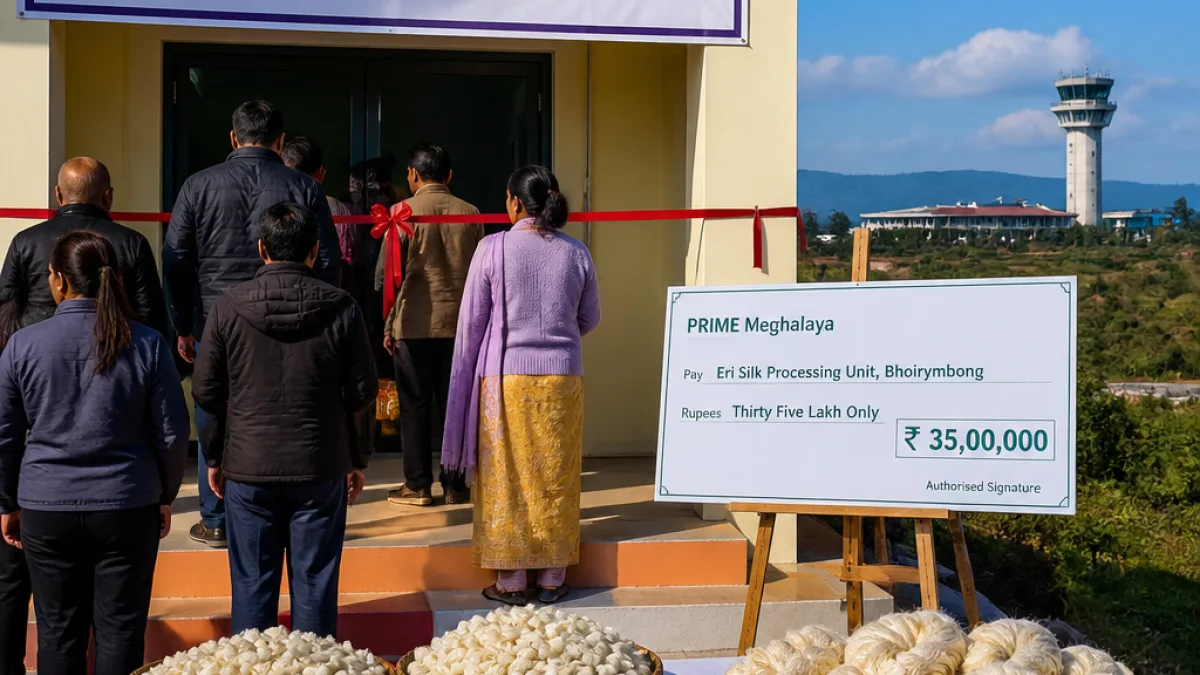
Bhoirymbong (Ri‑Bhoi), May 12: Meghalaya Chief Minister Conrad K. Sangma on Tuesday inaugurated an eri silk processing unit at Bhoirymbong in Ri‑Bhoi district, a move the state government said would bolster the traditional silk sector and expand market access for local weavers and artisans.
Project aims and support
The unit is intended to provide organised processing and value‑addition facilities for eri silk, locally known as Ryndia. In a brief address at the inauguration, the Chief Minister said the facility would help bridge gaps in organised marketing of eri silk cocoons and generate livelihood opportunities for weavers and artisans in the region.
As part of the launch, Mr Sangma handed over financial assistance of ₹35 lakh under the PRIME Meghalaya Scheme to support the initiative. Officials highlighted the unit's strategic location, noting Bhoirymbong’s proximity to Shillong Airport as a potential advantage to expand trade networks and promote Meghalaya’s eri silk products to wider markets.
Significance of eri silk and recent recognition
Eri silk, known regionally as Ryndia, was granted a Geographical Indication (GI) tag in 2025. The fabric is widely recognised for its non‑violent production process in which silkworms are not harmed, earning it the description Ahimsa silk. State authorities say the GI recognition strengthens the product’s brand value and opens avenues for better price realisation for producers.
Expected local impact
Government officials and local stakeholders expect the processing unit to contribute in several ways:
- Provide organised cocoon procurement and primary processing services.
- Improve quality control and standardisation to meet wider market requirements.
- Enable direct linkages between weavers, traders and markets, potentially reducing intermediaries.
- Create ancillary employment opportunities in processing, packaging and logistics.
While specific targets for production or employment were not released at the inauguration, the financial assistance and government backing are presented as initial steps towards scaling the sector.
Funding and programme details
The project received ₹35 lakh under the PRIME Meghalaya Scheme. Officials described the grant as seed support to operationalise the processing unit and to provide immediate relief and capacity building for local producers.
| Item | Detail |
|---|---|
| Project | Eri silk processing unit, Bhoirymbong (Ri‑Bhoi) |
| Financial assistance | ₹35 lakh (PRIME Meghalaya Scheme) |
| GI tag | Eri silk (Ryndia) – 2025 |
| Location advantage | Proximity to Shillong Airport |
Broader context and potential challenges
The inauguration aligns with state efforts to revive and strengthen traditional industries. Eri silk is part of Meghalaya’s cultural textile heritage and its GI status is expected to support branding and niche marketing. However, stakeholders will need to address supply chain issues, quality assurance, design development and market linkages to convert the GI recognition and the new processing capacity into sustained higher incomes for weavers.
Operational success will depend on consistent procurement of cocoons, availability of skilled manpower for processing, and the creation of reliable distribution channels to reach urban and export markets. Government schemes like PRIME Meghalaya and other support measures will be critical in providing training, design development and market access.
Next steps and stakeholder engagement
Officials said the unit will work with local weaver groups and cooperatives to streamline supplies and processing. The state government is expected to follow up with capacity‑building programmes and efforts to connect producers with buyers, both within India and beyond.
With the combination of GI recognition, a dedicated processing facility and state financial support, authorities hope the initiative will contribute to sustainable livelihoods for silk producers in Ri‑Bhoi and neighbouring areas.