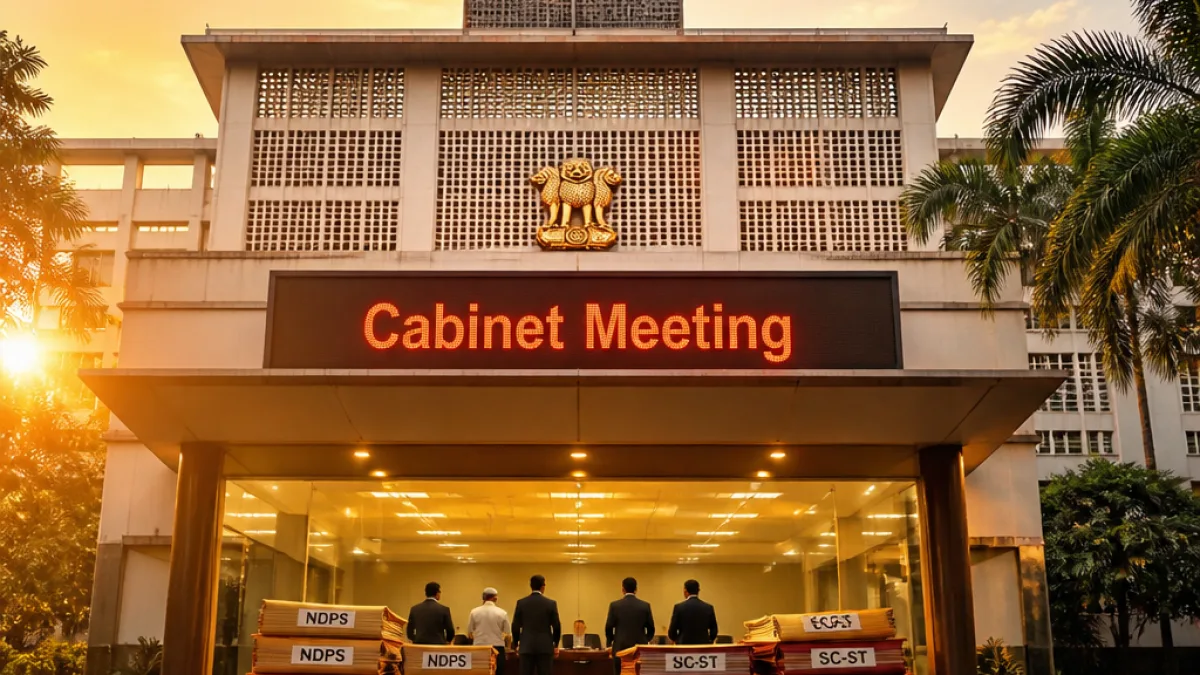
The Maharashtra Cabinet on July 28 approved the setting up of a special court under the Narcotic Drugs and Psychotropic Substances (NDPS) Act for Pune district and authorised five exclusive courts for cases under the Scheduled Castes and Scheduled Tribes (Prevention of Atrocities) Act across the State. The decisions, taken at a meeting chaired by Chief Minister Devendra Fadnavis, include sanctioned posts, staff and budgetary allocations to operationalise the courts.
Allocations and manpower
For the Pune NDPS court the Cabinet sanctioned ₹1.26 crore, one District and Additional Sessions Judge and seven support staff to handle the workload. At the time of the decision, Pune had about 1,425 pending NDPS cases, according to the figures submitted to the Cabinet.
Separately, the State approved five exclusive special courts to try offences under the SC‑ST (Prevention of Atrocities) Act at Ahilyanagar, Parbhani, Solapur, Nanded and Yavatmal. The package for these courts totals ₹4.51 crore, with each court to be presided over by one judge.
Rationale and caseload
Officials said the move seeks to expedite trial of cases under specialised laws that require dedicated procedures and judicial expertise. Maharashtra presently has 17,023 pending cases under the SC‑ST Act. The distribution of pending matters varies by district, with Ahilyanagar recording 1,014 pending SC‑ST Act cases and Nanded showing 735.
NDPS and SC‑ST Act cases are tried under distinct legal frameworks that often involve detailed investigation, forensic evidence and statutory safeguards; the Cabinet noted that dedicated courts could reduce delays and ensure focused judicial attention.
Other sanctioned courts
In addition to the NDPS and SC‑ST courts, the Cabinet approved the creation of a District and Additional Sessions Court at Karjat in the Ahilyanagar district. For Kurduwadi in Madha taluka of Solapur district, a Junior Division Civil Court and a Judicial Magistrate First Class Court were sanctioned.
- Pune — Special NDPS court; ₹1.26 crore; 1 judge; 7 support staff; 1,425 pending NDPS cases.
- Ahilyanagar, Parbhani, Solapur, Nanded, Yavatmal — Five exclusive SC‑ST Act courts; ₹4.51 crore total; 1 judge per court; 17,023 pending SC‑ST Act cases statewide.
- Karjat — District & Additional Sessions Court approved.
- Kurduwadi (Madha taluka) — Junior Division Civil Court and Judicial Magistrate First Class court approved.
| Location | Court Type | Funds Sanctioned | Judge/Staff | Pending Cases (where given) |
|---|---|---|---|---|
| Pune | Special NDPS Court | ₹1.26 crore | 1 District & Additional Sessions Judge; 7 support staff | 1,425 NDPS cases |
| Ahilyanagar, Parbhani, Solapur, Nanded, Yavatmal | Exclusive SC‑ST Act Courts (5) | ₹4.51 crore (total) | 1 judge per court | 17,023 SC‑ST Act cases (statewide total); Ahilyanagar 1,014; Nanded 735 |
Implications for speedy justice
The Cabinet’s action comes amid concerns over mounting pendency in courts dealing with sensitive crimes that carry significant social and legal ramifications. Advocates for specialisation in the judiciary argue that dedicated courts reduce procedural friction and help build subject‑matter expertise among bench and staff, potentially shortening trial duration.
By allocating funds and judicial posts, the State government aims to make the newly sanctioned courts operational. The practical impact will depend on timely recruitment, allocation of courtrooms and administrative support, and coordination with investigating agencies and public prosecutors.
The Cabinet meeting also highlighted the broader plan to strengthen district‑level judicial infrastructure, including civil and criminal courts in growing talukas and sub‑districts where caseloads have risen with population and economic activity.
Implementation details, including timelines for filling the sanctioned posts and the date on which the new courts will commence functioning, were not disclosed in the Cabinet note released after the meeting.