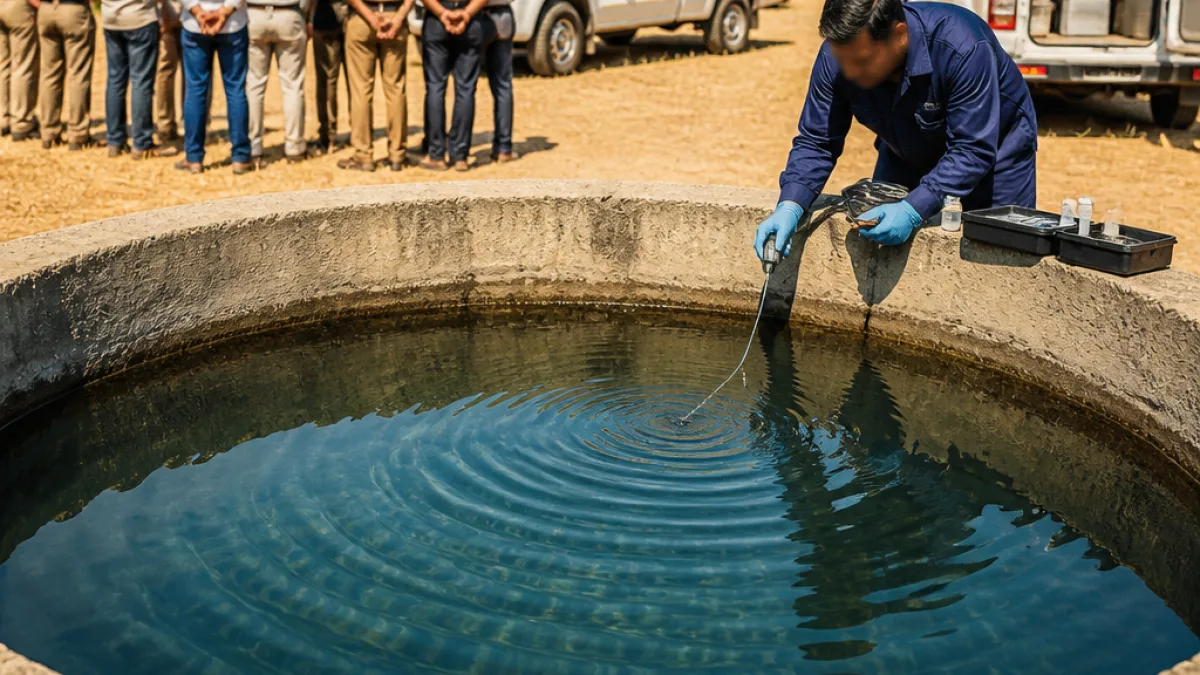
VIRPARDA, Morbi — A farm well in Virparda village of Morbi taluka has become an unexpected focus of attention after its water began exhibiting steady, wave-like oscillations without any obvious disturbance, videos circulating on social media show. The phenomenon, captured repeatedly on mobile phones, has prompted an official probe and a request for scientific examination.
Officials and experts mobilised
Morbi District Collector Swapnil Khare has directed local authorities to investigate the incident, according to official communications. The Gujarat Groundwater Research Institute has been asked to examine the well and submit a detailed report on possible causes.
Footage shared widely on platforms shows the water surface in the well making nearly continuous ripples, even when there is no visible object or person disturbing it. In some clips the movement appears strong enough that water spills over the rim.
Local reaction and visitors
Villagers and residents from nearby habitations have been visiting the site to witness the phenomenon. Motorists travelling on the highway adjacent to the field containing the well have also stopped to look and record videos, according to accounts circulating online.
- Location: Virparda village, Morbi taluka, Morbi district, Gujarat
- Well depth/size reported: About 18 feet (as described in social media captions)
- Action taken: District Collector ordered probe; Gujarat Groundwater Research Institute requested to inspect
Speculations and initial hypotheses
Social media users and some viewers have advanced multiple hypotheses to explain the oscillations, ranging from wind-driven surface effects to underground pressure variations. Several suggestions on platforms include asymmetric construction of the well, subterranean flow dynamics, or external ground vibrations coupling with the water column.
“Pressure difference, or flow issues underground or asymmetrical construction,” one user commented, while another suggested wind-driven effects concentrated by the well wall.
Such explanations reflect plausible mechanisms recognised in fluid dynamics: resonance of a confined water body, periodic forcing from wind or seismic-like vibrations, and pressure-driven inflows from subsurface channels can all create organised motion. However, officials and the requested groundwater institute have not yet released technical findings.
Why experts are needed
Investigators from the Gujarat Groundwater Research Institute are expected to carry out on-site measurements and observations before reaching conclusions. Key factors they will likely examine include:
- Structural geometry and construction of the well
- Local wind patterns and meteorological data at the time of recordings
- Subsurface hydrogeology and any nearby conduits or flows
- Possible external vibration sources such as traffic or machinery
| Aspect | Why it matters |
|---|---|
| Well shape and wall geometry | Can focus or reflect surface waves, affecting amplitude and persistence |
| Subsurface flow | Inflow or outflow through underground channels can generate sustained oscillations |
| External vibrations | Periodic ground motion can couple to the water column and produce standing waves |
Residents say the nearby trees sometimes bend in the wind while the well surface continues to show the oscillation pattern, an observation that has been cited in online discussion. No formal measurement of wind at the exact time of recordings has been released so far.
Public interest and safety
While the spectacle has drawn curiosity, officials should consider crowd management and safety steps. Open wells can pose risks if onlookers gather near fragile edges or if overflow alters ground stability. The district administration’s ordered probe is expected to advise on any immediate precautions.
Until the groundwater institute completes its inspection and submits findings, explanations will remain provisional. The situation highlights how unusual natural or physical phenomena can quickly attract widespread attention, prompting both popular theorising and official scientific scrutiny.
Further updates are expected after field teams from the district administration and the Gujarat Groundwater Research Institute complete their assessments and release a technical report.