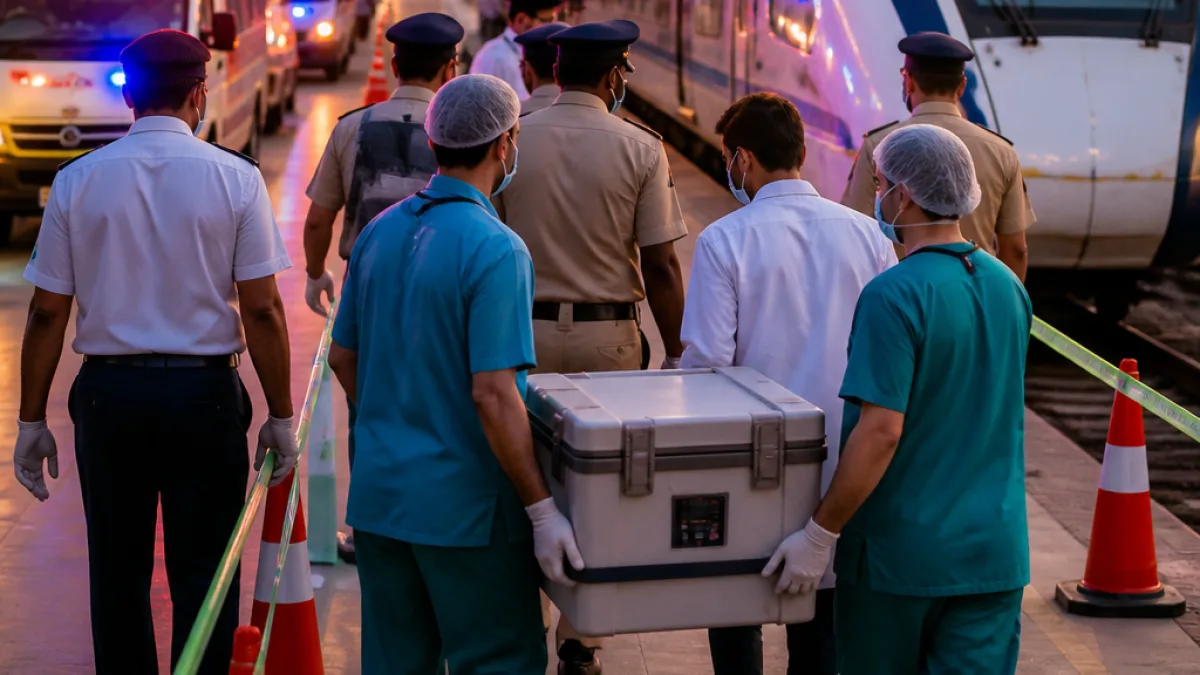
High-speed rail used for time-critical heart transplant to Ahmedabad
Ahmedabad — A donor heart was transported by Vande Bharat Express from Ankleshwar to Ahmedabad on Sunday, with the premium train making its first-ever stop at Ankleshwar Railway Station to enable a time-sensitive transplant at the U N Mehta Institute of Cardiology & Research Centre, hospital and rail officials reported.
The organ was retrieved from Smt. Jayaben Modi Multi‑Specialty Hospital, Ankleshwar. Authorities established a dedicated green corridor to move the heart from the hospital to the station within minutes, after which a team of doctors from U N Mehta accompanied the donor organ aboard the Vande Bharat. The speed and punctuality of the service were cited as decisive factors in ensuring the heart reached Ahmedabad within the critical transplant window.
"The successful missions highlight the speed, punctuality and reliability of the Vande Bharat Express while demonstrating Indian Railways' expanding contribution to critical healthcare services and emergency medical transportation," an official press release said.
The heart is intended for a patient undergoing treatment at U N Mehta Hospital, which will perform what the institute described as its 78th successful heart transplant. Hospital officials reported that this was the second time in three days that a donor heart was brought to U N Mehta by Vande Bharat Express.
Context and logistics
Medical and rail authorities coordinated the transfer to preserve precious minutes that determine transplant outcomes. The sequence reported by the hospital and rail statement comprised:
- Retrieval of the donor heart at Smt. Jayaben Modi Multi‑Specialty Hospital, Ankleshwar.
- Creation of a green corridor from the hospital to Ankleshwar Railway Station for uninterrupted transfer.
- Accompaniment by a specialised medical team from U N Mehta on the Vande Bharat Express bound for Ahmedabad.
- Immediate handover at Ahmedabad for preparation and transplant at U N Mehta Institute.
Earlier in the week, Indian Railways achieved what was described as a national milestone by transporting a live donor heart by train for the first time in the country. That organ travelled from Surat to Ahmedabad aboard the Mumbai Central–Gandhinagar Capital Vande Bharat Express.
| Origin | Train / Stop | Destination | Receiving Hospital |
|---|---|---|---|
| Ankleshwar (Smt. Jayaben Modi Hospital) | Vande Bharat Express — first stop at Ankleshwar | Ahmedabad | U N Mehta Institute of Cardiology & Research Centre |
| Surat (earlier mission) | Mumbai Central–Gandhinagar Capital Vande Bharat Express | Ahmedabad | U N Mehta Institute |
Implications for Ahmedabad healthcare and transport
Medical teams in Ahmedabad described the use of high-speed rail as an evolving asset for emergency healthcare logistics. The two successful transfers within days underline a growing collaboration between hospital transplant teams and Indian Railways to expand organ‑transport options beyond road ambulances and air corridors, particularly for intrastate transfers where rail timings and connectivity can provide a reliable alternative.
For Ahmedabad residents and regional healthcare planners, the missions demonstrate practical benefits: shorter door-to-door times in critical cases, reduced dependency on road conditions, and the capacity to mobilise specialised teams en route. Officials framed the operations as evidence of system readiness to harness scheduled high-speed services for clinical emergencies when time is the critical variable.
U N Mehta Institute's position as a major transplant centre in Gujarat means successful logistics directly affect patient outcomes across the region. The institute's reported tally of 78 heart transplants to date reflects its established surgical programme and the need for continued coordination among hospitals, transport authorities and transplantation networks to increase organ utilisation and save lives.
Rail and medical officials said they will review these missions to formalise protocols for future organ transport by Vande Bharat and other trains, balancing speed with safety, chain-of-custody procedures and medical oversight during transit.