
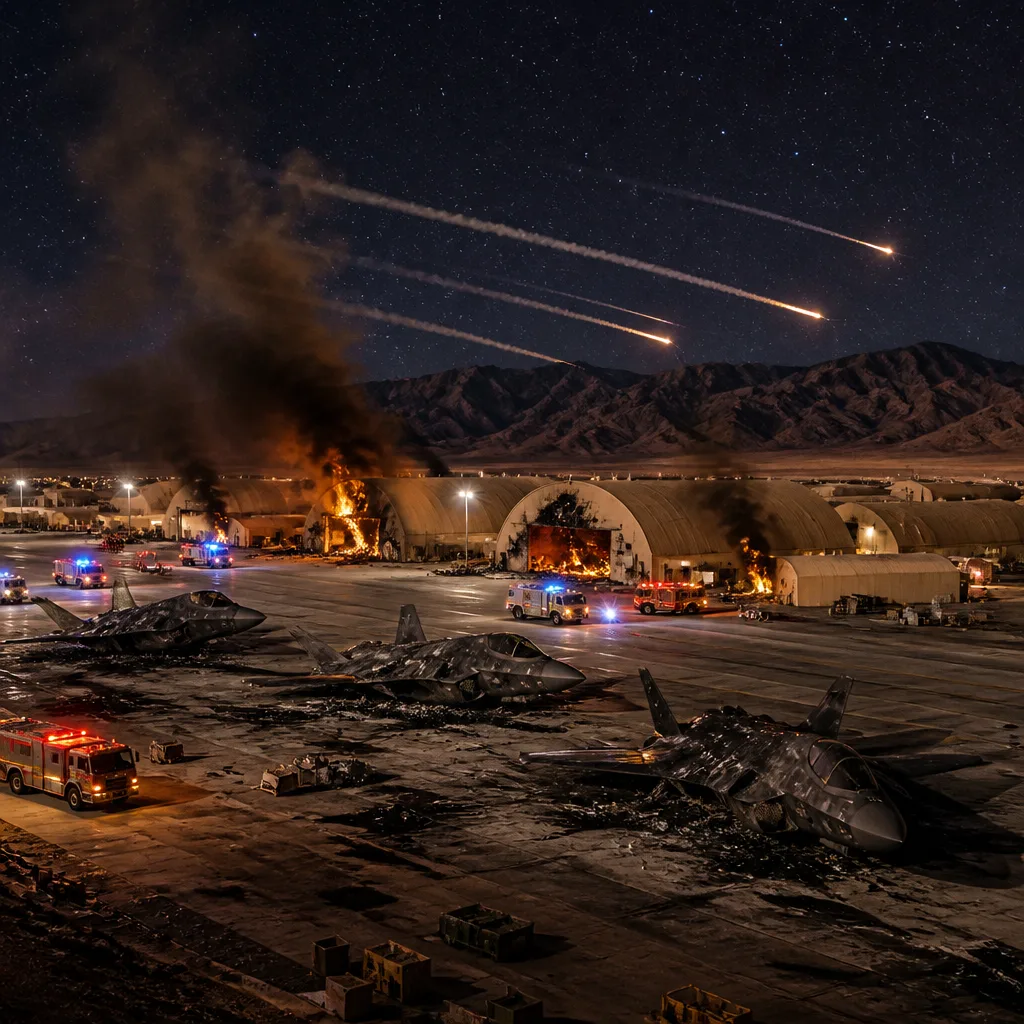
Tehran/New York: Iran's Islamic Revolutionary Guard Corps (IRGC) claimed on Thursday that it had destroyed three US F-35 fighter jets and heavily damaged a further three at Jordan's Al-Azraq Air Base, saying the attack was carried out in retaliation to American strikes on Qeshm Island.
IRGC statement and alleged casualties
The claim was made in a statement carried by state broadcaster Islamic Republic of Iran Broadcasting (IRIB), which said the IRGC Aerospace Force launched several ballistic missiles against deployment ramps and maintenance facilities housing F-35 aircraft at the Jordanian base. The IRGC said the operation "completely destroyed three F-35 aircraft and caused heavy damage to three others," and added that several US officers and technical and maintenance personnel were killed in the attack.
In the same statement, the IRGC said the strikes were in response to a US airstrike on Qeshm Island on Wednesday night. The IRGC alleged American forces, operating from bases in Jordan, had used bunker-busting bombs to strike two residential houses on Qeshm Island, killing three members of a family, including a child, and injuring two other children.
CENTCOM account of US strikes inside Iran
Earlier, US Central Command (CENTCOM) announced it had conducted a large-scale series of strikes against IRGC targets inside Iran. CENTCOM said its forces carried out the strikes at approximately 10 pm ET on July 29 in response to what it described as an attempted Iranian ballistic missile attack against US forces on July 28.
"The strikes aimed to further diminish threats posed by Iran and its proxies to American forces, commercial shipping, and neighbouring Gulf countries," CENTCOM said in a statement.
CENTCOM added that the strikes targeted dozens of IRGC military sites, including command centres, missile and drone facilities, coastal surveillance and defence sites, and maritime capabilities. The US military said the Iranian missile launches on July 28 were intercepted successfully. CENTCOM further noted that more than 50,000 US service members remain deployed across the Middle East and described those forces as "highly vigilant, focused, lethal, and ready."
Scope of targets struck, according to CENTCOM
The US statement listed the categories of IRGC infrastructure struck; it did not provide a comprehensive count of individual facilities or casualties.
| Target category | Examples cited by CENTCOM |
|---|---|
| Command centres | IRGC command and control locations |
| Missile and drone facilities | Launch and storage sites |
| Coastal surveillance and defence | Surveillance nodes and coastal defences |
| Maritime capabilities | Facilities supporting naval operations |
Regional implications and competing narratives
The two accounts — Iran's claim of striking US aircraft in Jordan and CENTCOM's account of strikes inside Iran — reflect competing narratives in a rapidly evolving confrontation. The IRGC framed its action as direct retaliation for the Qeshm Island strike, while CENTCOM described its operations as aimed at degrading threats to US forces, commercial shipping and Gulf partners following an attempted Iranian missile attack.
- IRGC claim: Destruction of three F-35s and heavy damage to three others at Al-Azraq Air Base, with several US personnel killed.
- CENTCOM account: Precision strikes inside Iran targeting dozens of IRGC sites on the night of July 29; interception of Iranian missiles the previous day.
- Deployment: CENTCOM said over 50,000 US service members remain deployed across the Middle East.
Independent verification of the IRGC's specific claims regarding damage at Al-Azraq Air Base or of any casualties was not provided in the statements. The contrasting accounts are likely to complicate diplomatic efforts and increase tensions in a region already marked by frequent confrontations between Iranian forces and US military assets.
Governments and militaries in the region, as well as global maritime and energy markets, will be closely watching further developments and official confirmations from the parties involved.