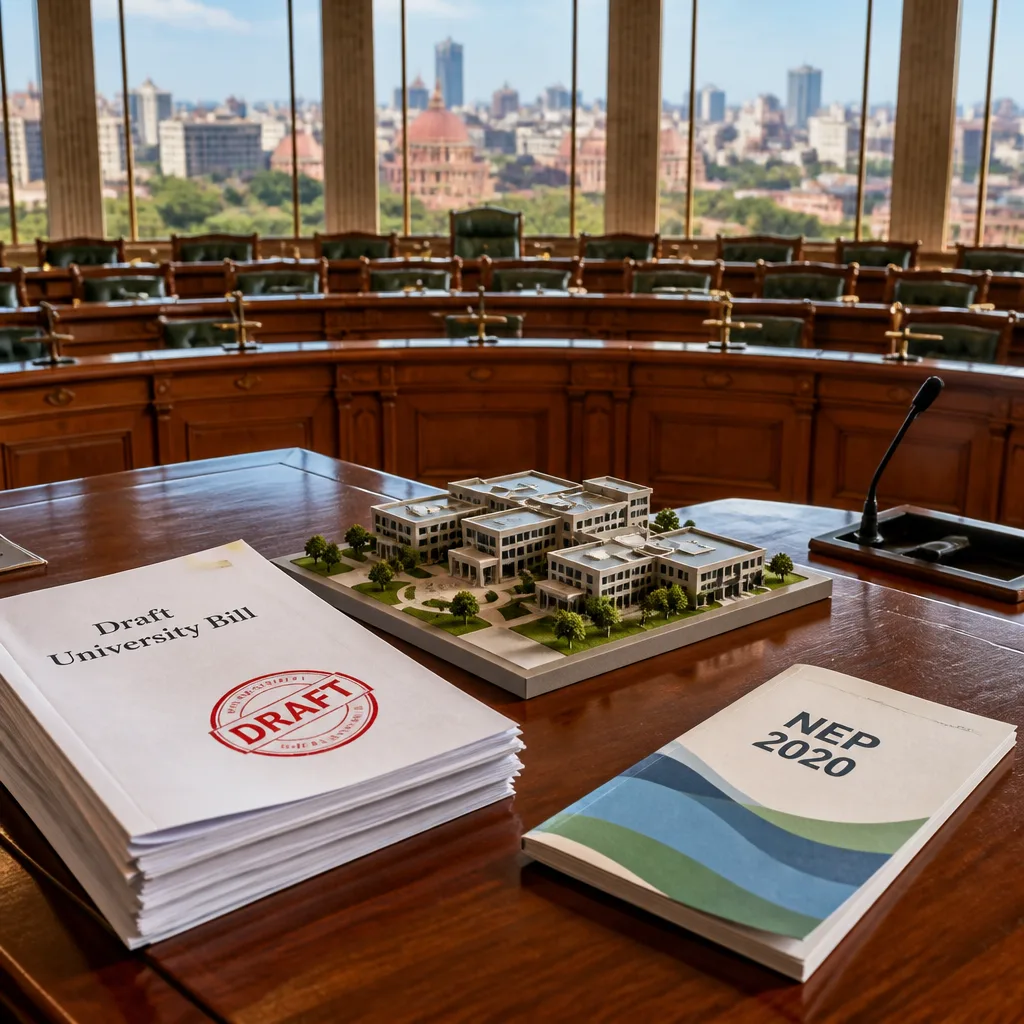
New Delhi: The Delhi Cabinet on Friday approved a draft Bill to allow the establishment and incorporation of private universities in the National Capital Territory (NCT) of Delhi, the Chief Minister's Office said, paving the way for the measure to be introduced in the Delhi Legislative Assembly.
What the Bill seeks to do
The draft legislation, prepared under the leadership of Chief Minister Rekha Gupta, aims to provide a contemporary, transparent and effective legal framework for setting up private universities in the Capital. Officials said the Bill emphasises academic standards, infrastructure and research capacity rather than solely mandating large, land-intensive campuses.
"The Bill would mark the beginning of a new era in higher education in Delhi," the Chief Minister said, according to the CMO.
The CMO said the initiative is aligned with the spirit of the National Education Policy (NEP) 2020 and is intended to help position Delhi as a leading global centre for higher education. The Bill is also designed to facilitate the entry of internationally reputed institutions and their off‑campus centres into Delhi.
Objectives and policy direction
According to the CMO release, the principal objectives of the Bill include:
- Expanding academic opportunities for students within the Capital by enabling more institutions to operate in Delhi.
- Promoting research and innovation by incentivising institutions with significant research capability and infrastructure.
- Encouraging entrepreneurship and stronger collaboration between academia and industry.
- Fostering international partnerships by allowing reputed foreign institutions and their centres to establish a presence in Delhi.
The release noted that despite being the national Capital, Delhi has been among the few major regions without a clear legal structure for private universities, which has compelled many students to seek higher education in neighbouring states or abroad.
Campus model and land constraints
With Delhi's limited land availability cited as a constraint, the Bill reportedly adopts a modern approach that moves away from the traditional model of expansive horizontal campuses. Instead, emphasis will be placed on:
- academic quality and faculty standards;
- adequate facilities and student services;
- research and innovation infrastructure.
The CMO highlighted that such flexibility is intended to accommodate Delhi's geographical limitations while still meeting global benchmarks for higher education.
Next steps and implications
Following cabinet approval, the Bill will be tabled in the Delhi Legislative Assembly for consideration and passage. If enacted, the law could change the higher-education ecosystem in the Capital by creating avenues for private and international institutions to set up campuses or centres in Delhi.
Potential consequences include increased competition for existing public universities, greater student retention within Delhi, and possible shifts in collaboration patterns between industry and academia. The move also signals Delhi's intent to align more closely with national policy directions under the NEP 2020, which advocates diverse institutional forms and greater private participation to expand access and quality.
The CMO statement did not specify timelines for introduction in the Assembly, eligibility criteria for institutions, or regulatory safeguards the Bill will contain. Those details are expected to emerge when the draft is tabled and examined during legislative proceedings.
| Key aim | Headline focus |
|---|---|
| Access | Provide more local options for higher education |
| Quality | Emphasise academic standards and research capacity |
| Model | Allow non‑traditional campus arrangements owing to land limits |
The draft Bill marks a notable policy shift for the NCT, which until now lacked a clear statutory route for private universities. As the draft moves to the Assembly, stakeholders — including student groups, academic institutions, and industry partners — will be watching closely for the detailed provisions that will determine how the new framework operates in practice.