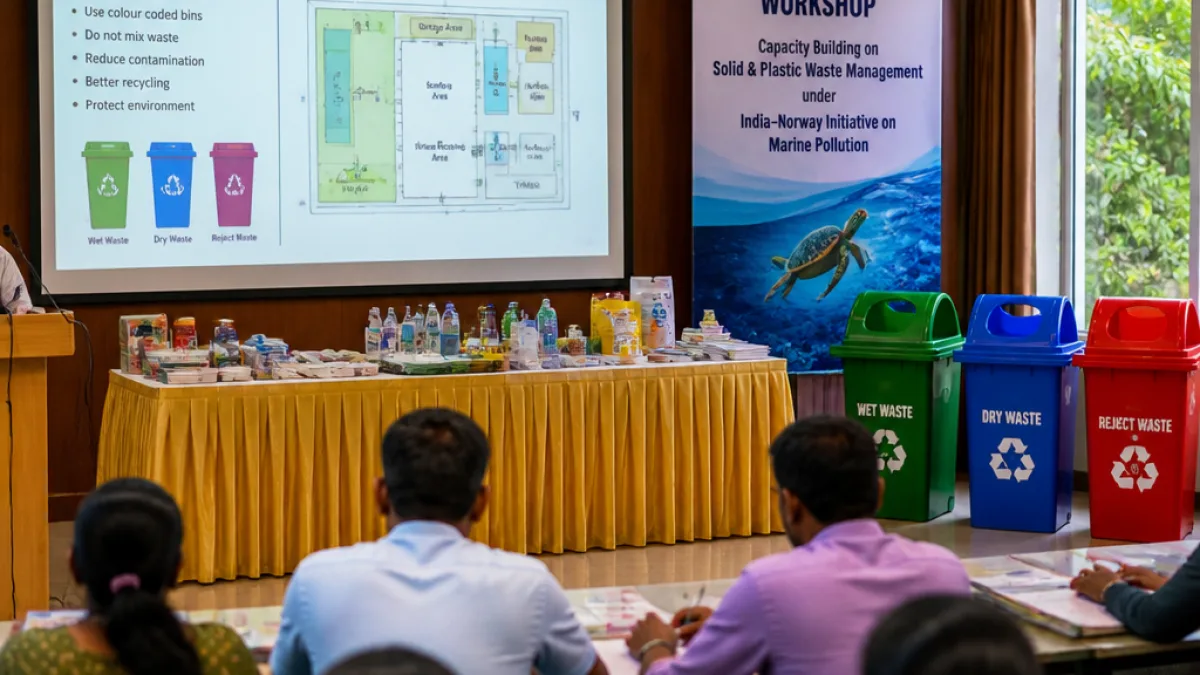
Training held in Sri Vijaya Puram as part of INMPI Phase-II
Sri Vijaya Puram, Aug 2: A two-day UT-level Master Trainer Capacity Building Workshop on operationalising solid waste management (SWM) and plastic waste management (PWM) concluded on July 29 at the Directorate of Disaster Management training hall in Sri Vijaya Puram. The Andaman & Nicobar Pollution Control Committee (ANPCC), Department of Science & Technology, organised the workshop in association with the Centre for Science and Environment (CSE), New Delhi, under Phase‑II of the India–Norway Marine Pollution Initiative (INMPI) of the Ministry of Environment, Forest and Climate Change.
The programme assembled approximately 60 participants representing 23 stakeholder departments and organisations, including government departments, local bodies, non-governmental organisations, civil society groups and self‑help groups. Participants were trained as master trainers to cascade practical skills and technical knowledge on waste management across the Union Territory.
Hands‑on modules and compliance focus
The workshop combined classroom sessions with practical exercises, covering core components of contemporary waste management policy and operations. Course elements included:
- Source segregation and citizen-level interventions
- Operation of Material Recovery Facilities (MRFs)
- Extended Producer Responsibility (EPR) mechanisms
- Compliance requirements for Bulk Waste Generators (BWGs)
- Sustainable collection, transport and disposal practices
Sessions were designed to equip participants to both advise implementing agencies and conduct on-site training in institutional and community settings across the Islands.
Valedictory remarks stress behavioural shift, accountability
The valedictory function was presided over by the Member Secretary, ANPCC‑cum‑Director (Science & Technology), who handed out certificates to the newly trained master trainers. The chief guest underscored that adherence to waste management rules must evolve into a behavioural change, not merely a regulatory checkbox, and recalled directions issued by the Hon’ble Supreme Court in this context. He also called on the cohort of master trainers to translate the workshop learnings into effective implementation within their respective departments and organisations.
Stakeholder spread and expected outcomes
Officials said the multi‑agency composition of attendees was deliberate, reflecting the cross‑sectoral nature of waste management and the need for coordinated action among municipal bodies, port authorities, tourism stakeholders and community groups. The organisers expect the trained master trainers to:
- Conduct outreach and training programmes locally
- Facilitate setting up and improving MRFs
- Assist Bulk Waste Generators to meet compliance obligations
| Item | Detail |
|---|---|
| Dates | Two‑day workshop, concluded July 29 |
| Location | Training Hall, Directorate of Disaster Management, Sri Vijaya Puram |
| Organisers | ANPCC, Department of Science & Technology; Centre for Science and Environment (CSE), New Delhi |
| Programme | Phase‑II, India–Norway Marine Pollution Initiative (MoEF&CC) |
| Participants | ~60 participants from 23 stakeholder departments/organisations |
Why the training matters for the Islands
Solid and plastic waste management is a priority for the Andaman and Nicobar Islands, which are ecologically sensitive and host extensive coastal and marine environments. Effective handling of municipal and plastic wastes reduces risks of marine debris, protects coral reefs and shorelines, and supports tourism and fisheries livelihoods. The workshop sought to align local practice with national policy instruments such as EPR while emphasising practical, replicable measures that departments and community groups can implement immediately.
Organisers and participants said the next steps will include localised training roll‑outs, technical support for MRFs and follow‑up to ensure Bulk Waste Generators meet statutory requirements. The workshop forms part of a broader push under INMPI to curb marine pollution through institutional strengthening, capacity building and inter‑agency coordination across coastal states and UTs.
Reporting from the archipelago noted that the participatory model adopted in the workshop is intended to create a network of trainers capable of sustaining behaviour change and compliance in the long term.