New Delhi: The Supreme Court has declared that the right to walk safely on designated footpaths constitutes a fundamental right, underscoring long-standing deficiencies in urban infrastructure that have left pedestrians vulnerable across Indian cities, reported BBC/AFP.
Judicial pronouncement meets urban reality
The observation, made by the apex court in June and highlighted in international reporting, comes amid growing evidence that walking remains the principal mode of mobility for large sections of the population, even as city design favours motor vehicles. According to the report, an estimated 45 million people walk to work daily, while only about 5.4 million commute in private cars, jeeps or vans.
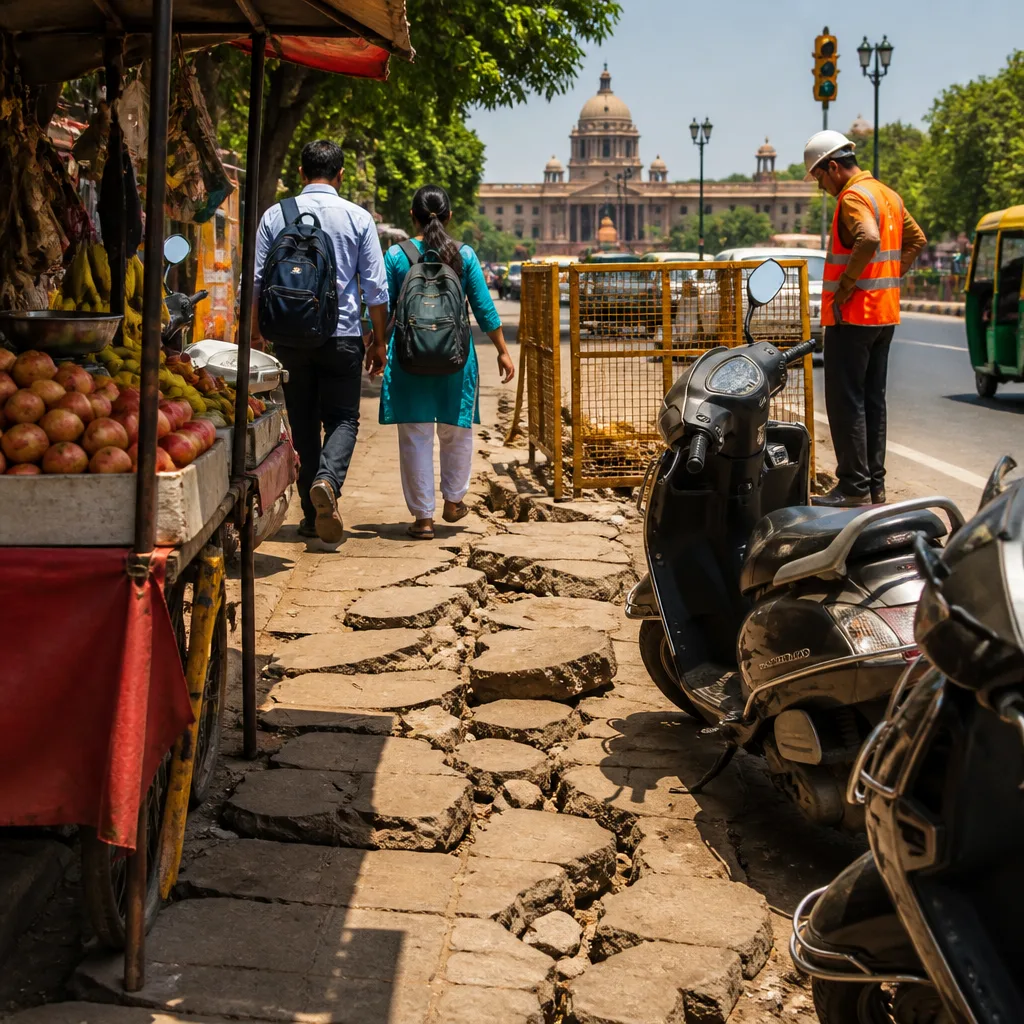
Commenting on the judgement, the coverage noted that pavements in many cities are often broken, encroached upon by hawkers, blocked by parked two- and four-wheelers, or interrupted by construction and utility works — conditions that disproportionately affect women, the elderly, children and people with disabilities.
“The right to walk safely on designated footpaths was a fundamental right.”
Scale and consequences
Mobility surveys cited in the report indicate that walking accounts for a substantial share of urban trips. A 2019 city-level survey cited there found that around 63% of journeys in selected cities were made on foot, making pedestrians the single largest category of road users in those places.
Public-interest advocates and urban planners have argued that failure to provide continuous, accessible and safe footpaths forces many into hazardous roadways, increases pedestrian casualties and effectively denies low-income residents and women the full benefit of public transport networks.
- 45 million — estimated number who walk to work daily, per report.
- 5.4 million — estimated private vehicle commuters in comparison.
- 63% — proportion of journeys on foot in a 2019 survey of selected cities.
These figures, the report said, reveal that walking is not a marginal mode but central to urban mobility. The court’s pronouncement therefore places a legal onus on municipal authorities and state governments to ensure footpaths are safe, continuous and usable by all sections of society.
Policy implications and municipal responsibilities
Legal recognition of walking as a fundamental right could have immediate and long-term policy consequences. In the short term, municipal corporations may face court directions to remove obstructions, repair damaged pavements and redesign footpaths to be accessible. In the longer term, urban planners will be prompted to integrate pedestrian-first design into transport and land-use plans.
Observers suggested that concrete measures likely to follow include stricter enforcement against illegal parking on footpaths, mandatory reinstatement procedures after utility work, and pedestrian audits as part of city masterplans. The report emphasised that many journeys by public transport begin and end on foot, making the condition of footpaths integral to the effectiveness of bus and metro systems.
Equity and gender dimensions
The coverage highlighted that women are especially dependent on walking for daily errands and commutes, and are more exposed to safety risks when footpaths are absent or obstructed. Urban activists warn that unless cities prioritise continuous and well-lit walkways, women’s mobility and access to jobs, education and services will remain constrained.
Experts quoted in the reporting argued that protecting the right to walk is an equity measure as much as a safety one: it defends the mobility of those who cannot afford motorised transport and reduces the marginalisation of vulnerable groups.
The Supreme Court’s declaration is likely to sharpen debates in state capitals and municipal boards over budget allocations, urban design priorities and enforcement mechanisms. How quickly and effectively civic agencies respond will determine whether the legal recognition translates into safer, more inclusive streets for millions of pedestrians.