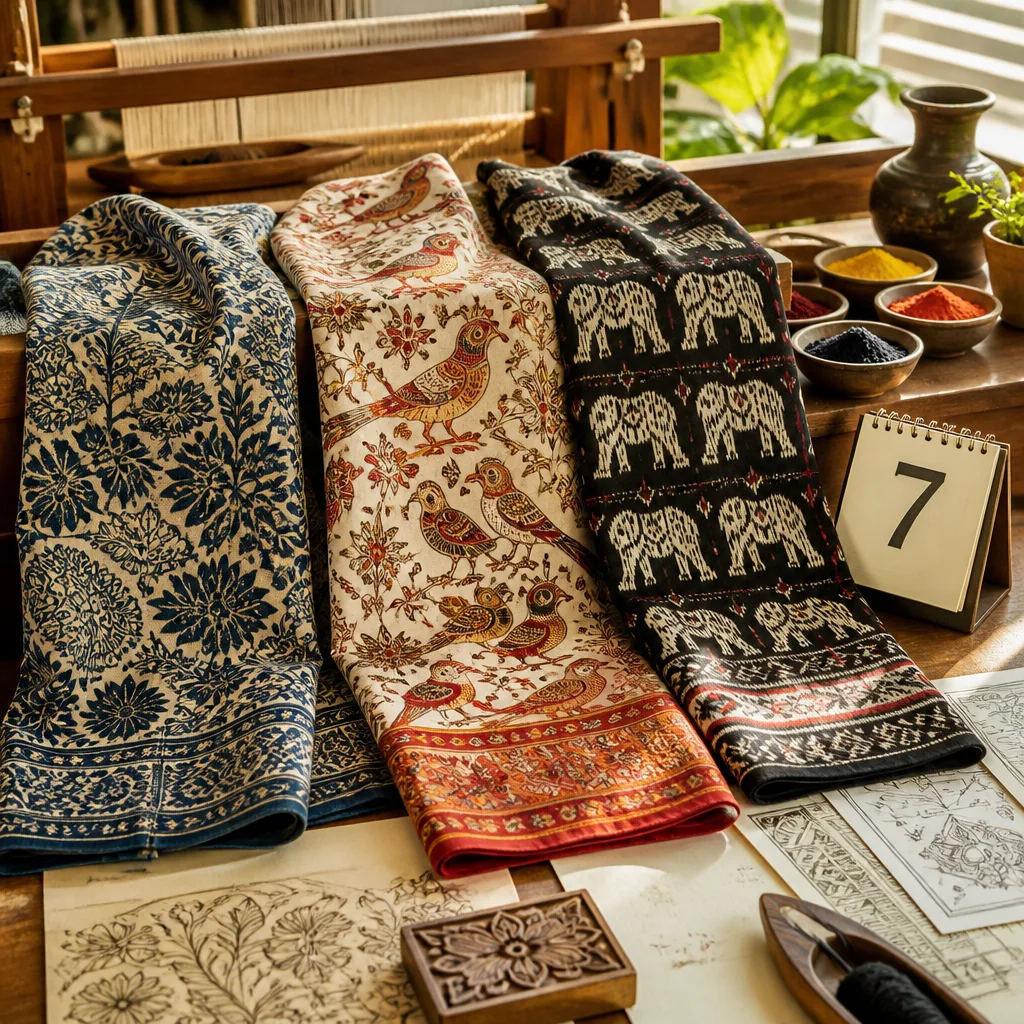
National Handloom Day, observed on August 7, offers a moment to read the visual language of India's handloom traditions. Beyond decorative appeal, motifs embedded in textiles signal community identity, local beliefs and long-standing craft techniques. Three emblematic designs—the Miri Gach of Assam, the Chilika parrot associated with Venkatagiri weaving in Andhra Pradesh, and the Gaja elephant of Odisha's Bandha ikat—illustrate how pattern, place and memory intertwine in Indian handlooms.
Motifs as cultural signposts
The motifs used by weavers are rarely arbitrary. They draw on nature, mythology and everyday life to create a visual shorthand that can indicate the origin of a textile and its cultural associations. The designs persist across generations, functioning both as aesthetic elements and as repositories of community narratives.
Three motifs highlighted by artisans and textile historians include:
- Miri Gach (Tree of Life) — a stylised flowering tree motif from Assam, tied to the Mishing community; often portrayed with birds on either side and evoking the bond between tribal communities and the natural world.
- Chilika (Royal Parrot) — a parrot design associated with Venkatagiri weaving in Andhra Pradesh, symbolising love, prosperity and beauty; historically found on textiles made for royal households and later reintroduced to contemporary handloom collections through archival revival.
- Gaja (Elephant of Power) — a defining motif in Odisha's Bandha (single weft ikat) weaves, representing wisdom, royalty and strength; it also points to the state's rich artistic past and its historic maritime links.
Persistence, revival and meaning
These motifs do more than ornament fabric. In Assam, the Miri Gach continues to anchor the textile vocabulary of the Mishing community, carrying ecological and social resonances. In Andhra Pradesh, the Chilika parrot's return to modern handloom lines followed work with archival designs, underlining how historical records can spur revival and sustain traditional techniques within new markets. Odisha's Gaja motif, integral to Bandha ikat, reflects both local symbolism and broader historical contacts that helped shape regional aesthetics.
| Motif | State / Weave | Primary associations |
|---|---|---|
| Miri Gach | Assam | Tree of life; tribal ties to nature; birds |
| Chilika | Andhra Pradesh (Venkatagiri) | Love, prosperity, beauty; royal provenance; archival revival |
| Gaja | Odisha (Bandha ikat) | Wisdom, royalty, strength; maritime heritage |
Why motifs matter for handloom sustainability
Motifs serve practical and economic functions as well. They act as markers of authenticity in a market where machine-made imitations compete with hand-crafted goods. When communities and designers invest in archival research and revive traditional patterns—such as the Chilika parrot in Venkatagiri—they not only preserve craft knowledge but also create distinctive products that can command attention in contemporary fashion and lifestyle spaces.
At the same time, the continuity of motifs like the Miri Gach points to how handloom traditions sustain intangible cultural memory. For weavers, patterns encode techniques, symbolic meanings and social histories that are passed down in looms, motifs and narratives rather than written archives.
As the country observes National Handloom Day, these patterns offer more than visual pleasure: they are entry points to conversations about heritage protection, designer–artisan collaboration and market strategies that keep weavers' livelihoods viable.
Key takeaways:
- Handloom motifs act as a visual language indicating origin, meaning and technique.
- Revival through archival designs can reintroduce historic patterns into contemporary lines and support craft sustainability.
- Regional motifs such as Miri Gach, Chilika and Gaja embody ecological, social and historical narratives.