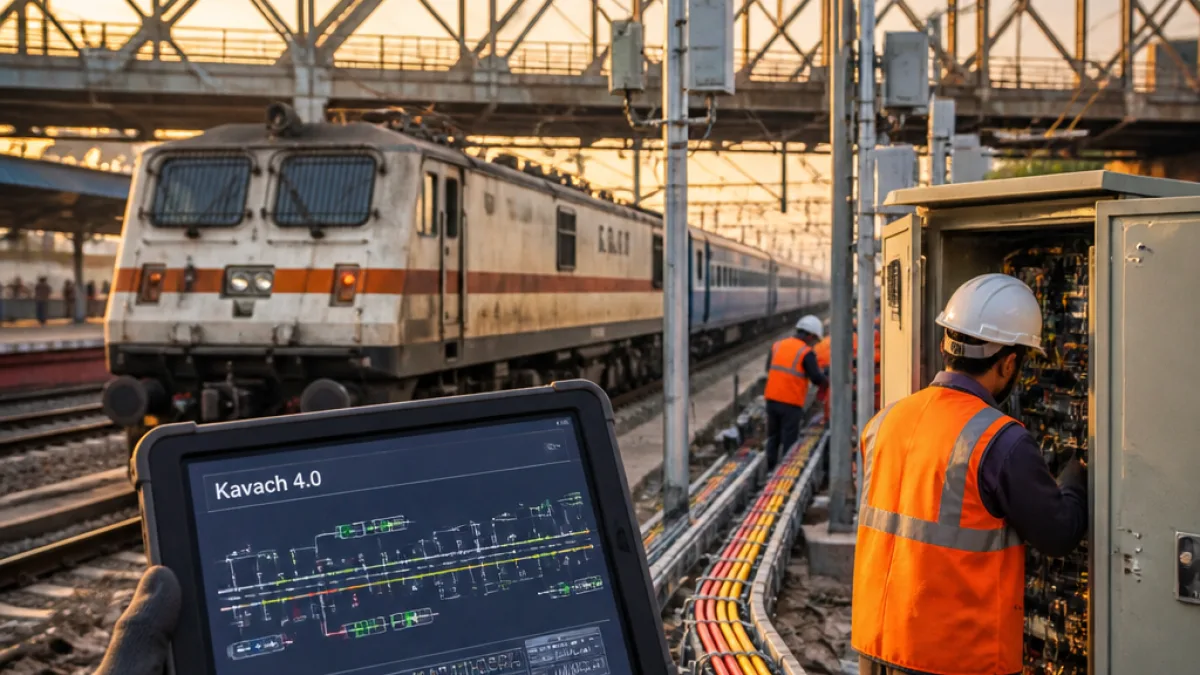
Howrah, West Bengal: The Railway Ministry has commissioned Kavach Version 4.0 on 2,569 route kilometres, covering high-density corridors including the Delhi–Howrah route, the government told Parliament on Wednesday. The move marks a significant step in the Indian Railways’ effort to strengthen automatic train protection on routes serving Howrah and other major terminals.
What Kavach 4.0 adds to the Delhi–Howrah corridor
In a written reply to a Lok Sabha question, Railway Minister Ashwini Vaishnaw described Kavach as an indigenously developed Automatic Train Protection (ATP) system that assists loco pilots by enforcing speed limits and applying brakes automatically if required. The Ministry said version 4.0 incorporates several technical improvements aimed at better performance in dense traffic and complex yard environments.
- Increased location accuracy for on-board systems and trackside coordination.
- Improved information of signal aspects in larger yards where multiple lines and signals operate.
- Station-to-station Kavach interface on OFC (optical fibre cable) to enable consistent communication over longer sections.
- Direct interface to existing electronic interlocking systems, facilitating integration with current signalling infrastructure.
“After extensive and elaborate trials, Kavach Version 4.0 has been successfully commissioned on 2,569 Route Kilometres as of 20.07.26, covering the high-density Delhi-Mumbai and Delhi-Howrah routes,” Vaishnaw said in Parliament.
Funding and deployment progress
The Ministry reported that expenditures on Kavach works up to June 2026 totalled ₹3,874 crore, and the allocation for the financial year 2026–27 is ₹2,066 crore. Officials said the roll-out is planned for large-scale deployment across the network, and funds are being released in line with project progress.
| Item | Figure |
|---|---|
| Route kilometres commissioned (Kavach 4.0) | 2,569 km |
| Expenditure up to June 2026 | ₹3,874 crore |
| Allocation for 2026–27 | ₹2,066 crore |
Safety gains cited by the Ministry
The Ministry highlighted an overall improvement in safety on Indian Railways since the introduction of modern systems and practices. It reported a fall in train accidents from 135 incidents in 2014–15 to 16 incidents in 2025–26. For the current year up to June, the figure stands at two incidents. The Consequential Accident Index (accidents per million train‑kilometres) is recorded at 0.01 in 2025–26 compared with 0.11 in 2014–15.
Local implications for Howrah commuters and freight
Howrah, which anchors one of the busiest rail complexes in eastern India, stands to benefit directly from the enhanced protections on the Delhi–Howrah corridor. Improved location accuracy and signal information should reduce the risk of signal-passed-at-danger events and excessive speeds, particularly on long-distance expresses and high-frequency mail and passenger services that call at Howrah station.
For passengers, the expected outcomes include higher safety margins and potentially fewer service disruptions caused by signalling or human-error incidents. For freight users and logistics operators dependent on the Howrah–Sealdah–Kolkata cluster, more reliable train movement may aid scheduling and turnaround.
Railway planners said the features in Kavach 4.0 are intended to integrate with existing electronic interlocking and communications infrastructure, which is critical in complex terminals like Howrah where yard movements and platform operations are intensive.
Officials indicated that deployment will continue progressively across the network, prioritising high-density and safety-critical stretches. Passengers and local stakeholders will be able to assess the operational impact as more sections enter service under Kavach 4.0 in the coming months.