
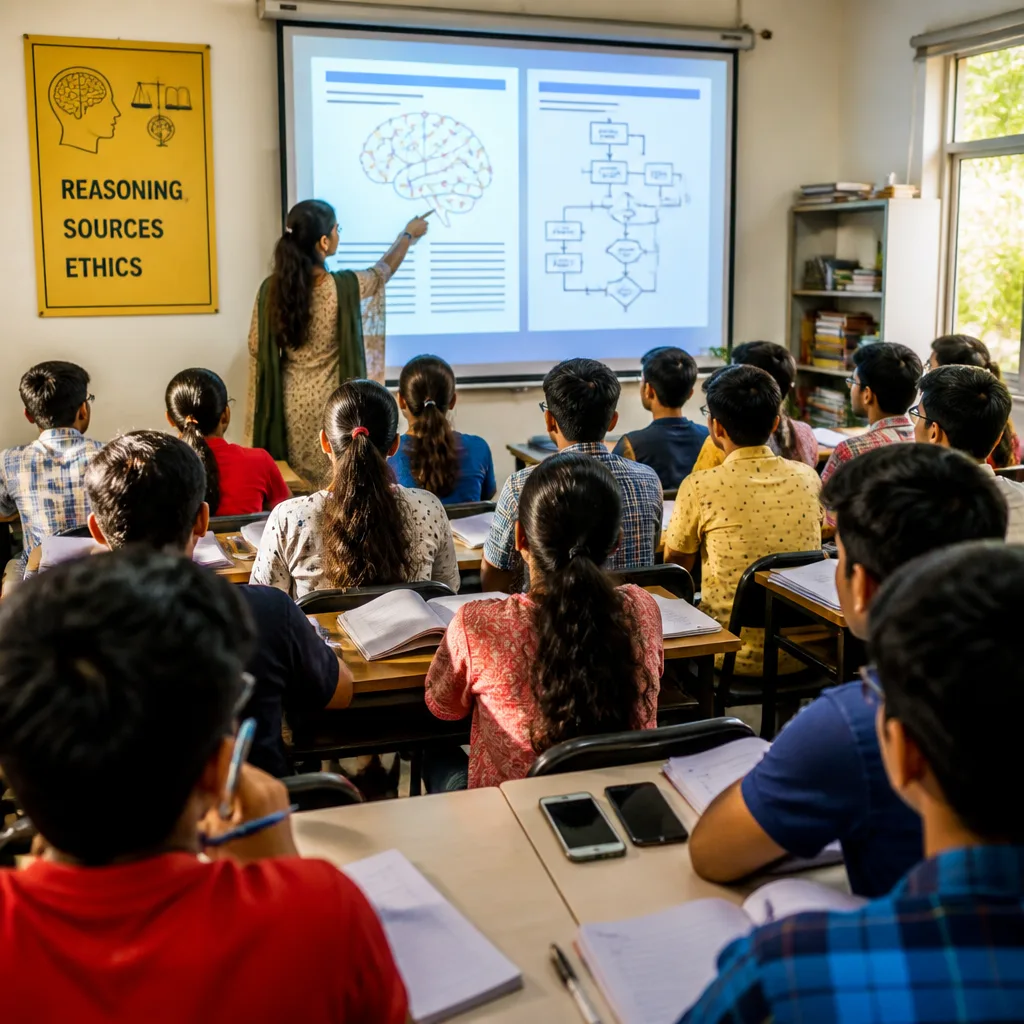
New Delhi: As generative artificial intelligence becomes capable of producing essays, summarising research and answering complex questions, education systems need to reframe what constitutes real learning, according to educators and commentators exploring AI literacy.
From producing work to demonstrating judgement
The rapid improvement of AI tools means submitting an assignment no longer reliably proves that a student has understood a subject. Educators and curriculum designers are increasingly arguing that assessment systems must change so they test the human capacities that machines cannot replicate easily—chief among them judgement.
Where traditional tasks once served as a proxy for student thinking, the presence of AI shifts the emphasis from output to process: how decisions were made, why particular sources were trusted and how trade-offs were weighed. The tools can make production faster, but they cannot on their own demonstrate the discerning, context-sensitive reasoning educators want students to develop.
What schools should emphasise
- Critical evaluation of AI outputs: Teaching students to question and test AI-generated content for accuracy, bias and relevance.
- Domain judgement: Cultivating subject-specific judgement so learners can interpret results in the light of disciplinary conventions.
- Ethical and civic reasoning: Preparing students to consider the social and ethical consequences of relying on AI.
- Metacognition and process documentation: Encouraging learners to reflect on how they reached answers and to document their reasoning.
Presenters at recent discussion forums argued that classroom debate, project-based work and oral examinations can be repurposed to foreground judgement. Such formats force students to articulate reasoning and respond to sceptical questioning—tasks that cannot be fully outsourced to automated systems.
“cognitive offloading”
Research cited in these discussions suggests that heavy reliance on AI may encourage what scholars call "cognitive offloading"—a reduction in the mental effort learners invest when they permit tools to do substantial parts of the thinking. While some studies remain preliminary, educators report seeing patterns in classrooms where students complete tasks more efficiently but retain less of the underlying understanding.
Implications for assessment and policy
The shift has direct consequences for assessment design at school and university levels. High-stakes examinations and automated grading systems that focus narrowly on products will need adaptation to capture reasoning processes. Policymakers and examination boards must consider complementary measures such as:
- oral viva voce and in-person problem solving;
- assessment rubrics that value justification, source evaluation and reflective practice;
- projects requiring iterative drafts with documented feedback and revisions.
Failure to adapt assessments risks producing credentials that do not reflect actual capabilities, particularly in jobs where judgement, ethical reasoning and contextual decision-making matter.
Preparing teachers and updating curricula
Effective integration will demand investment in teacher professional development. Educators must be trained not only in how to use AI tools, but in how to teach students to interrogate their outputs, identify limitations and combine machine assistance with human oversight.
Curriculum frameworks may also need to be rewritten to place greater emphasis on higher-order cognitive skills rather than factual recall. In practice this could mean more emphasis on open-ended investigations, interdisciplinary projects and guided reflection.
| Skill | Why it matters |
|---|---|
| Judgement | Enables contextualised decisions that AI cannot independently make |
| Source evaluation | Reduces risk of accepting inaccurate or biased content |
| Ethical reasoning | Prepares learners for societal impacts of AI use |
Experts involved in several recent panels urged a balanced approach: neither blanket bans on generative AI nor uncritical adoption will serve learners well. Instead, educational systems should equip students to work alongside AI—using tools to amplify human capabilities while preserving and strengthening the uniquely human skill of judgement.
The conversation has immediate resonance for Indian schools and higher education institutions that are already wrestling with how to treat AI in examinations, coursework and employability frameworks. Adapting pedagogy and assessment now will determine whether certifications continue to signal genuine competence in a world where machines can produce convincing but not necessarily correct work.