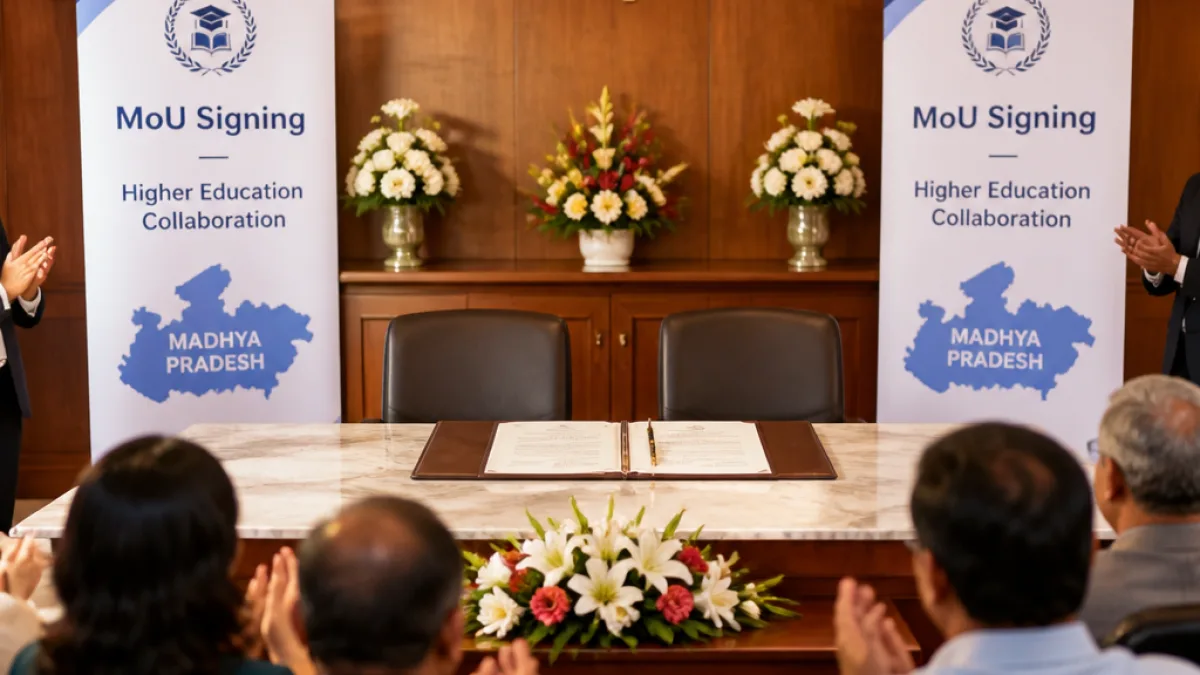
Bhopal: The Indian Institute of Technology (Banaras Hindu University), Varanasi (IIT (BHU)), and the Department of Higher Education, Government of Madhya Pradesh, signed a Memorandum of Understanding (MoU) on 31 January 2026 aimed at strengthening cooperation in higher education, research, innovation and technology development across the state.
Purpose and scope of the partnership
The agreement, signed at the RCVP Noronha Academy of Administration in Bhopal, was entered into to foster academic collaboration and build capacity in cutting‑edge fields. It brings together some 30 higher education institutions under the Madhya Pradesh government — including state universities, National Institutes of Technology and other technical institutions — to benefit from IIT (BHU)’s expertise.
The MoU was signed by Prof. Rajesh Kumar, Dean (Research & Development), on behalf of IIT (BHU), and Prabal Sipaha, Commissioner, Higher Education, on behalf of the department. The ceremony took place in the presence of Governor Mangubhai Patel and Chief Minister Mohan Yadav. Also present were Prof. M.K. Meshram, Coordinator of the Centre for Innovation, Incubation and Entrepreneurship (CIIE) at IIT (BHU), and Vikas Kumar, Assistant Professor from the Department of Higher Education, Government of Madhya Pradesh, together with senior officials from both sides.
Planned activities under the MoU
The collaboration envisages a range of academic and capacity‑building activities designed to align state institutions with the National Education Policy (NEP) 2020 and evolving industry needs. According to the document, the partners will jointly deliver:
- certificate programmes and executive education;
- Faculty Development Programmes (FDPs), workshops and boot camps;
- technical competitions and entrepreneurship initiatives;
- research collaborations and technology development efforts in priority areas.
Technical focus areas listed for collaboration include Artificial Intelligence, Machine Learning, Data Science, Robotics, Internet of Things (IoT), Cyber Security, Semiconductor Technologies, Smart Manufacturing, Industry 4.0, Additive Manufacturing, Digital Engineering and Quantum technologies.
Expected institutional benefits
The MoU aims to elevate teaching quality, research output and industry linkages in Madhya Pradesh’s tertiary institutions. Officials framed the pact as a means to:
- upgrade faculty skills through targeted training and exposure;
- promote student engagement with contemporary technologies and entrepreneurship;
- foster joint research projects and innovation initiatives with potential for commercialisation;
- facilitate industry‑academia partnerships that address regional skill and technology needs.
| Area | Activities envisaged |
|---|---|
| Capacity building | FDPs, executive education, workshops, boot camps |
| Academic programmes | Certificate courses, technical competitions |
| Research & innovation | Joint projects, incubation, technology development |
| Industry linkages | Collaborative programmes aligned to Industry 4.0 and semiconductor tech |
Alignment with national education goals
Officials framed the collaboration as consistent with the NEP 2020, which emphasises multidisciplinary learning, industry engagement and research‑led teaching across higher education institutions. The MoU signals an effort by the state government to leverage an IIT’s institutional capacity to implement NEP objectives at scale within Madhya Pradesh.
Representatives from both sides said the partnership will also pursue initiatives to boost entrepreneurship and incubation through the CIIE at IIT (BHU), opening avenues for start‑ups emerging from colleges and universities in the state.
Next steps and implementation
The MoU specifies that the partners will organise specific programmes and activities jointly; further operational details, timelines and measurable targets were not disclosed at the signing. The two parties are expected to draw up implementation plans, identify participating institutions and begin rolling out capacity‑building and academic initiatives as per the agreement.
By formalising the collaboration, Madhya Pradesh’s higher education department intends to upgrade academic standards and produce graduates with skills tailored to rapidly evolving technology sectors.
This report is based on the official announcement of the memorandum and the list of areas and activities set out in the agreement.