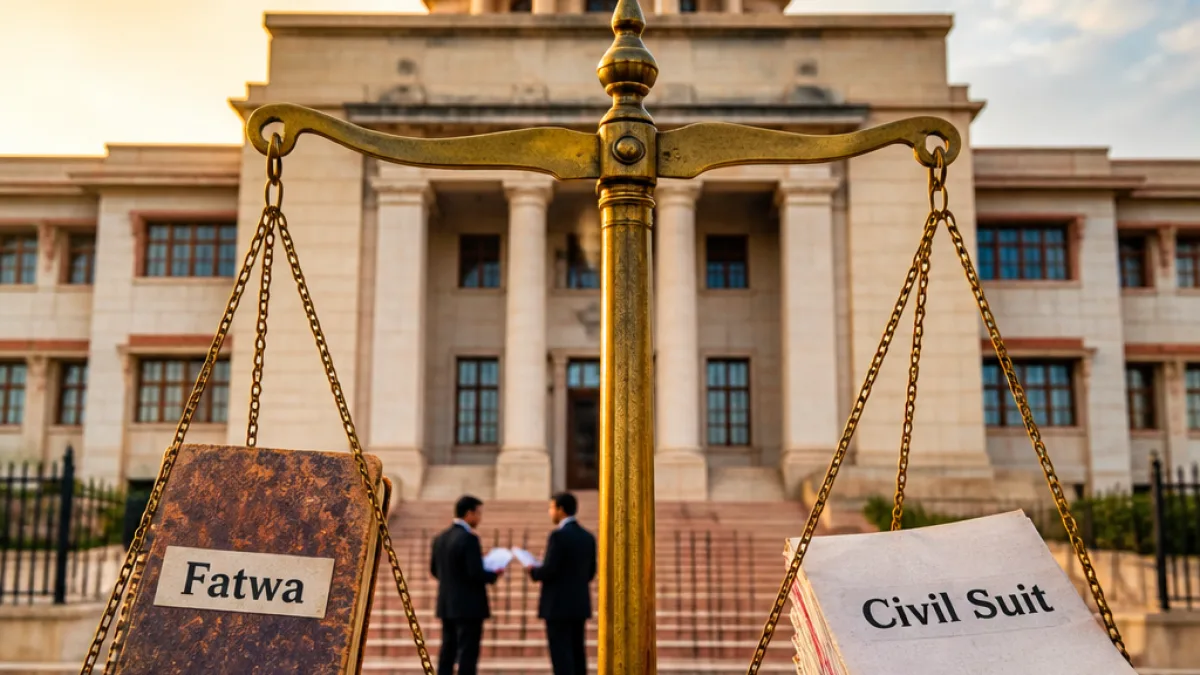
The Madhya Pradesh High Court has ruled that a Fatwa or religious opinion explaining Islamic principles cannot, on its own, serve as a legal basis for a civil court to declare a marriage dissolved. The court set aside a Family Court order and dismissed a civil suit that sought a declaration of divorce solely on the strength of a Fatwa issued by a Bhopal seminary.
Background of the litigation
The dispute originated from a civil revision petition challenging an order passed by the Family Court under Order VII Rule 11 of the Code of Civil Procedure. The husband had approached the Family Court seeking a declaratory decree that his marriage stood dissolved, relying on a Fatwa issued by the Darul-Ifta Masajid Committee, Bhopal.
The wife contested the suit, arguing that the Fatwa did not itself grant a divorce nor did it vest the issuing seminary with power to dissolve a marriage. She submitted that the document merely expounded Islamic doctrines and circumstances under which divorce may be sought, and therefore could not sustain a civil decree of dissolution.
Court's analysis and findings
Justice Vivek Jain examined the Fatwa in question and concluded that it did not pronounce or grant a divorce. The judgment records that the Fatwa responded to a query and provided religious guidance by explaining principles under Islamic scriptures rather than operating as a legal instrument to sever matrimonial ties.
"Any seminary cannot grant any divorce to a Muslim male."
The court relied on established legal principles and previous rulings which make clear that matrimonial matters must be determined by competent civil forums. The bench observed that Muslim men are entitled to seek divorce through the statutory processes before Family Courts and that assuming a declaratory decree founded exclusively on a Fatwa was legally incorrect.
Disposition and practical outcome
Holding that the suit disclosed no valid cause of action, the High Court set aside the Family Court order that had permitted the plaint to proceed and dismissed the civil suit seeking a declaration of divorce based solely on the Fatwa. At the same time, the court made clear that the husband remains free to institute a fresh petition under the relevant statutory provisions before the Family Court.
| Aspect | High Court Ruling |
|---|---|
| Validity of Fatwa as legal instrument | Not sufficient to declare marriage dissolved |
| Family Court order (allowing plaint) | Set aside |
| Husband's options | May file fresh divorce petition before Family Court |
Legal and social implications
The judgment clarifies the separation between religious guidance and civil adjudication in matrimonial disputes, emphasising that a religious seminary's opinion cannot substitute for judicial process. The ruling reinforces the role of Family Courts as the appropriate forum for divorce petitions, irrespective of the religious context of the parties.
For litigants and practitioners, the decision underscores the need to approach family law matters through statutory procedures under the Code of Civil Procedure and relevant personal laws, rather than seeking declaratory relief solely on the basis of religious edicts.
What this means for parties in similar disputes
- Religious pronouncements or Fatwas may be treated as evidence of religious practice or belief but are not self-executing legal instruments to dissolve marriage.
- Parties seeking dissolution of marriage must approach the Family Court or other competent civil forum under applicable laws.
- Legal practitioners should ensure plaints disclose a valid cause of action under civil procedure and family law before initiating declaratory suits.
The High Court's order provides a reiteration of established law that marries constitutional and statutory principles with social realities, aiming to prevent the substitution of religious guidance for legal adjudication in family matters.
Reportedly delivered by the bench presiding over the revision, the judgment reiterates that while religious institutions may offer counsel and interpretation of faith-based texts, they do not possess the authority to effect legally binding dissolution of marriage under civil law.