Centre, State sign MoU for integrated telecom cluster in Gwalior
GWALIOR: The Department of Telecommunications (DoT) and the Government of Madhya Pradesh have signed a memorandum of understanding to set up an integrated Telecom Manufacturing Zone (TMZ) in Gwalior, officials said, marking a push to develop domestic telecom production and allied research and testing facilities.
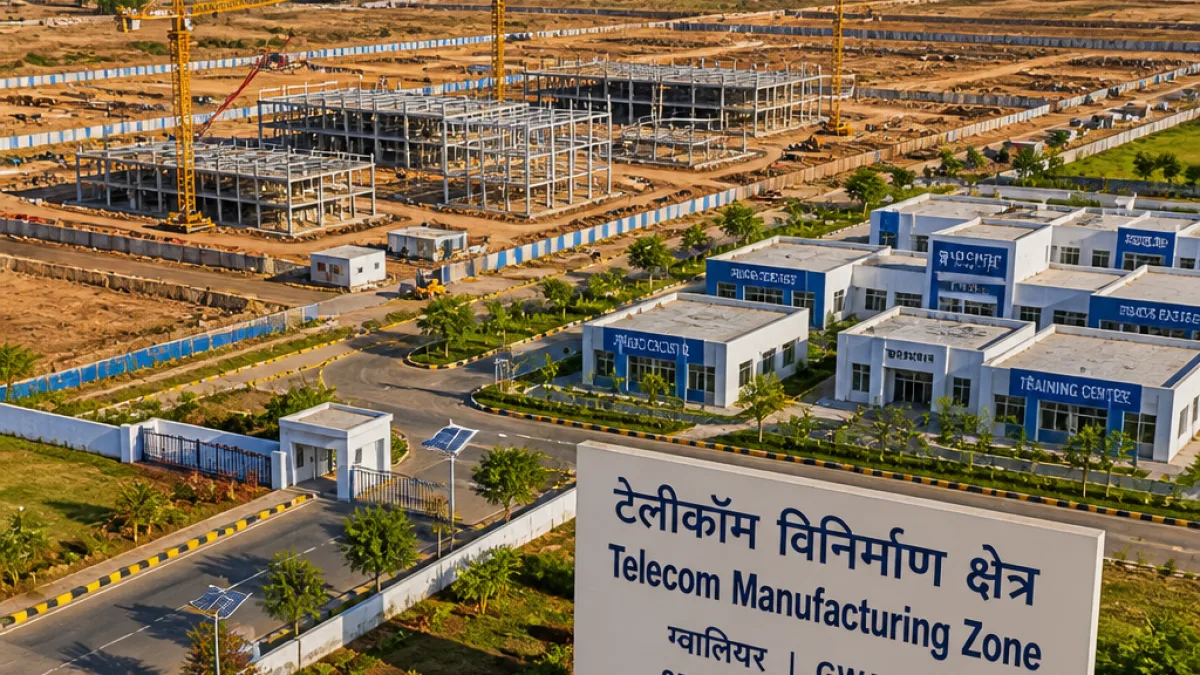
The TMZ will be developed on about 350 acres as a plug‑and‑play industrial cluster designed to host manufacturing units, R&D centres, common testing laboratories and other support infrastructure. The project is expected to attract investments in the range of ₹12,000–15,000 crore over time and generate around 14,000 direct skilled jobs, according to the MoU text and state officials.
Funding, land allocation and governance
The Centre will provide complete funding for the first phase of infrastructure development with an allocation of ₹493 crore. The state government has set aside roughly 170 acres for the TMZ, including parcels in the SADA region and the Gwalior IT Park, officials said.
The MoU envisages formation of a special purpose vehicle (SPV) to implement the project, with a governance structure that reflects central and state participation. Additional land for expansion will be made available under highly concessional terms, including nominal lease rents and minimal premiums, according to the agreement.
Incentives for manufacturers
To attract investors, the Madhya Pradesh government has outlined a policy package that includes capital subsidies, employment support and other fiscal incentives. Key measures include:
- 50% capital subsidy on eligible fixed capital investment, capped at ₹200 crore per unit;
- Employment support of ₹5,000 per month for eligible workers for a period of five years;
- Skill development assistance of up to ₹13,000 per new employee;
- Reimbursement of stamp duty and registration charges and power tariff incentives;
- Support for standalone R&D units and limited reimbursement for expenses on patents, copyrights and trademarks;
- Freight subsidies for export‑oriented units to ports and air cargo facilities.
| Item | Benefit |
|---|---|
| Phase‑I infrastructure | Centre funding of ₹493 crore |
| Land allocation | ~170 acres provided by the state (including SADA, IT Park) |
| Capital subsidy | 50% of eligible investment; max ₹200 crore |
Policy intent and strategic goals
Union Communications Minister Jyotiraditya Scindia described the development as part of a broader effort to shift India from primarily providing telecom services to establishing a robust manufacturing base for telecom equipment. He said the TMZ would assemble manufacturing, testing, design and innovation capabilities on a single campus, strengthening the domestic supply chain and reducing import reliance.
"The Telecom Manufacturing Zone will help build an indigenous ecosystem by bringing manufacturing, testing, design and innovation capabilities together in one location," the Minister said.
Officials noted the project fits within the national aim of Aatmanirbhar Bharat by promoting locally made telecom products and enabling export potential for Indian manufacturers. The availability of common testing laboratories and certification facilities within the TMZ is intended to reduce time‑to‑market for new products and support smaller innovators who otherwise face high compliance costs.
Local implications and next steps
For Gwalior, the TMZ is pitched as an economic opportunity that could boost the industrial and technological profile of the city and surrounding districts in central India. The state has already indicated concessional land terms — including allocations free of cost for certain parcels and long‑term leases at minimal rent — to make the zone more attractive to investors.
According to the MoU, establishment of the SPV and completion of detailed project planning will be the immediate next steps. Officials will now move to finalise investor outreach, infrastructure design and a timeline for Phase‑I execution backed by the Centre’s allocated funds.
Implementation timelines and the names of early anchor investors were not specified in the documents made public at signing.