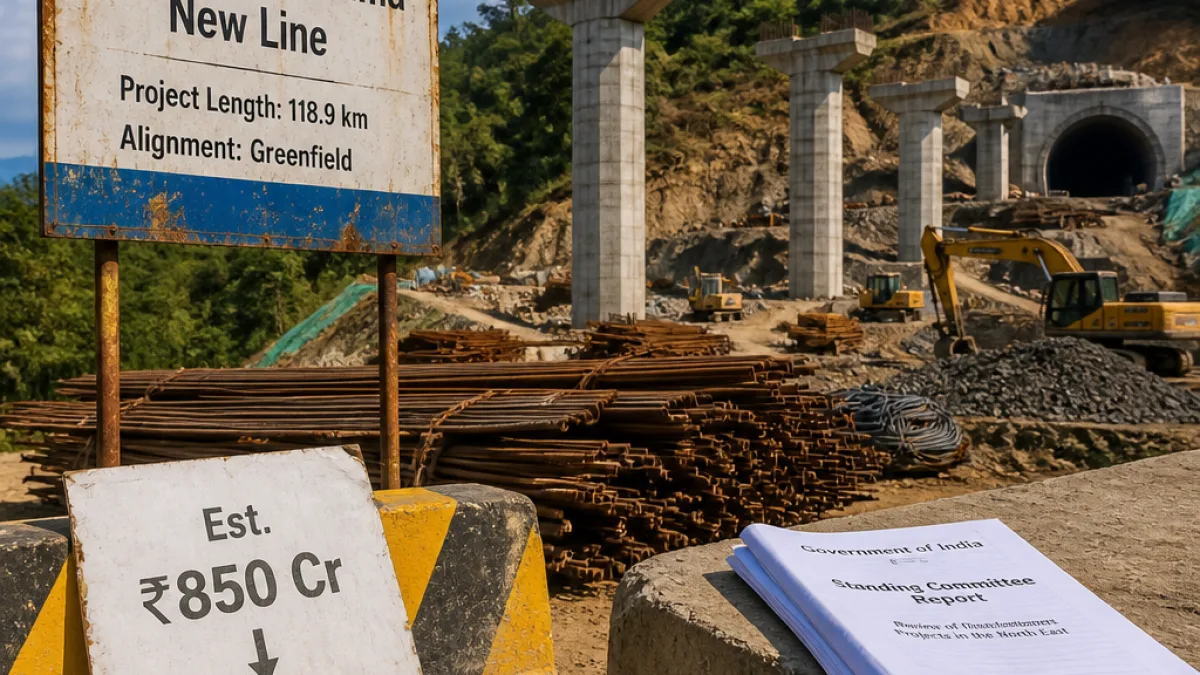
Parliamentary committee cites governance, survey and land acquisition failures
NEW DELHI — The cost of the Dimapur–Kohima new line project in the Northeast Frontier Railway zone has escalated more than sevenfold, increasing from a sanctioned estimate of ₹850 crore in 2006-07 to ₹6,663.20 crore by May 2022, while physical progress stood below 25 per cent as of March 2022, a Public Accounts Committee (PAC) report presented in Parliament said on Tuesday.
The report, titled Construction of Dimapur–Kohima New Line Project: Northeast Frontier Railway, observed that the stalling of the project illustrates recurring shortcomings common to large railway infrastructure works in geographically complex regions. These include inadequate initial surveys, rushed land acquisition, tunnel design problems, premature procurement and weak contract management, the committee said.
- Cost escalation: From ₹850 crore (2006-07) to ₹6,663.20 crore (May 2022).
- Physical progress: Reported as below 25% by March 2022.
- Contract and design issues: Repeated alignment revisions and tunnelling design challenges.
The committee said such an increase in cost coupled with limited on-ground progress represents “a failure of financial oversight and project governance”, delaying the socio-economic benefits the line was intended to deliver to the people of Nagaland, a landlocked hill state heavily dependent on road transport. Nagaland currently has only 11.13 km of broad-gauge railway lines, the report noted.
“The project has been plagued by repeated alignment revisions, persistent land acquisition challenges, tunnelling design issues, premature procurement, and systemic failures in contract management,” the committee observed.
According to the PAC, the pre-construction survey between Dimapur and Zubza was entrusted to M/s RITES and completed at a reported cost of ₹7 crore, but the survey work did not avert subsequent alignment revisions and technical complications that have impeded progress. The committee highlighted that these lapses have led to long delays and major cost overruns.
| Item | Figure |
|---|---|
| Sanctioned cost (2006–07) | ₹850 crore |
| Revised cost (May 2022) | ₹6,663.20 crore |
| Physical progress (March 2022) | Below 25% |
| Existing broad-gauge in Nagaland | 11.13 km |
For Kohima residents, the Dimapur–Kohima link has long been billed as a project that would improve all-weather connectivity, reduce travel time and bolster trade and transport links to the plains. The PAC said the delayed completion and mounting cost burden have deferred those anticipated benefits.
The report did not provide a fresh completion date. It underlined systemic weaknesses that require corrective measures, including rigorous pre-construction surveys, thorough cost-benefit analysis at the design stage, strengthened oversight of procurement and contracts, and more effective mechanisms for land acquisition and environmental clearances in rugged terrain.
Transport and infrastructure planners routinely cite the North-East’s difficult topography and ecological sensitivity as complicating factors for large projects. The PAC report, however, pointed to administrative and procedural faults rather than geography alone as major causes of the protracted timeline and budget overruns.
Public accountability bodies have increasingly scrutinised projects where early estimates prove inadequate and governance gaps widen the scope for delays and cost escalation. The committee’s findings on the Dimapur–Kohima project add to broader concerns about execution of infrastructure projects in hilly and remote areas, and will likely prompt calls for tighter monitoring and revised project-management frameworks.
Officials in Nagaland have long pressed for improved rail connectivity to foster economic opportunities and better access to essential services. With the PAC report now on record in Parliament, state stakeholders and the Ministry of Railways face renewed pressure to present a clear action plan to accelerate work, contain costs and ensure that the intended benefits reach Kohima and other parts of the state within a realistic timeframe.