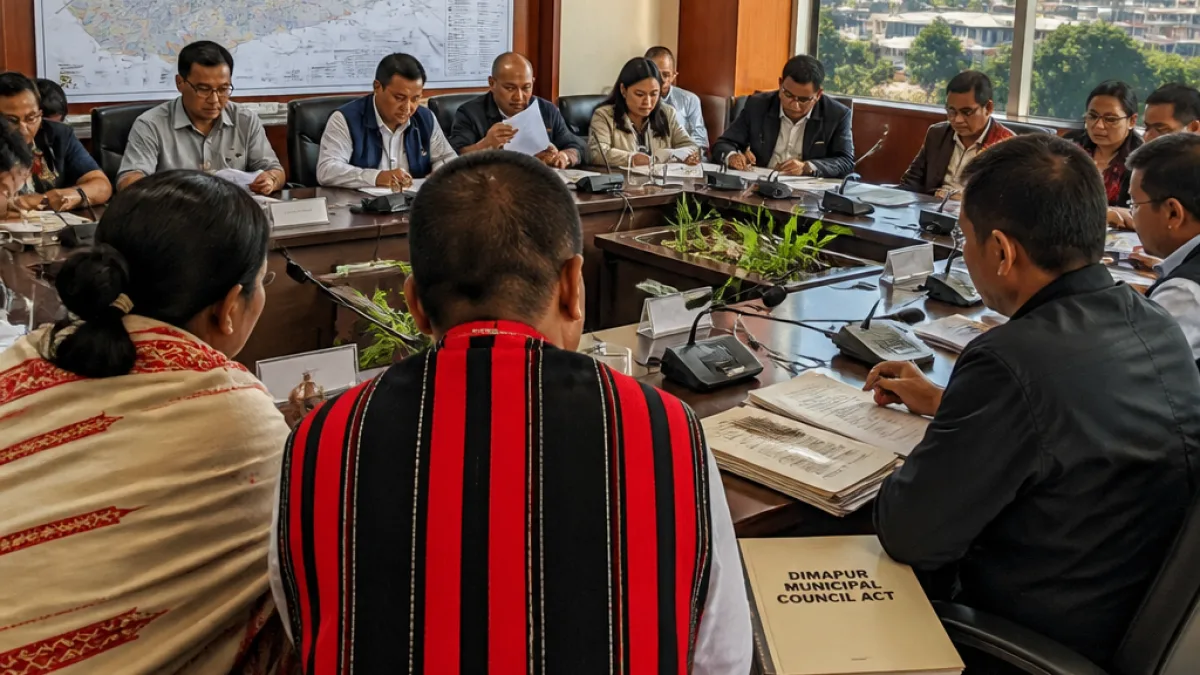
Committee reviews interface between new municipal law and customary institutions
Dimapur: A legislative panel undertaking oversight of urban local bodies and village councils held two separate stakeholder consultations in Dimapur on Friday as part of a spot visit to assess how the Nagaland Municipal Act, 2023 and the Nagaland Village and Tribal Councils Act, 1978 (amended up to 2022) are functioning on the ground, Nagaland Tribune reported.
The Committee on Urban Local Bodies and Nagaland Village Councils, chaired by K Tokugha Sukhalu, MLA — who is also Advisor for Food & Civil Supplies and Legal Metrology — met first with the district administration, Urban Gaon Buras and colony chairmen. A second meeting was held with the newly elected Dimapur Municipal Council (DMC). Committee members present included Imkongmar, Dr Kekhrilhoulie, A. Nyamnyie Konyak, Dr Neisatuo Mero, Lima Onen Chang and Ar. Jwenga Seb.
"listen, investigate and understand"
In his introductory remarks, Sukhalu said the committee had convened in Dimapur to listen, investigate and understand how the municipal council, customary Urban Gaon Buras, colony chairmen and the district administration coordinate in practice. He described Dimapur as the commercial hub and gateway to the State and observed that developments in the city have ramifications for Nagaland as a whole.
Dual governance and practical challenges
The committee’s mandate, Sukhalu noted, is to review the implementation and intersection of the two laws, which together reflect the State’s dual reality of statutory urban governance alongside enduring customary authority. The visit acknowledged a historic transition: after more than two decades without an elected municipal body, the newly formed DMC represents the operationalisation of the 2023 municipal statute.
At the same time, the committee recognised that Urban Gaon Buras continue to play a central role in maintaining customary authority, law and order, and community mediation. The meetings sought to surface areas where the 2023 Act empowers or restricts councillors and to identify administrative support required for effective implementation.
- First consultation: district administration, Urban Gaon Buras and colony chairmen.
- Second consultation: Dimapur Municipal Council members.
- Objective: review overlaps, gaps and administrative needs arising from the two Acts.
Immediate issues and implications for residents
The committee’s focus on the interface between statutory municipal structures and customary institutions is likely to centre on practical matters that affect daily life in Dimapur — from service delivery, sanitation and licensing to dispute resolution and local law-and-order coordination. As towns expand, jurisdictional overlaps can create administrative confusion and affect the pace at which civic services are delivered.
By asking DMC councillors to outline specific areas where the 2023 Act aids or constrains their work, the committee is seeking actionable feedback that could inform amendments, rules or administrative directions aimed at smoothing implementation. Any recommendations that emerge may influence resource allocation, staffing and standard operating procedures for municipal functions across the State.
Committee composition and follow-up
The panel is chaired by K Tokugha Sukhalu and includes six other named members. The reported presence of both elected municipal representatives and customary leaders suggests the committee is pursuing a consultative approach to reconcile statutory mandates with customary practice.
| Name | Role (as reported) |
|---|---|
| K Tokugha Sukhalu | MLA; Chairperson of the Committee; Advisor for Food & Civil Supplies, Legal Metrology |
| Imkongmar | Committee member |
| Dr Kekhrilhoulie | Committee member |
| A. Nyamnyie Konyak | Committee member |
| Dr Neisatuo Mero | Committee member |
| Lima Onen Chang | Committee member |
| Ar. Jwenga Seb | Committee member |
Further deliberations and any recommendations arising from the consultations were not detailed in the report. The committee’s findings and subsequent action — whether administrative guidance, rule framing or legislative amendment — will be closely watched by municipal representatives, customary authorities and urban residents who depend on clear lines of authority for civic services.
The consultations underscore the broader task in Nagaland of harmonising statutory governance mechanisms with customary institutions as urban areas grow and administrative responsibilities evolve.