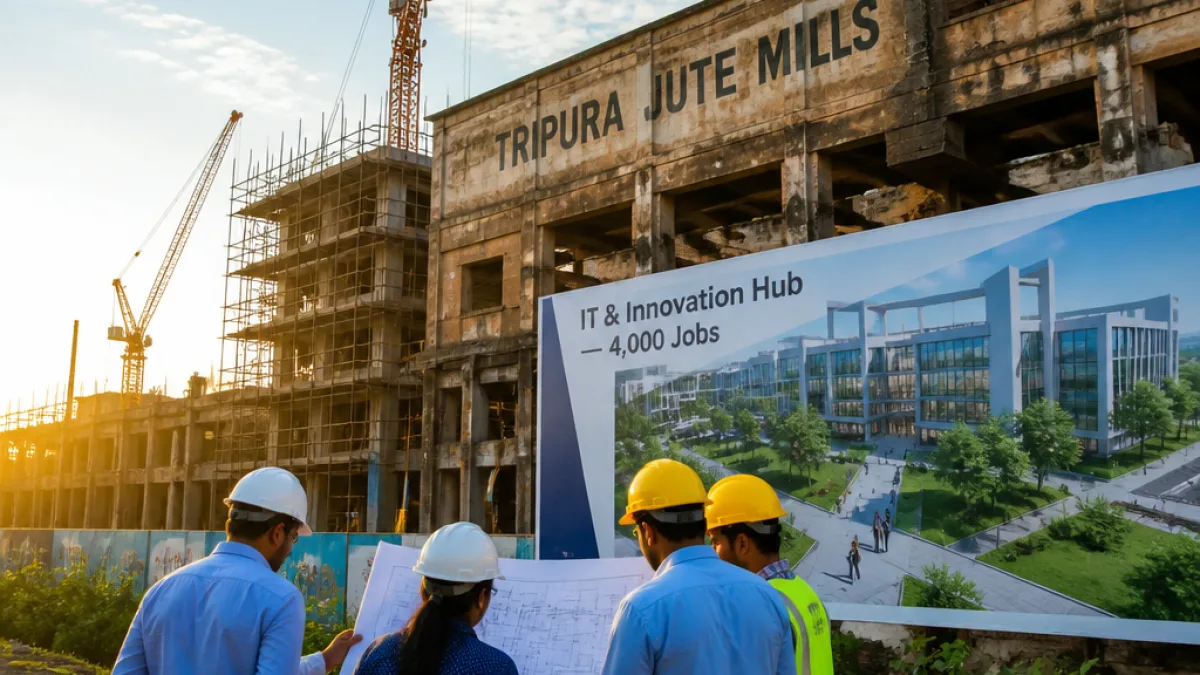
Agartala: The Tripura government has announced plans to convert the long-defunct Tripura Jute Mills Limited (TJML) into an information technology and economic hub, a move officials say will expand the state's revenue base and create employment for thousands.
Redevelopment, liabilities cleared
Addressing a media briefing at the BJP state office in Agartala, Finance Minister Pranajit Singha Roy said the administration has already settled over ₹220 crore in pending employee liabilities tied to the state-owned unit and will repurpose the facility's land for economic activities. The proposed plan includes an IT park, a hospital and a convention centre on or adjacent to the site, the minister said.
"The responsibility of a government is not merely to preserve failed institutions but to take difficult decisions in the larger public interest. We first ensured justice for the workers by clearing their long-pending dues and are now converting the land into a productive economic asset," the minister said.
Singha Roy framed the project as a strategic reorientation of Tripura's industrial policy aimed at boosting self-generated revenue, creating local employment and cutting dependence on Central grants.
History and allegations
The minister traced TJML's history, noting the company was incorporated in 1956, trial production began after the Left Front took office in 1978, and commercial operations started in 1981. He charged that the mill was allowed to decline under the previous Left Front government, attributing the collapse to politicisation, indiscriminate recruitment and mismanagement.
Singha Roy alleged that the factory "became a centre of political activities instead of production," and said large-scale appointments were made without operational justification. He claimed there were about 860 employees appointed during that period.
Employment and economic expectations
The government is projecting that the redevelopment will generate approximately 4,000 jobs—a mix of direct employment in IT and related services and indirect opportunities from ancillary services, infrastructure and the proposed hospital and convention centre. Officials emphasised that the move is intended to revive an idle asset into a contributor to the state's economy.
- Cleared liabilities: ₹220 crore (as stated by the Finance Minister)
- Historical milestones: Company formed in 1956; trial production 1978; commercial operations 1981
- Alleged past staff strength: about 860 employees (allegation)
- Projected employment from redevelopment: around 4,000 jobs
Local impact and next steps
Redeveloping TJML is presented by the state as both a means of delivering long-overdue wage justice to former employees and of creating a new economic node in the state capital's periphery. The government has so far indicated financial closure of liabilities; details on project partners, timelines, funding models and land-use plans were not disclosed at the briefing.
Observers and stakeholders in Tripura will look for formal project documents, tender notices and memoranda of understanding that would clarify whether the project will be driven through public investment, public–private partnership, or through inviting private developers. The announcement did not specify whether the site will retain any jute-based activities or how existing employees or pensioners will be integrated into the transition.
Political context
Singha Roy used the occasion to criticise the previous Left Front administration, pointing to what he described as long-term deterioration under its management. The remarks reflect the broader political debate in the state over industrial policy, employment and the role of state-owned enterprises.
| Year | Event |
|---|---|
| 1956 | Company incorporated |
| 1978 | Trial production began (after Left Front assumed office) |
| 1981 | Commercial operations commenced |
Officials have framed the redevelopment as a corrective measure to maximise value from idle land while addressing past employee grievances. For the project to translate into the promised employment and revenue gains, detailed implementation plans, investor interest and clear timelines will be required.
Tripura's move mirrors a growing trend among states to repurpose legacy public-sector industrial sites for new economic activities. Residents and local businesses in and around Agartala will be watching for announcements about project contracts, construction schedules and opportunities for local participation.