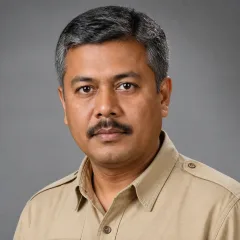
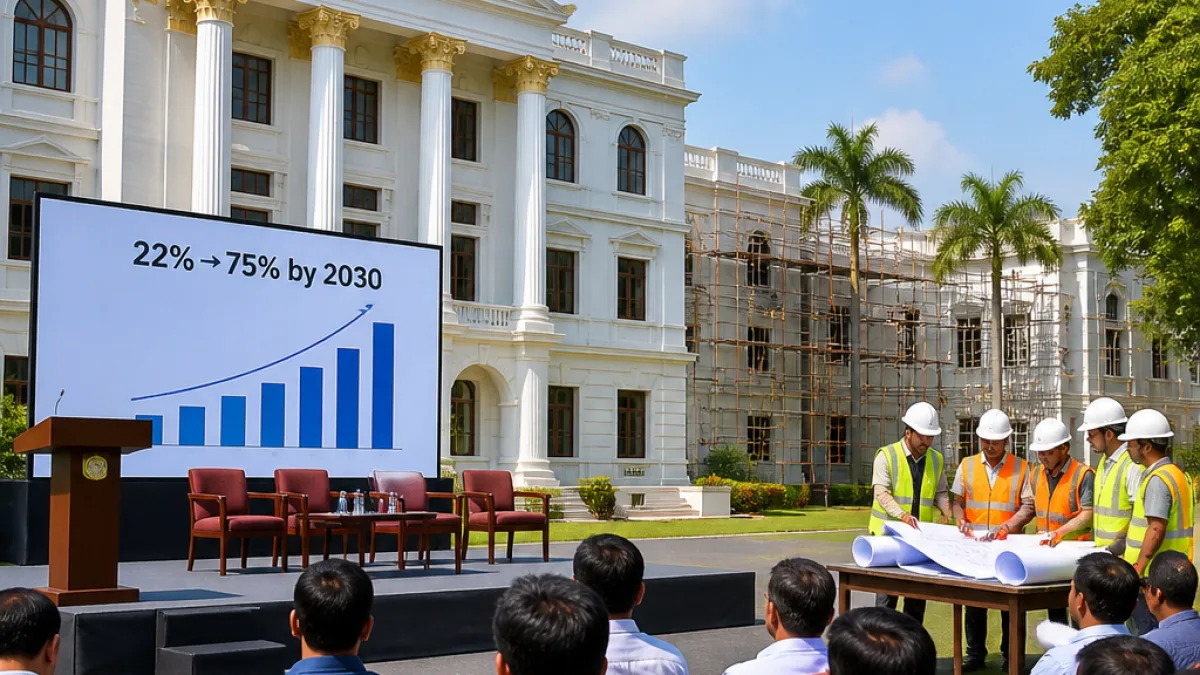
Agartala, 6 August: Tripura’s Higher Education Minister Kishore Barman on Thursday announced an ambitious plan to raise the state’s higher education participation rate from the present 22 percent to 75 percent by 2030, saying system-wide transformation is essential to realise the central government’s development objectives.
Target, approach and institutional changes
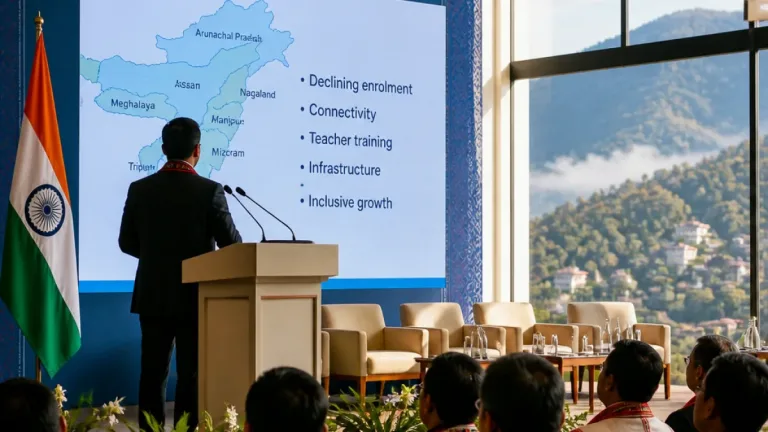
Addressing a review meeting titled Higher Education Dialogue at the administrative building of Maharaja Bir Bikram (MBB) University, Barman said students must remain at the centre of all policy decisions. He outlined a multi-pronged approach that includes modernising infrastructure, creating a healthy academic environment and strengthening coordination among teachers, students and administrators.
To build model centres of higher learning, the minister announced plans to integrate MBB University, MBB College, BBMC College and the Law College into a unified academic ecosystem and develop them as benchmark institutions by 2030. He said such consolidation would help concentrate resources, raise standards and provide learners with improved facilities.
Student voice and decentralised problem-solving
Barman stressed that institutional development cannot be achieved by government action alone and urged equal participation from ministers, administrators, faculty and students. He emphasised that policy-making should give greater weight to the opinions of students who regularly attend classes and make active use of campus facilities such as libraries, laboratories and canteens.
"Students' voices should form the foundation of every major policy decision," the minister said.
On administrative processes, the minister directed college authorities to resolve minor issues at the institutional level rather than routinely escalating them to the ministry. He said similar review meetings would be held across all districts to identify and address local bottlenecks promptly.
Infrastructure, coordination and capacity building
The review meeting examined current infrastructure gaps across colleges and discussed measures to improve academic coordination. Barman identified three broad requirements: modern physical infrastructure, a supportive academic environment and active engagement between stakeholders to ensure improved enrolment and retention.
Officials at the meeting reviewed existing challenges and explored ways to strengthen teacher-student-administration linkages, though the minister did not lay out a detailed financing plan or specific timelines for each intervention during the session.
Pending proposals and follow-ups
The minister also mentioned proposals for expanding higher education through new initiatives. The source account truncates a reference to a proposed Tripura Technical University and a scheme beginning with "Women’s Un", but does not provide full details. The government has said district-level meetings will follow to take stock of local issues and implementation needs.
- Current participation: 22%
- Target participation: 75% by 2030
- Key institutions for development: MBB University, MBB College, BBMC College, Law College
- Planned measures: Infrastructure upgrades, stronger academic environment, stakeholder coordination, district review meetings
| Metric | Present | Target (2030) |
|---|---|---|
| Higher education participation rate | 22% | 75% |
| Model institutions (named) | Four (identified) | Integrated academic ecosystem |
Implications for students and institutions
The minister’s announcement signals a major push to enlarge access to collegiate education in Tripura. Achieving the target will require increases in capacity, improvements in quality and greater outreach to potential students, especially in semi-urban and rural areas where higher education participation has traditionally been low.
Education stakeholders will be watching for follow-up measures that specify funding sources, timelines for infrastructure projects, faculty recruitment plans and measures to promote student retention. District-level reviews, if effectively executed, may help tailor interventions to local needs and expedite problem resolution.
The announcement places a clear emphasis on student-centred policymaking and institutional integration. How the proposals are translated into funded projects and operational reforms will determine whether the state moves towards the substantial rise in participation envisaged by 2030.
Reporting from Agartala.