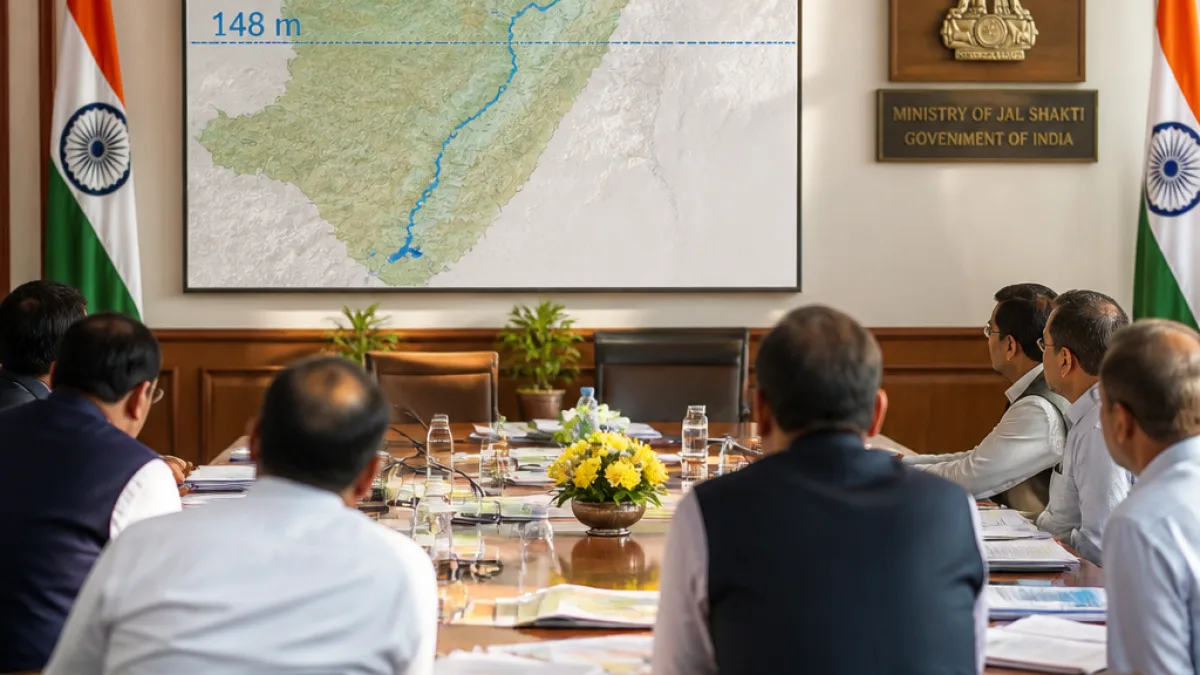
Telangana Chief Minister Revanth Reddy on Wednesday urged the Union Jal Shakti Ministry to intervene in the prolonged dispute with Maharashtra over the proposed height of the Tummidihetti Barrage, seeking approval for a 150-metre full reservoir level (FRL) to maximise irrigation benefits for the State’s northern districts.
Mr Reddy called on Union Minister C.R. Patil in New Delhi, and was accompanied by Telangana Irrigation Minister N. Uttam Kumar Reddy and Members of Parliament from the State. The meeting focused on resolving differences with Maharashtra, which has reportedly cleared a lower FRL of 148 metres.
Telangana’s case: higher FRL, limited submergence, greater benefits
The Telangana government argued that raising the barrage to 150 metres would not materially increase submergence in Maharashtra and that submergence would remain below 1,000 hectares. It maintained that the additional elevation would substantially increase the project’s irrigation potential and overall utility.
“Such a system would eliminate the need for large-scale lift irrigation infrastructure, thereby significantly reducing project costs, lowering energy consumption and ensuring more sustainable water management.”
Telangana officials explained that at the proposed height the barrage would allow gravity-based distribution of Pranahita River water — a tributary of the Godavari — reducing dependence on energy-intensive lift schemes and lowering long-term operational costs.
Background and stakes
The Tummidihetti Barrage is a central component of Telangana’s irrigation strategy for its northern districts. The project has been pending for several years because of disagreements with Maharashtra over permissible FRL and consequent submergence in the neighbouring State’s territory. Following the bifurcation of Andhra Pradesh in 2014, the design and alignment of the project were modified, and remaining inter-state issues have delayed implementation.
Telangana officials told the Union Minister that the higher FRL would deliver a more viable gravity-irrigation scheme capable of serving a larger command area while reducing displacement and environmental impacts compared with alternate lift-intensive plans.
Steps sought from the Centre
In the meeting, Mr Reddy requested that the Union Jal Shakti Ministry facilitate consultations between the two States to reach a consensus on the FRL. Telangana asked the Centre to play a mediatory role and clear the way for constructing the barrage at 150 metres.
- Requested FRL: 150 metres
- Maharashtra reportedly cleared: 148 metres
- Estimated submergence at 150 m: below 1,000 hectares (as stated by Telangana)
| Item | Detail |
|---|---|
| River | Pranahita (Godavari tributary) |
| Proposed FRL (Telangana) | 150 m |
| Reported FRL (Maharashtra) | 148 m |
| Submergence (Telangana estimate) | Below 1,000 hectares |
Officials said the Tummidihetti Barrage, if constructed at the higher FRL, would enable gravity flow to downstream canals and minimise the need for expensive pump houses and continuous power supply — an argument the Telangana delegation placed before the Union Minister.
Implications for farmers and regional planning
For farmers in Telangana’s northern districts, the resolution of the FRL dispute could determine the scale and timeline of irrigation benefits. A gravity-based distribution network could lower operating costs for irrigation and expand assured water supply, officials said, while failure to secure the higher FRL could limit the project’s reach and necessitate costlier alternatives.
The Centre’s intervention will be closely watched by water management and planning authorities in both States. Any mediated outcome will need to balance irrigation gains, submergence impact across borders, environmental considerations and rehabilitation concerns for affected populations.
The meeting comes amid continued negotiations and technical discussions between Telangana and Maharashtra. Telangana has argued repeatedly that modest increases in FRL at Tummidihetti would yield disproportionately larger irrigation dividends without substantial additional submergence in the neighbouring State.
Telangana now awaits the Union Ministry’s response on convening discussions with Maharashtra and on the technical and administrative route to finalise the FRL and move the project forward.
Reporting from New Delhi.