Chandigarh: The Punjab Cabinet on Wednesday, August 5, 2026 approved a set of measures aimed at tightening oversight of private school fees, regularising long-serving outsourced staff and expanding higher-education access through three new Digital Open Universities, the Chief Minister’s Office said.
Key legislative approvals
In a meeting at the Punjab Vidhan Sabha, the Council of Ministers gave nod to the Punjab Regulation of Fee of Un-aided Educational Institutions (Amendment) Bill, 2026. The amendment is intended to check "unnecessary and unreasonable" annual fee hikes by private unaided educational institutions, the CMO said, and will modify the Punjab Regulation of Fee of Unaided Educational Institutions Act, 2016, the 2019 amendment and the rules framed under the Act.
The Cabinet also approved the Punjab State Outsourced Personnel Transition to Contractual Engagement Bill, 2026, which provides for the transition of eligible outsourced personnel into direct contractual engagement after a qualifying period. Under the proposals, personnel with five years of continuous service would be eligible for transition; the qualifying period is three years for those deployed in enumerated hazardous categories under Section 2(1). The CMO said the Department of Finance will determine the remuneration for such contractual appointees.
Expansion of digital higher education
The Council of Ministers sanctioned the establishment of three new Digital Open Universities in the state, describing the move as part of efforts to strengthen education and broaden access to tertiary learning through digital modes. The CMO characterised the package of decisions as aimed at "strengthening education, improving governance and public service delivery, and promoting inclusive development across the state."
Government rationale and intended impact
The fee-amendment Bill was presented as a response to arbitrary and unreasonable fee increases by some private unaided institutions that imposed financial burdens on students and parents. The Cabinet said the amendment was required to restore regulatory oversight and protect families from unjustified fee hikes.
On outsourced personnel, the transition Bill is intended to provide a statutory route for long-serving outsourced employees to move to contractual engagement, offering continuity of employment and formalising terms for a cohort that has provided services to government departments over years.
Decisions at a glance
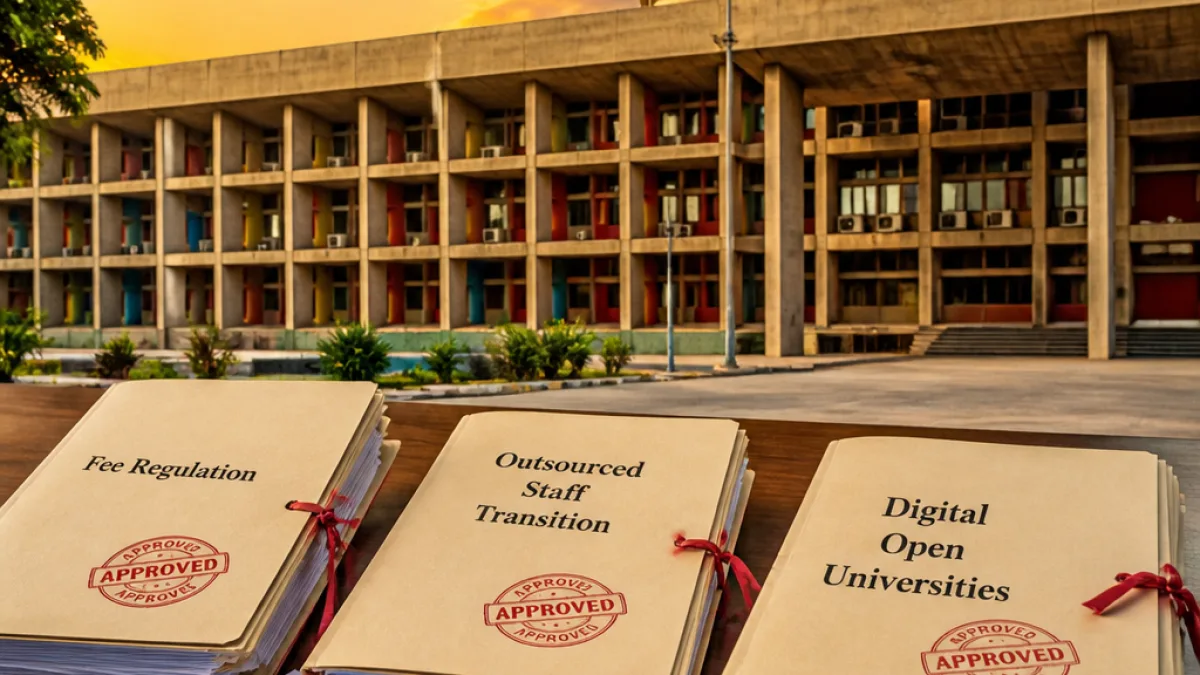
- Fee regulation: Punjab Regulation of Fee of Un-aided Educational Institutions (Amendment) Bill, 2026 — to curb unreasonable fee hikes by private unaided schools.
- Outsourced staff transition: Punjab State Outsourced Personnel Transition to Contractual Engagement Bill, 2026 — eligibility after five years of continuous service (three years for hazardous categories); remuneration to be fixed by the Department of Finance.
- Higher education: Approval to establish three Digital Open Universities to expand digital access to university-level courses.
| Decision | Primary aim | Key feature |
|---|---|---|
| Fee regulation amendment | Protect students/parents from unjustified fee hikes | Amend Acts of 2016 and 2019 and associated rules |
| Outsourced personnel transition Bill | Formalise engagement of long-serving outsourced staff | Eligibility after 5 years (3 years for hazardous categories); pay set by Finance |
| Digital Open Universities | Expand access to higher education via digital delivery | Three new institutions approved |
What the decisions mean locally
For families across Punjab, the fee-regulation amendment is likely to be welcomed by parents who have complained about sudden and steep fee increases at private unaided schools. Regulators under the amended statute will be empowered to examine and, where warranted, restrict fee hikes deemed arbitrary.
The outsourced personnel Bill affects a large category of employees who have been engaged through agencies or contractors. By offering a pathway to contractual engagement after prescribed periods of service, the move could stabilise livelihoods for many who work in public-facing roles across education, sanitation, health and administrative services. The precise scale of impacted employees and timelines for implementation were not specified in the CMO statement.
Approval for three Digital Open Universities signals a push to broaden tertiary and continuing-education options via online platforms. The move aligns with broader national and state-level trends to use digital delivery to increase reach and reduce costs for learners who cannot attend campus-based courses.
Next steps and legal process
The Cabinet has approved placing the bills before the legislature. The amendment to the fee regulation Act will require legislative passage and rule revisions; similarly, the outsourced personnel transition Bill will proceed through the statutory process before becoming law. Administrative details, including the framework for the Digital Open Universities, will be worked out by the concerned departments following Cabinet approval.
The CMO described the measures as part of a larger agenda to improve governance and ensure inclusive development, stating the decisions were taken in the August 5 meeting of the Council of Ministers at the Punjab Vidhan Sabha.
Further details, including the exact structure and launch timelines for the Digital Open Universities and the implementing rules for fee regulation and contractual transition, will be released by relevant departments as the legislative and administrative processes advance.