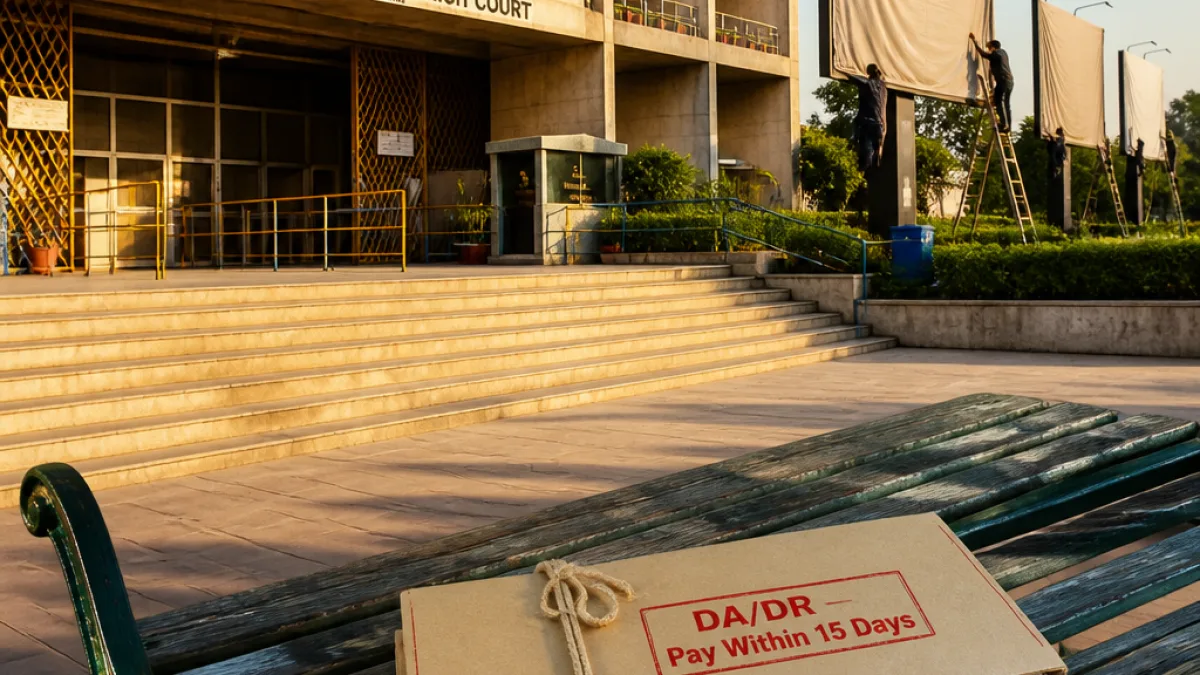
Chandigarh: The Punjab and Haryana High Court on Monday directed the State government to release all pending instalments of Dearness Allowance (DA) and Dearness Relief (DR) to its employees and pensioners within 15 days and restrained the State from undertaking large-scale advertising campaigns until the dues are cleared.
Bench emphasises priority of statutory dues over 'unproductive' spending
A division bench comprising Acting Chief Justice Ashwani Kumar Mishra and Justice Rohit Kapoor dismissed appeals by the State and the Punjab State Power Corporation Limited (PSPCL) against an earlier single-judge order and directed the payments be made "at the same rates as has been paid to the members of the All India Services (IAS/IPS/IFS) serving within the State of Punjab, in accordance with the Central Government pattern" within a fortnight.
"Till all such dues are cleared, the State of Punjab shall not resort to any unproductive expenditures such as large-scale advertising campaigns in print or social media as these expenses cannot justify the denial of dues admissible to State employees"
The bench made it clear that if the State fails to comply within the stipulated period, it will be liable to pay six per cent simple interest on the outstanding amount. It also directed the Punjab chief secretary to ensure "scrupulous compliance of the directions" and submit a compliance affidavit by 31 August 2026.
Government had cited fiscal constraints; bench flagged other expenditures
The State had earlier informed the court that it could not immediately comply with the single-judge directions because the arrears exceeded ₹15,000 crore. The division bench, however, observed that the plea of financial constraints could not justify withholding legitimate dues where information in the public domain indicated substantial spending by the State on freebies, doles and advertorial campaigns.
The court's observations focused on the distinction between essential expenditure and what it termed "unproductive expenditures", noting that grant of freebies and large advertorial spends do not strictly fall within the domain of essential welfare spending.
Immediate impact and compliance timeline
The order applies to the State of Punjab and PSPCL and affects current employees and pensioners who are entitled to DA/DR adjustments in line with the Central pattern. The principal directives are:
- Payment deadline: Release all pending DA/DR instalments within 15 days (a fortnight).
- Interest on delay: 6% simple interest if payment is not made by the deadline.
- Spending restraint: No large-scale advertising campaigns in print or social media until dues are cleared.
- Compliance affidavit: Chief secretary to file a compliance report by 31 August 2026.
| Directive | Detail |
|---|---|
| Payment timeline | 15 days / a fortnight |
| Arrears cited by State | ₹15,000 crore (amount previously mentioned by the State) |
| Interest for non-compliance | 6% simple interest |
| Compliance affidavit | 31 August 2026 |
Employees, pensioners and administrative consequences
The order, if implemented within the court-mandated timeline, would require the State treasury and agencies such as PSPCL to mobilise funds for the payment of DA/DR arrears. For employees and pensioners, it provides a clear and enforceable timeframe and a specified rate of interest as compensation for delayed disbursal.
Administratively, the bench's direction to the chief secretary to file an affidavit is meant to create a monitored compliance mechanism and to ensure accountability at the highest level of the State bureaucracy. The restraint on large-scale publicity and advertorial spends could also force a re-evaluation of budgetary priorities in the short term.
Wider legal and fiscal implications
The judgment underscores the judiciary's expectation that statutory entitlements to employees and pensioners take precedence over non-essential State expenditures. It may prompt other States facing similar disputes to review their pending DA/DR liabilities and reconsider discretionary spending ahead of compliance deadlines imposed by courts.
The immediate next steps will be closely watched: whether the State moves to make payments within the 15-day window, whether it seeks further legal remedies, and how the treasuries and departments such as PSPCL reallocate resources to meet the demand.
Reporting from Chandigarh.