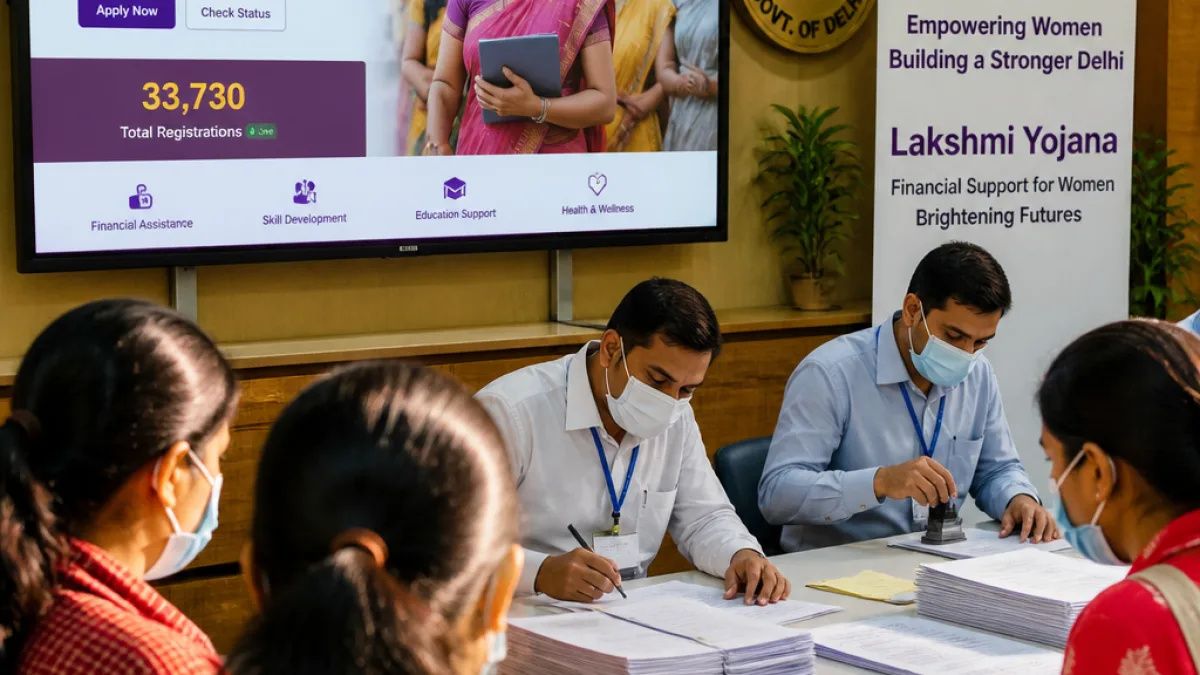
New Delhi: The Delhi government on Saturday inaugurated the online registration portal for the Delhi Lakshmi Yojana, a flagship transfer programme that will provide monthly financial assistance of ₹2,500 to eligible women in the city, officials said.
Immediate response as portal goes live
The Chief Minister, Rekha Gupta, launched the portal at the District Magistrate's office in East Delhi and opened applications on the government website. The Chief Minister’s Office reported that between 6.30 a.m. and 6.30 p.m. on the first day, a total of 33,730 registrations had been completed.
Of these, the CMO said, 1,940 applications were directly submitted for processing and another 9,170 were pending recommendation from MLAs to confirm constituency residency and reduce discrepancies. The administration expects roughly 17 lakh women to ultimately receive benefits under the scheme.
"When we made this promise to you, it was not just an announcement, but a resolve for your happiness, your honour and your better future," the Chief Minister said at the launch, according to the CMO.
Scheme design and payment options
The yojana offers two disbursement choices. Under the first option, beneficiaries will get ₹1,000 credited each month to a Central Bank Digital Currency (CBDC) wallet for immediate use, while the remaining ₹1,500 will be placed in a recurring deposit or fixed deposit. The second choice allows the full ₹2,500 to be deposited into a recurring or fixed deposit product.
The government has earmarked a budget of ₹5,100 crore for the programme, which was a prominent poll commitment. To promote savings, the scheme will keep ₹1,500 of the monthly payment in a deposit with a lock-in period of three years, reducing the monthly liquid cash to ₹1,000 where the split option is chosen.
Eligibility and exclusions
According to the cabinet-approved guidelines, applicants must be women aged between 21 and 60 and should be the eldest female member of their household. Family annual income must not exceed ₹2.5 lakh. Applicants are required to be registered voters and either the applicant, her husband or one of her parents must have been Delhi residents for at least ten years, the CMO said.
- Age bracket: 21–60 years
- Maximum family income: ₹2.5 lakh per annum
- Residence requirement: 10 years for applicant or spouse or parents
- Applicant must be the eldest female member of the family
Several categories are explicitly excluded: women already receiving other government financial assistance or pensions, taxpayers, government employees, families with electricity consumption above 2,400 units per year, households with any member in government service, families owning four-wheelers, women with more than three living children and those with a criminal record.
Verification and implementation steps
Applications are scheduled to pass through a four-stage verification process before approval, according to the CMO. Local MLA recommendation is one of the steps intended to confirm constituency linkage. The government has indicated that the portal will continue to accept registrations and channel them into the verification pipeline.
| Aspect | Detail |
|---|---|
| Monthly assistance | ₹2,500 |
| Liquid amount if split | ₹1,000 (₹1,500 locked for 3 years) |
| Budget allocation | ₹5,100 crore |
| Estimated beneficiaries | ~17 lakh women |
Officials said the government will monitor registrations and verification backlogs; MLA recommendations were cited as necessary to avoid erroneous entries linked to residency. With tens of thousands applying within hours, administrators are preparing to scale verification teams and resolve possible bottlenecks in constituency-level checks.
Political context and next steps
The scheme was approved by the Delhi Cabinet on July 28 and was a central pledge in the party's assembly campaign last year. The launch and rapid registration figures are likely to shape early perceptions of the administration's delivery on electoral promises.
Prospective applicants can access the portal at the government website and submit forms online. The CMO has advised applicants to ensure supporting documents reflect the residence and income criteria to facilitate verification.
As the verification process unfolds, the administration will publish periodic updates on numbers cleared and fund disbursement timelines, officials said.